

Four-character idioms with numbers: clear explanations of meanings and usage

“Isshin furan” (single-minded devotion), “shichiten hakki” (fall down seven times, get up eight), “juunin toiro” (to each their own)…
Have you noticed that these common four-character idioms all contain numbers? Many four-character idioms with numbers express life lessons and mindsets.
Some describe achieving two results with one action, while others convey the strength to rise no matter how many times you fail.
Knowing their meanings can make daily life feel richer.
In this article, we’ve collected four-character idioms that include numbers.
We also explain their meanings and usage in detail, so try incorporating them into your everyday conversations.
Four-character idioms that include numbers: clear explanations of meanings and usage (1–10)
people-pleaser
https://www.tiktok.com/@dbdsjohn2008/video/7577212522780953863In Japan, the word happō bijin is often used with a negative nuance.
It’s pronounced “hap-pō bijin.” Originally, it means someone who is friendly and pleasant to everyone, and it can even be a compliment praising that skill.
However, in Japan it tends to be taken as implying a two-faced person who puts on a good face for anyone, so few people would be happy to be called a happō bijin.
Therefore, it’s not recommended to use it when you want to compliment someone.
Be sure to rephrase it with a different expression.

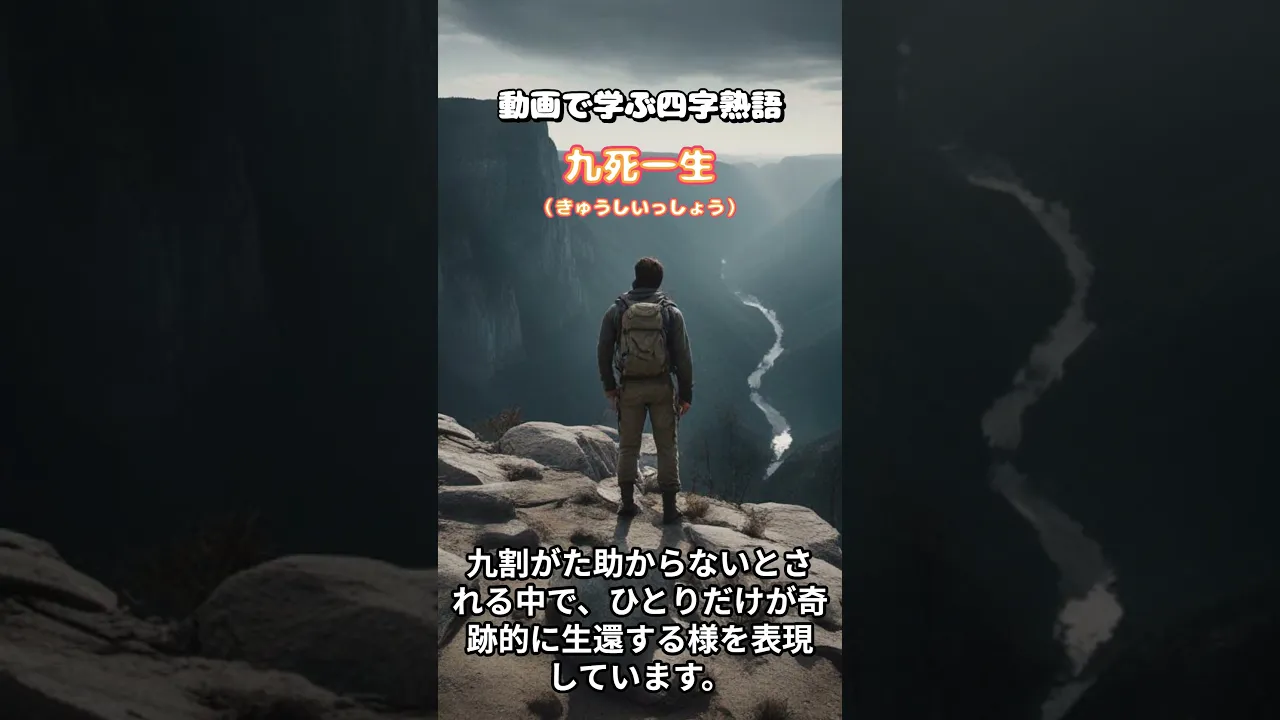
a narrow escape from death; a close call

Kyūshi isshō is a phrase that means being saved from a life‑threatening situation where you thought it was all over.
You’ve probably heard it in the expression “kyūshi ni isshō o eru” (to have a narrow escape).
Basically, it’s used when someone recovers from a serious illness or survives a major accident.
However, in practice it’s also used even when life and death aren’t involved—for example, when you somehow overcome a major blunder in a business setting or have a close call in everyday life.
It’s pronounced kyūshi isshō.
next to nothing; dirt cheap

Nisoku-sanmon is a four-character idiom that has been used in Japan since the Edo period.
It’s read nisoku-sanmon and means extremely cheap or of little value.
For example: “I thought it would be worth more, but it turned out to be a nisoku-sanmon item.” The “two pairs” refers to pairs of sturdy straw sandals (kongō zōri), and “three mon” refers to three mon coins, the smallest currency unit in the Edo period.
In other words, because two pairs of these sandals cost only three mon, the phrase came to mean something very cheap.
It’s often used with a negative connotation, such as for shoddy goods.
lost in a thick fog; completely at a loss

Gorimuchū is read as “gori-muchū.” Gori-mu (five-li fog) refers to a deep fog spreading in all directions—meaning you are inside such fog.
By extension, it describes a state where you can’t grasp the situation, are confused, and can’t make a move.
The division is gorimu/chū, not gori/muchū, so be careful.
It’s used like: “I’ve started a new venture and feel completely lost,” or “We neglected training and preparation, and when the disaster actually struck, we were at a complete loss.” Let’s act diligently on a daily basis so we don’t fall into a state of total confusion.
nine times out of ten
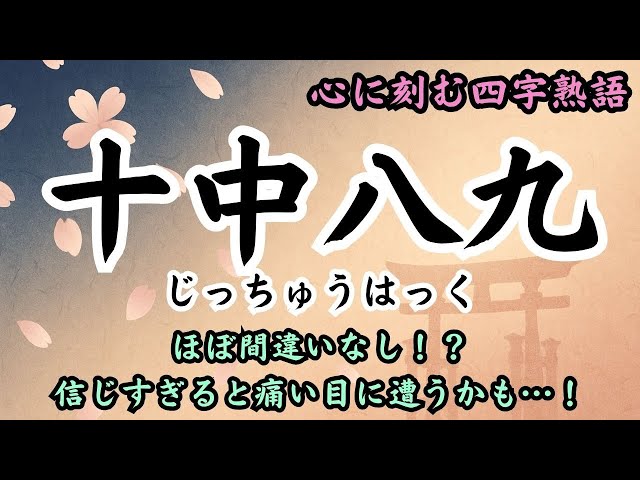
Jitchū hakkū is pronounced “jicchū hakkū.” Be careful not to misread it as “jucchū hakkū.” As the kanji suggest—eight or nine out of ten—it’s used to mean “for the most part,” “generally,” or “almost certainly.” It indicates a state of near certainty.
For example: “He will, in all likelihood, win this match,” or “That line of reasoning is almost certainly correct.” It’s one of the four-character idioms that’s easy to use in conversation and is also common in business settings.
Take this opportunity to remember it.
to be in deep trouble; to struggle desperately; to have a hard time (literally: “four and eight sufferings”)

The four-character idiom shiku hakkū (四苦八苦) is one many of you know well.
Pronounced shiku hakkū, it refers to great suffering or all kinds of suffering.
It comes from Buddhism’s classification of suffering: the basic Four Sufferings—birth, aging, sickness, and death—plus four more: the suffering of separation from loved ones, the suffering of meeting those you hate, the suffering of not getting what you seek, and the suffering arising from the five aggregates.
It’s used in sentences like, “I’m struggling in a new environment” or “I’m having a hard time because nothing is going as planned.” Be careful not to misread the idiom as shikku hakkū, which is a common mistake.
Three in the morning, four in the evening

Chōsan-boshi (literally “three in the morning, four in the evening”) means being fixated on immediate gains and failing to notice that, in the end, nothing actually changes.
This four-character idiom comes from a Chinese anecdote.
A man named Zigong kept monkeys, but because he had little money, he told them he would give them three pieces of food in the morning and four at night.
The monkeys got angry, but when he rephrased it to four in the morning and three at night, they were pleased because the morning share sounded larger.
In the same way, people tend to feel something is a better deal when it’s labeled “3 for 1,500 yen” rather than “500 yen each,” even though the price is the same.