

Four-character idioms with numbers: clear explanations of meanings and usage

“Isshin furan” (single-minded devotion), “shichiten hakki” (fall down seven times, get up eight), “juunin toiro” (to each their own)…
Have you noticed that these common four-character idioms all contain numbers? Many four-character idioms with numbers express life lessons and mindsets.
Some describe achieving two results with one action, while others convey the strength to rise no matter how many times you fail.
Knowing their meanings can make daily life feel richer.
In this article, we’ve collected four-character idioms that include numbers.
We also explain their meanings and usage in detail, so try incorporating them into your everyday conversations.
- Boost your vocabulary with four-character idioms that include numbers! A collection of four-character idioms for elementary school students to learn.
- Amusing four-character idioms you’ll want to use right away! A collection of expressions to remember as general knowledge.
- Become positive with four-character idioms that resonate with the heart! Common yet deeply meaningful words.
- Enrich your heart with beautiful four-character idioms! A collection of expressions you'll want to use in everyday life.
- Interesting four-character idioms for elementary schoolers! Words you'll want to use once you understand their meanings
- Four-character idioms that help you achieve goals! Phrases you can use in everyday situations
- Learn the meanings too! Cool four-character idioms that elementary school students will want to remember
- General: Four-character idioms that encourage determination—powerful, heart-stirring words
- [Four-Character Idioms] Impressive and Cool Sound! A Collection of Famous Quotes Worth Knowing as General Knowledge
- [Kakizome] Four-character idioms fit for the New Year: Introducing words that resonate with the heart and their meanings
- Easy to remember and fun! A collection of number pun/mnemonic ideas
- A collection of four-character idioms perfect for baseball: words to rouse both teams and individuals
- Surprisingly tricky! Check your general knowledge with a four-character idiom quiz
Four-character idioms that include numbers: clear explanations of meanings and usage (1–10)
obvious at a glance

Hitomoku-ryozen (ichimoku ryōzen) literally means “clear at a single glance,” and refers to something that is obvious at first sight.
In conversation, you might say, “It’s obvious you want that.” Words with similar meanings include “meimeihakuhaku” (crystal clear) and “akiraka” (clear/obvious).
Ichimoku ryōzen is a four-character idiom frequently used in everyday and business contexts, so it’s worth remembering.
Four-character idioms are handy for expressing your thoughts and feelings succinctly, but they’re meaningless if they don’t get across to your listener.
In that regard, ichimoku ryōzen is widely understood, so you don’t need to worry about that.

Trinity

Sanmi-ittai is read as “sanmi-ittai” and is one of the concepts in Christianity.
It is the idea that the Father (God the Father), the Son (Jesus Christ, the Son of God), and the Spirit (the Holy Spirit) are one and the same single God.
As a four-character idiom, it means that three things are essentially one, or that three people unite their minds and become one.
Example usages include: “For a company to grow, a triune structure of X, Y, and Z is necessary,” and “If X, Y, and Z work together as one, they will likely achieve it.”
almost certainly

The four-character idiom that expresses a state that is almost complete is “九分九厘” (kubukurin).
"Bu" and "rin" are units, with nine bu meaning 90 percent and nine rin meaning 9 percent.
In other words, “九分九厘” means 99 percent.
You can use it like this: “Your success is ninety-nine percent certain,” or “He will come here with a ninety-nine percent chance.” It has a similar meaning to the expression many of you know, “十中八九” (juu-chuu-hakkou), so try using it in everyday conversation.
Four-character idioms that include numbers: Clear explanations of meanings and usage (11–20)
Once-in-a-lifetime encounter

The four-character idiom “ichigo ichie” carries the meaning of cherishing the special, once-in-a-lifetime moment at hand, and is rooted in the teachings of the tea master Sen no Rikyū.
Through the words of Rikyū’s disciple Yamanoue Sōji, the phrase spread in the Edo period when the tea master Ii Naosuke recorded it as “ichigo ichie” in his collection Tea Gatherings: Once-in-a-Lifetime Meetings.
“Ichigo” means “a lifetime,” and “ichie” means “a single tea gathering.” It’s a beautiful saying that encourages both the host and the guests of a tea gathering to approach the occasion with wholehearted sincerity, as if it were a once-in-a-lifetime moment.

To each their own.

A four-character idiom meaning “ten people, ten colors = everyone has different ways of thinking and preferences.” For example, some people love curry, while others prefer ramen.
In the same way, it’s only natural that what each person values and likes will differ.
This phrase is perfect for cultivating kindness and consideration for those around you.
When you find yourself wondering, “Why does so-and-so think that way?” try remembering, “To each their own.” Everyone is different, and everyone is good—that’s the wonderful thing about this idiom.
If both adults and children can enjoy these “differences,” each day will become even more colorful.

killing two birds with one stone
@az0202za #TwoBirdsWithOneStone #FourCharacterIdiom #Learning
♬ Original Song – 0202civo – az0202za
They say, “If you take a walk in the park, you can refresh your mind and make up for a lack of exercise—truly killing two birds with one stone.” This means that by walking in the park and moving your body, you’ll both lift your spirits and address insufficient exercise.
It’s a four-character idiom used to express gaining two benefits or results from a single action.
When using the idiom ‘ikkyō ryōtoku’ (killing two birds with one stone), clearly explaining what action you take and what benefits or results you gain will make your point more persuasive and easier for others to understand.
single-mindedly; with undivided focus
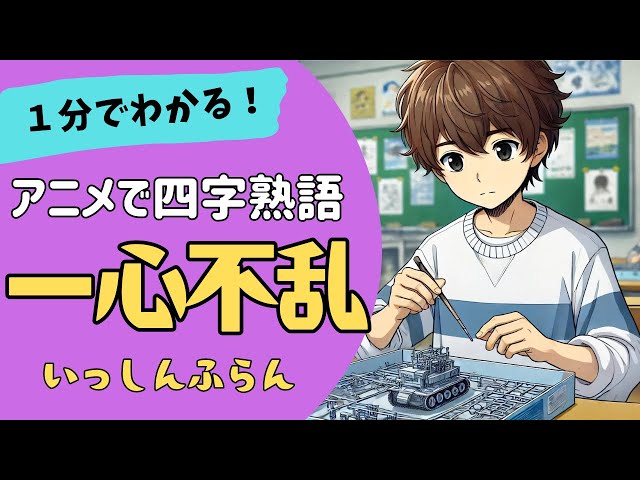
This four-character idiom is read as “isshin furan,” and it describes the state of focusing intently on a single task.
It is used when one charges ahead toward a purpose or goal, rather than turning one’s attention to various things.
For example, during a sports match, an exam, or while absorbed in a favorite game, you might find yourself unconsciously becoming isshin furan.
However, concentrating too much on just one thing can lead to accidents or injuries, so it’s best to be careful.