

Amusing four-character idioms you’ll want to use right away! A collection of expressions to remember as general knowledge.

Do you know any interesting four-character idioms? From common ones that are surprisingly useful in everyday conversation to rare expressions that might make someone ask, “What does that mean?”, there’s a truly fascinating world to explore.
We’ll introduce four-character idioms that will make you chuckle, make you think “I see!”, and make you want to start using them today.
Slip them into daily chats or on social media, and your cultural literacy is sure to get a boost! Please enjoy the profound world of four-character idioms.
- Interesting four-character idioms for elementary schoolers! Words you'll want to use once you understand their meanings
- Enrich your heart with beautiful four-character idioms! A collection of expressions you'll want to use in everyday life.
- [Four-Character Idioms] Impressive and Cool Sound! A Collection of Famous Quotes Worth Knowing as General Knowledge
- Surprisingly tricky! Check your general knowledge with a four-character idiom quiz
- Become positive with four-character idioms that resonate with the heart! Common yet deeply meaningful words.
- General: Four-character idioms that encourage determination—powerful, heart-stirring words
- Popular even among elementary school students! Stylish and easy-to-remember four-character idioms
- Four-character idioms that help you achieve goals! Phrases you can use in everyday situations
- A four-character idiom quiz that elementary schoolers will love! Questions become fun once you understand the meanings
- Learn the meanings too! Cool four-character idioms that elementary school students will want to remember
- Boost your vocabulary with four-character idioms that include numbers! A collection of four-character idioms for elementary school students to learn.
- [For Elementary Students] A Collection of Beautiful Four-Character Idioms to Know
- Four-character idioms wishing happiness: a collection of heartwarming expressions for everyday use
Amusing four-character idioms you’ll want to use spontaneously! A collection of expressions to know as general knowledge (11–20)
ecstatic frenzy

This is a four-character idiom that describes being so happy you can’t help but break into a dance.
It’s read as “kyōki ranbu,” and since it contains the word “kyōki” (madness), you can tell the joy it expresses is extremely intense.
Imagining someone dancing with delight is a bit amusing, isn’t it? There’s nothing wrong with being happy, but you should pay attention to your surroundings.
If you’re too overjoyed to notice what’s around you, you might get hurt.
May something happen to all of you that makes you so happy you dance with wild joy!

Gokuraku-tonbo (carefree person; lit. “paradise dragonfly”)

Some people might be reminded of a certain comedian by how it sounds, but in fact it’s a bona fide four-character idiom.
It means “a person who lives carefree, playing around without thinking about the future.” Combining the image of a dragonfly flitting about and the word “paradise,” it has come to symbolize a laid-back, optimistic personality.
It can be used to tease someone with a touch of irony, but it also carries an endearing charm that keeps it from feeling mean.
Older folks may feel nostalgic, thinking, “We used to use this expression a lot back in the day.”

leading by example

There are people who, day in and day out, behave in ways that are admirable and worth emulating.
For such individuals, this expression—used to describe setting a model example and serving as a role model for everyone—is a perfect fit.
Once you understand its meaning, it makes you sit up straight and think, “I should pull myself together.” Older adults who see this four-character idiom might also feel more positive after learning what it means.
And those who know a leader type close to them may be pleased to learn a four-character idiom they can use for that person, happy to have gained some new knowledge.

indomitable; unyielding; untiring perseverance
@kurukoba Four-character idioms translationIndomitable and unyielding
♬ Original Song – Bird v🔍💙 – Hour of Four Ripe
Futō Fukutsu is a term that expresses the attitude of never yielding in the face of difficulty and maintaining a strong will.
It carries the meaning of neither bending nor giving in, and it signifies the power to uphold one’s convictions and move forward even in adversity.
Life brings unexpected events and unavoidable trials, and it is important to cultivate the mindset to confront them without giving up.
For older adults as well, this word can serve as a guiding light that supports the heart when facing changes in physical strength or environment in daily life.
It symbolizes an unbreakable spirit that gives the courage to keep challenging oneself.

bizarre; mysterious; strange and uncanny (kiki-kaikai)
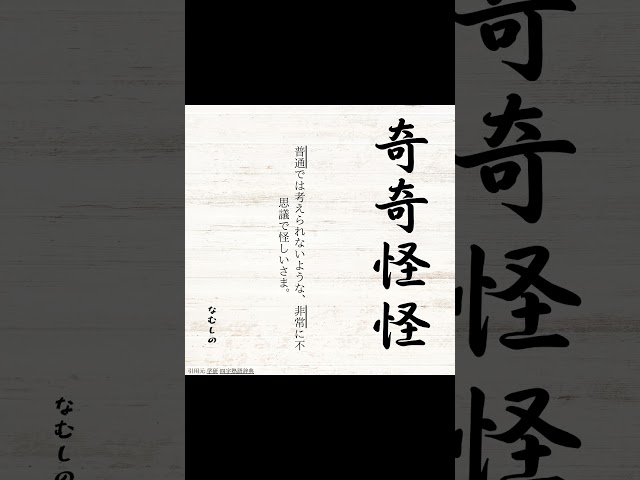
A four-character idiom meaning “something very strange and beyond ordinary understanding,” it has long been used to refer to ghost stories and mysterious happenings.
Many older people will naturally have heard it.
With a catchy rhythm that even children want to imitate, it’s friendly on the surface, yet its content is a bit eerie and mysterious.
It carries a nostalgic ring that recalls ghost-story programs and storytelling shows from the Showa era.
Used in daily life, it’s a handy word that can liven up a conversation with a touch of humor.
Ikonikimi

It’s a four-character idiom with a striking, powerful visual impact.
All the characters look similar, so people seeing it for the first time might do a double-take.
It means “there’s no real difference between the two; they’re much the same.” It’s used, for example, to refer to people whose personalities or behavior are very similar, or to things that hardly differ.
Both the forms of the characters and their meaning are unique, leaving an unforgettable impression once you learn it.
It’s also a fun conversation piece and a bit of mental exercise for older folks—turning it into a quiz like “How do you read this?” or using it as an icebreaker would likely liven up the conversation.
Amusing Four-Character Idioms You'll Want to Use! A Collection of Expressions to Know as General Knowledge (21–30)
Harmony, Respect, Purity, and Tranquility
@momihogusi.kiwamiya Wakei-Seijaku (Harmony, Respect, Purity, Tranquility). I hope to help you find words that resonate with you so you can live each day feeling happy. For physical refreshment, leave it to Momi-Hogushi Kiwamiya: 5-6 Ueno-machi, Nagasaki City. Wishing you good fortune today as well. Health, healing, happiness, good luck, worries, vitality.
♪ Original Song – Batayan Wishing for Health and Happiness – Batayan Wishing for Health and Happiness
Sen no Rikyū, who established wabi-cha and is revered as the “Tea Sage.” Even those not well-versed in the tea ceremony or history likely know him as the figure who laid the foundations of today’s tea ceremony.
“Wa-kei-sei-jaku” is a four-character idiom expressing the four principles of the tea ceremony and is widely known as its fundamental philosophy.
It conveys the ethos of host and guest honoring one another, keeping the tearoom and utensils clean, approaching the gathering with a tranquil mind, and cultivating profound spirituality.
Moreover, this phrase is often used not only in the context of tea ceremony but also in everyday conversation and business to mean harmony and hospitality.
