

Amusing four-character idioms you’ll want to use right away! A collection of expressions to remember as general knowledge.

Do you know any interesting four-character idioms? From common ones that are surprisingly useful in everyday conversation to rare expressions that might make someone ask, “What does that mean?”, there’s a truly fascinating world to explore.
We’ll introduce four-character idioms that will make you chuckle, make you think “I see!”, and make you want to start using them today.
Slip them into daily chats or on social media, and your cultural literacy is sure to get a boost! Please enjoy the profound world of four-character idioms.
- Interesting four-character idioms for elementary schoolers! Words you'll want to use once you understand their meanings
- Enrich your heart with beautiful four-character idioms! A collection of expressions you'll want to use in everyday life.
- [Four-Character Idioms] Impressive and Cool Sound! A Collection of Famous Quotes Worth Knowing as General Knowledge
- Surprisingly tricky! Check your general knowledge with a four-character idiom quiz
- Become positive with four-character idioms that resonate with the heart! Common yet deeply meaningful words.
- General: Four-character idioms that encourage determination—powerful, heart-stirring words
- Popular even among elementary school students! Stylish and easy-to-remember four-character idioms
- Four-character idioms that help you achieve goals! Phrases you can use in everyday situations
- A four-character idiom quiz that elementary schoolers will love! Questions become fun once you understand the meanings
- Learn the meanings too! Cool four-character idioms that elementary school students will want to remember
- Boost your vocabulary with four-character idioms that include numbers! A collection of four-character idioms for elementary school students to learn.
- [For Elementary Students] A Collection of Beautiful Four-Character Idioms to Know
- Four-character idioms wishing happiness: a collection of heartwarming expressions for everyday use
Amusing four-character idioms you'll want to use right away! A collection of expressions to remember as basic common knowledge (1–10)
burst into hearty laughter

It might fall into the category of words we’re not very familiar with.
It’s read as “kakataishō.” The meaning is “to laugh heartily in a loud voice.” The “taishō” (大笑) part naturally makes you think of a big laugh, right? But in fact, the “kaka” (呵呵) part also means laughing loudly.
Think of the final scene in the drama Mito Kōmon, when everything is resolved and Lord Kōmon laughs, “Ka-ka-ka!”—that kind of feeling.
It’s a tricky set of characters to use, but if you understand the meaning and can use it, isn’t it a cool four-character idiom?
reluctantly
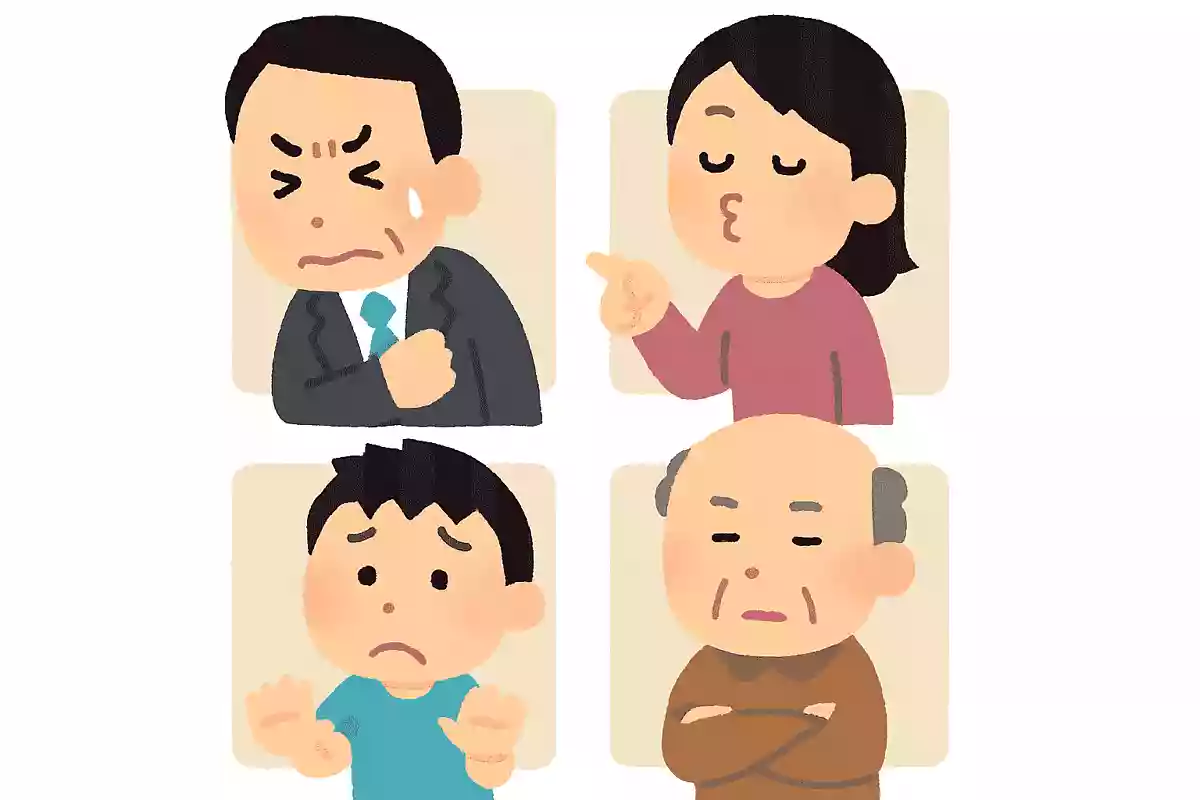
I feel like smart people can casually use even four-character idioms.
This particular term isn’t one you hear every day, so it’s pretty cool if you can slip it in smoothly.
It’s read as “fushō-bushō.” Fushō means “not consenting,” and by repeating it, the word often conveys the sense of “reluctantly, unwillingly.” The repetition makes it sound truly begrudging in a funny way, and it also reminds you that this feeling is something people have always had.
Try using it like this: “After being pestered to tears, I reluctantly agreed.”
Self and others are alike
@iroha.o_1128 Isn't it absolutely unreadable??translationTranslationTranslationRecommendation#fyp
♬ Electro Swing sounds like old vinyl sampling(1066214) – Ponetto
At first glance, the four-character idiom “已己巳己” might make you think it’s just the same character repeated.
しかし実際には、「已」「己」「巳」という3つの異なる文字から成る「いこみき」と読む四字熟語です。
Because these similar-looking characters are lined up together, the idiom is used to refer to things that closely resemble each other.
Instead of saying “You look identical” when seeing twins or people who look alike, try saying “It’s ‘ikomiki’!”—you might come across as very clever.

Amusing four-character idioms you’ll want to use spontaneously! A collection of expressions to know as general knowledge (11–20)
recklessly charging ahead
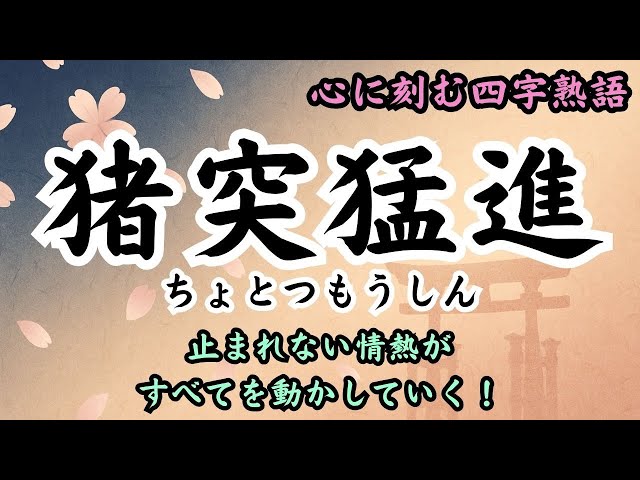
It contains the character for “boar,” which gives it a strong, forceful feel.
On New Year’s cards for the Year of the Boar, you almost always see this character leaping off the page.
This four-character idiom is read “chototsu mōshin.” Its meaning is exactly “to charge straight ahead like a boar, looking only forward.” For those who always hesitate, thinking, “What if I fail…,” it could be an encouraging phrase.
It can also serve to showcase your proactive personality in part-time job or company interviews.
You can even feel the momentum in the explosive sound of “chototsu”!
ecstatic; overjoyed; beside oneself with joy

It’s read as “uchōtengai,” and it’s a four-character idiom that describes being so overjoyed that you forget yourself and your surroundings.
It’s essentially an intensified form of the Buddhist term “uchōten” (ecstasy).
While it’s often used with a cautionary tone for someone who’s rejoicing without regard for others—like saying, “You’re getting carried away”—it’s also used to express great joy, as in, “An unbelievable, ecstatic event.” It might be fun to imagine what kind of joy could make you lose yourself, and how you would act if it actually happened.

rights and wrongs; pros and cons; rights and wrongs of a matter
https://www.tiktok.com/@kurukoba/video/7434154620223606023Calling good things good and bad things bad is called 'zezehihi' (是是非非).
It’s quite difficult to do this without being swayed by position or power, but it’s the way things ideally should be.
This four-character idiom looks almost like a typo at first glance, which makes its arrangement of characters interesting.
It’s pronounced “ze-ze-hi-hi,” and if you don’t know it, you might not even realize in conversation that it’s a four-character idiom.
When you want to solve problems or make proper evaluations, judge matters from a neutral standpoint using zezehihi.
carefree person
https://www.tiktok.com/@kurukoba/video/7401651357922479376This four-character idiom, which features a string of difficult kanji, is read as “gokuraku-tonbo.” It refers to an easygoing person who doesn’t think deeply about things and fails to recognize the seriousness of situations, and it’s generally used in a negative sense.
The term is said to have originated from the image of a dragonfly lazily flitting about.
Although it’s a word used to disparage someone, in today’s stress-filled society, some people see it as an ideal way of life.
Doing nothing and just passing the time—depending on the person, that might be the ultimate luxury.