

[Four-Character Idioms] Impressive and Cool Sound! A Collection of Famous Quotes Worth Knowing as General Knowledge

“Lion-like valor,” “a match for a thousand,” “battle-hardened”…
There’s an undeniable coolness to four-character idioms, isn’t there? If you can use them well, your everyday conversations and writing will feel much tighter, and your intellectual appeal will rise.
What’s more, the world of these idioms is incredibly deep—from phrases everyone knows to rare ones that make you go ‘Wow!’ In this article, we’ll introduce stylish four-character idioms you can use in daily life.
It’s packed with expressions that shine not only in business settings but also on social media and in messages.
- Amusing four-character idioms you’ll want to use right away! A collection of expressions to remember as general knowledge.
- Enrich your heart with beautiful four-character idioms! A collection of expressions you'll want to use in everyday life.
- General: Four-character idioms that encourage determination—powerful, heart-stirring words
- Become positive with four-character idioms that resonate with the heart! Common yet deeply meaningful words.
- Learn the meanings too! Cool four-character idioms that elementary school students will want to remember
- Four-character idioms that help you achieve goals! Phrases you can use in everyday situations
- [For Elementary Students] A Collection of Beautiful Four-Character Idioms to Know
- Interesting four-character idioms for elementary schoolers! Words you'll want to use once you understand their meanings
- Four-character idioms for New Year’s resolutions! A collection of motivational phrase ideas
- Intellectual beauty that shines! Stylish four-character idioms you can use in everyday situations
- Popular even among elementary school students! Stylish and easy-to-remember four-character idioms
- [Kakizome] Four-character idioms fit for the New Year: Introducing words that resonate with the heart and their meanings
- Boost your vocabulary with four-character idioms that include numbers! A collection of four-character idioms for elementary school students to learn.
[Yojijukugo] Strikingly Cool-Sounding! A Collection of Quotations Worth Knowing as General Knowledge (31–40)
inspiration and encouragement

Kobu refers to boosting morale by performing a dance while beating drums, thereby stirring the spirit and drawing out motivation.
Gekirei means to encourage someone vigorously and rouse them.
These two words carry similar meanings, and when combined, they form a four-character idiom that emphasizes the sense even more.
It is used in expressions such as: “After receiving kobu-gekirei from the baseball team’s coach, the members’ morale rose greatly,” and “My respected mentor kept offering me unyielding kobu-gekirei when I was struggling with my future.”

diligent effort
@0qf_harvey_3005 diligent effort#shortstranslationProverb
♬ original sound – 0qf_harvey_3005 – 0qf_harvey_3005
Pronounced “funrei-doryoku,” this four-character idiom means to muster your spirit and devote yourself wholeheartedly to your goal.
When you want to succeed at something, you need energy, effort, and a strong will to see it through.
If you find it hard to stay positive or feel your motivation slipping, try recalling this phrase to draw out your inner strength.
Because it serves as a mental pillar, it also makes a great personal motto or New Year’s resolution.

turn over a new leaf

Simply put, it means “Correct what was wrong and move forward each day as a new you.” Some people brood endlessly over what’s past; others shrug off unpleasant things in no time—everyone has their own temperament.
You might think, “Ah, I wish I had a straightforward, no-nonsense personality like that,” but even those forthright people have their own worries.
You could call it a matter of mindset, and leave it at that, but I believe the phrase ‘kaika jishin’—amending past faults and renewing oneself—will give your slightly downcast heart a timely lift.
The characters are different, but renewing yourself (自新, jishin) also becomes self-confidence (自信, jishin)!
a do-or-die gamble

In life, there are times when you have to take a chance even if it involves risk.
The four-character idiom that captures exactly such a situation is kenkon ittēki (乾坤一擲).
It is read “kenkon ittēki” and is said to originate from a line in the poem ‘Crossing the Honggou’ by the Chinese poet Han Yu.
Kenkon refers to heaven and earth, or to the faces of dice, and ittēki means to make a single throw and stake everything on the outcome.
This expression is often adopted as a personal motto by businesspeople and athletes, and is used when one wants to convey a strong spirit ready to make a decisive, high-stakes move.
Once-in-a-lifetime encounter

「一期一会」(いちごいちえ)という四字熟語は、英語で “a once-in-a-lifetime encounter” を意味します。茶道に由来し、同じ集まりは二度と繰り返されないという価値観から、参加者同士が互いに最大限の誠意をもって接すべきだという心構えを育みます。
I think this is a wonderful philosophy, so why not make it your New Year’s resolution? By seeing every meeting with others and every spark for new work as a one-time opportunity, you’ll be inclined to respond more thoughtfully.
Sincerity toward others goes around and, I’m sure, will ultimately lead to your own happiness as well.
[Yojijukugo] Strikingly Cool-Sounding! A Collection of Quotations You Should Know as General Knowledge (41–50)
fair and square

This four-character idiom, often heard as a personal motto, might be a great choice to adopt as your New Year’s resolution for the coming year.
Kōmei seidai means being fair and impartial, transparent, and acting and thinking in an open, aboveboard manner.
It’s an expression that encourages us to abandon little white lies and the urge to cut corners, and to resolve to treat everyone without discrimination.
By breaking down barriers of age and gender, it inspires us to be honest and straightforward with both ourselves and others.
bright future
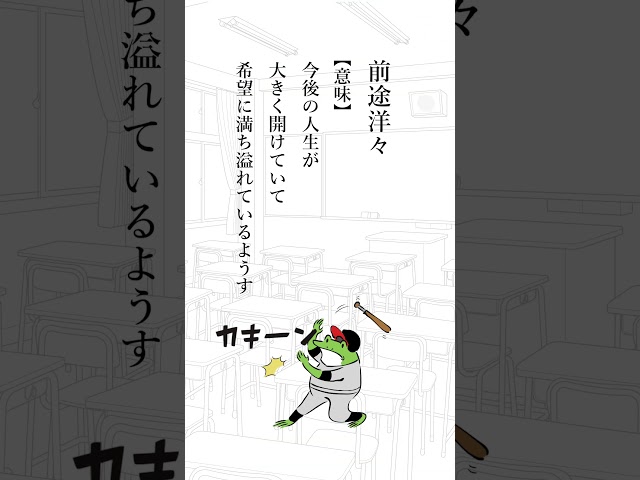
The four-character idiom zento-yoyo (前途洋々) carries a positive meaning that suggests a future full of hope.
At New Year’s, many people set goals with hopes like “What kind of year will it be?” and “I want to have a happy year.” Thinking that the future is brimming with possibility and hope can help you get off to a great start! It’s also a good idea to write down the four-character idiom you’ve chosen as your New Year’s resolution and keep it where you’ll see it in daily life—at home or in your planner—as a kind of good-luck charm.
Let’s start the New Year on a positive note!