

[Four-Character Idioms] Impressive and Cool Sound! A Collection of Famous Quotes Worth Knowing as General Knowledge

“Lion-like valor,” “a match for a thousand,” “battle-hardened”…
There’s an undeniable coolness to four-character idioms, isn’t there? If you can use them well, your everyday conversations and writing will feel much tighter, and your intellectual appeal will rise.
What’s more, the world of these idioms is incredibly deep—from phrases everyone knows to rare ones that make you go ‘Wow!’ In this article, we’ll introduce stylish four-character idioms you can use in daily life.
It’s packed with expressions that shine not only in business settings but also on social media and in messages.
- Amusing four-character idioms you’ll want to use right away! A collection of expressions to remember as general knowledge.
- Enrich your heart with beautiful four-character idioms! A collection of expressions you'll want to use in everyday life.
- General: Four-character idioms that encourage determination—powerful, heart-stirring words
- Become positive with four-character idioms that resonate with the heart! Common yet deeply meaningful words.
- Learn the meanings too! Cool four-character idioms that elementary school students will want to remember
- Four-character idioms that help you achieve goals! Phrases you can use in everyday situations
- [For Elementary Students] A Collection of Beautiful Four-Character Idioms to Know
- Interesting four-character idioms for elementary schoolers! Words you'll want to use once you understand their meanings
- Four-character idioms for New Year’s resolutions! A collection of motivational phrase ideas
- Intellectual beauty that shines! Stylish four-character idioms you can use in everyday situations
- Popular even among elementary school students! Stylish and easy-to-remember four-character idioms
- [Kakizome] Four-character idioms fit for the New Year: Introducing words that resonate with the heart and their meanings
- Boost your vocabulary with four-character idioms that include numbers! A collection of four-character idioms for elementary school students to learn.
[Four-Character Idioms] Strikingly Cool-Sounding! A Collection of Quotations You Should Know as General Knowledge (21–30)
fiery and high-spirited; brimming with passionate enthusiasm

This is a four-character idiom that expresses a spirit so vigorous it overwhelms others.
It doesn’t simply mean being motivated or energetic; it signifies a force of will and passion powerful enough to sweep up those around you.
It evokes the image of flames surging high, conveying a person’s intense presence and the momentum to transform the atmosphere.
Used in contexts like speeches, competitions, or challenges, it highlights the depth of one’s resolve and overwhelming energy.
Because the word itself carries power, even a short sentence can leave a strong impression.
It can be called a highly forceful idiom that expresses grandeur from the angle of “fighting spirit.”

to cover the sky and the earth
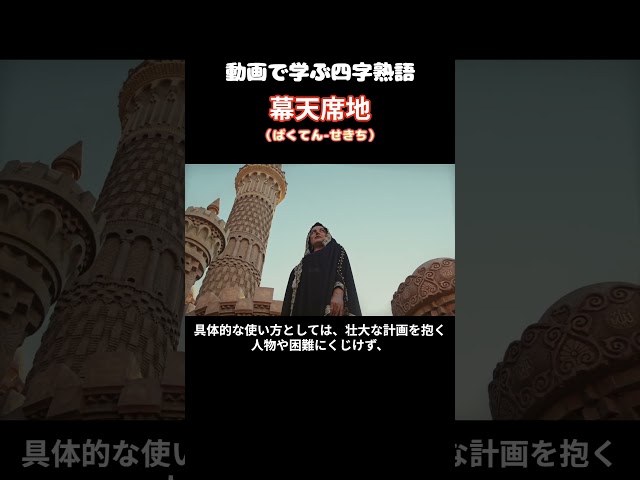
From the idea of using the sky as a roof and the earth as a mat, this four-character idiom expresses broad-mindedness and lofty ambition.
It’s used as in, “He is a makuten-sekichi type of person, unbound by worldly conventions.” Its origin traces back to a phrase in Ode to the Virtue of Wine by Liu Ling, a thinker of the Jin dynasty: “幕天席地 縱意所如,” meaning to use the sky as a ceiling and the ground as a seat, living as one’s heart leads.
By the way, in English, it might be akin to “ambitious,” as in the phrase “Boys, be ambitious.”
Bold and openhearted

It is a four-character idiom that describes someone broad-minded, easygoing, and unconcerned with trivialities, pronounced “gōhō-rairaku.” By combining the similar meanings of “豪放” (bold and free-spirited) and “磊落” (openhearted and straightforward), it emphasizes having a generous, untroubled nature.
“磊” depicts stones piled up, and “落” means to fall; together they suggest a place so full of stones that the falling of small ones goes unnoticed—hence the notion of a broad, untroubled heart.
For example: “He is gōhō-rairaku—easygoing and doesn’t worry about the little things.”
Vast sky and boundless sea
@i_am_sousukesuzuki favorite four-character idioms#AspiringVoiceActorAspiring Voice Actor Linestranslation
♪ Original song – i_am_sousukesuzuki – Sosuke Suzuki, voice actor
Through the boundless expanse of sky and sea, it impressively conveys the grandeur of one’s heart and perspective as a four-character idiom.
Its sound evokes the majesty of nature and, simply by reading it, a sense of liberation comes through.
It is appealing in that it can also be used to describe a person’s magnanimity or a free mind unbound by fixed ideas.
When used in writing or speeches, it adds depth and resonance to the expression and greatly expands the listener’s imagination.
I felt it is a four-character idiom that perfectly fits situations where you want to express grandeur by likening it to nature, combining both elegance and strength.

magnanimous in spirit; grand in vision

It is introduced in a very striking way as a four-character idiom that succinctly expresses the grandeur of one’s spirit and the scale of one’s ideas.
Its appeal lies in how it conveys not only the sense of having big dreams, but also an unshakable mindset and a far-sighted perspective.
I can clearly see how using it in character evaluations, speeches, or when discussing goals adds persuasiveness and dignity to one’s words.
Among expressions that denote grandeur, it stands out as a phrase that focuses on inner strength and high aspiration, making it highly practical and memorable.
just cause

Taigi-meibun refers to the justification or grounds for taking an action.
It’s fine when something can be completed by yourself, but when your words and actions affect those around you, you need a clear, convincing reason.
By making this word your New Year’s resolution, it may prompt you to question the legitimacy of your actions when you’re about to act impulsively or emotionally.
Before you end up regretting it—“I shouldn’t have done that…”—adopt this word as your resolution and take a fresh look at your words and actions.
By aiming to speak with legitimacy, you can be more confident when expressing your opinions, and you may also earn greater trust from those around you.

pure breeze and bright moon
It depicts a serene, composed scene in nature—clear wind and a bright moon.
Free of anything superfluous, it conveys a purity that seems to lighten the heart.
Thinking of the refreshing breeze on a summer night or a round moon floating in the sky brings peace of mind.
You could say this phrase also carries the message: “Keep your heart calm and face things with honesty.” Even on irritating days, recalling these words can help your feelings settle.
It reminds us not to forget to take time to clear our minds amid our busy daily lives.
It is a four-character idiom that teaches the importance of that mindfulness.