



Suddenly, but do you know how much a horse’s heart weighs? Horses are familiar animals, yet they have many mysterious traits and features that aren’t widely known.
In this article, we’ve prepared a quiz that lets you enjoyably learn fun facts about horses.
From how their teeth work, to why they’re easily startled, the secrets of their sleep, and the real reason they swish their tails—every question will make you say, “I didn’t know that!” It’s perfect as a conversation starter with children or as handy trivia for animal lovers.
Give it a try right away!
- Surprising horse trivia you probably didn’t know: astounding behaviors and fun facts
- Learn with Fun Horse Quizzes! Mysterious Facts about Horses Elementary School Kids Want to Know
- [Trivia] Do you know the answers? A roundup of animal quizzes
- [For Elementary School Students] Animal Quiz to Learn Knowledge and Fun Facts
- [Dog Biology] Things You Might Not Know? Dog Trivia
- [For Elementary School Students] 3-Choice Quiz to Deepen Knowledge of Living Things
- Who am I? A fun quiz collection: Animal edition
- Trivia quiz with useful tips to know: fun facts that come in handy at school or at home [for kids]
- Surprisingly unknown? A fun health trivia quiz that will make you want to try it
- [Trivia] A quiz to learn about the ecology and habits of medaka (Japanese rice fish)
- [Common Sense & Trivia] True-or-False Quiz with Knowledge for Elementary School Students
- Learn while having fun! Ocean Trivia Quiz & Fun Facts for Kids
- [Snake Quiz] Surprisingly fascinating once you know! Snake ecology & characteristics
A Surprisingly Unknown Horse Quiz! A Fun Collection of Questions to Learn from General Knowledge to Astonishing Ecology (1–10)
Which of the following statements about horse teeth is correct?

- Horses have the same number of teeth throughout their lives.
- A horse’s teeth wear down and become worn with age.
- Horses do not use their teeth when swallowing food.
See the answer
A horse’s teeth wear down and become worn with age.
A horse’s teeth wear down with age. Observing the degree of tooth wear is a common method for estimating a horse’s age. The wear condition is used as an indicator for a rough age estimate. If left unattended, the bite can become misaligned and may require treatment.

How big is a horse’s heart?
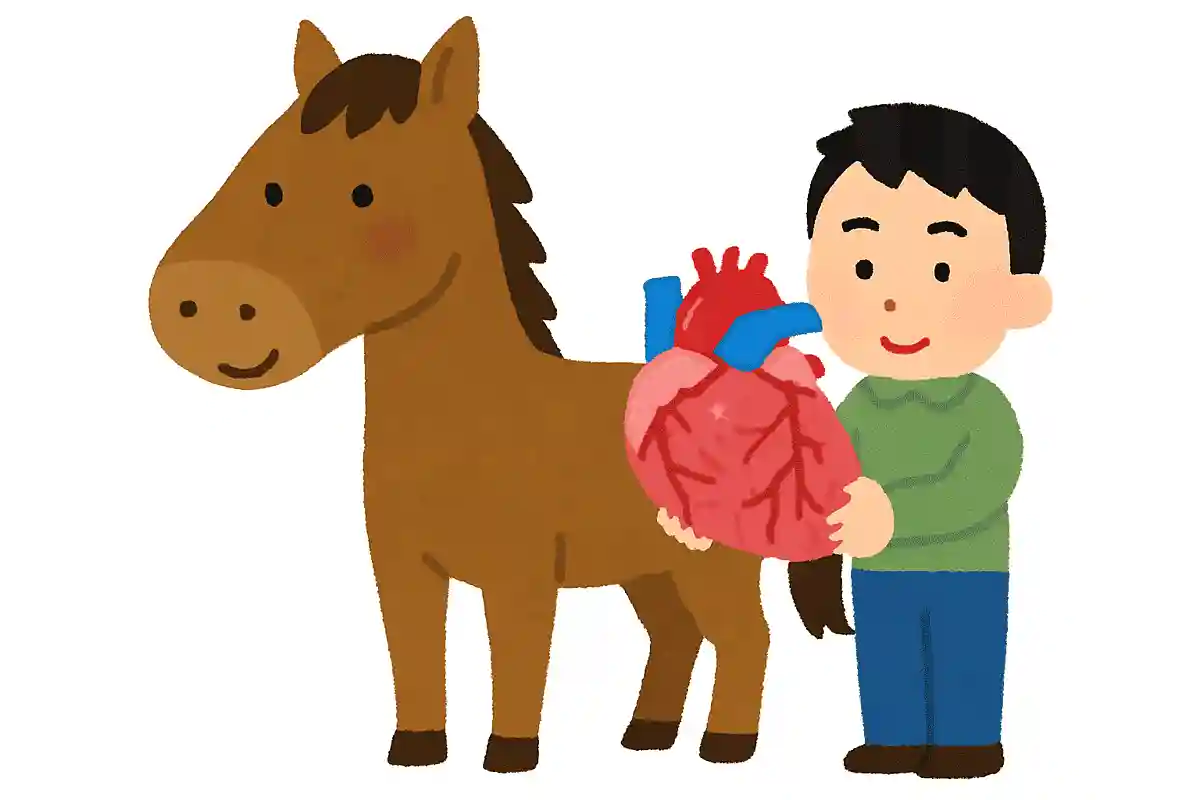
- about 300 grams
- about 1 kilogram
- about 5 kilograms
See the answer
about 5 kilograms
A horse’s heart weighs about 5 kilograms on average, which is much larger than a human heart at about 300 grams. This is because horses need to deliver a large amount of oxygen throughout their bodies to run fast and for long periods. By pumping a large volume of blood through the body, they supply oxygen to their muscles, supporting endurance and speed.
What aspects were particularly emphasized in the pedigree of racehorses?
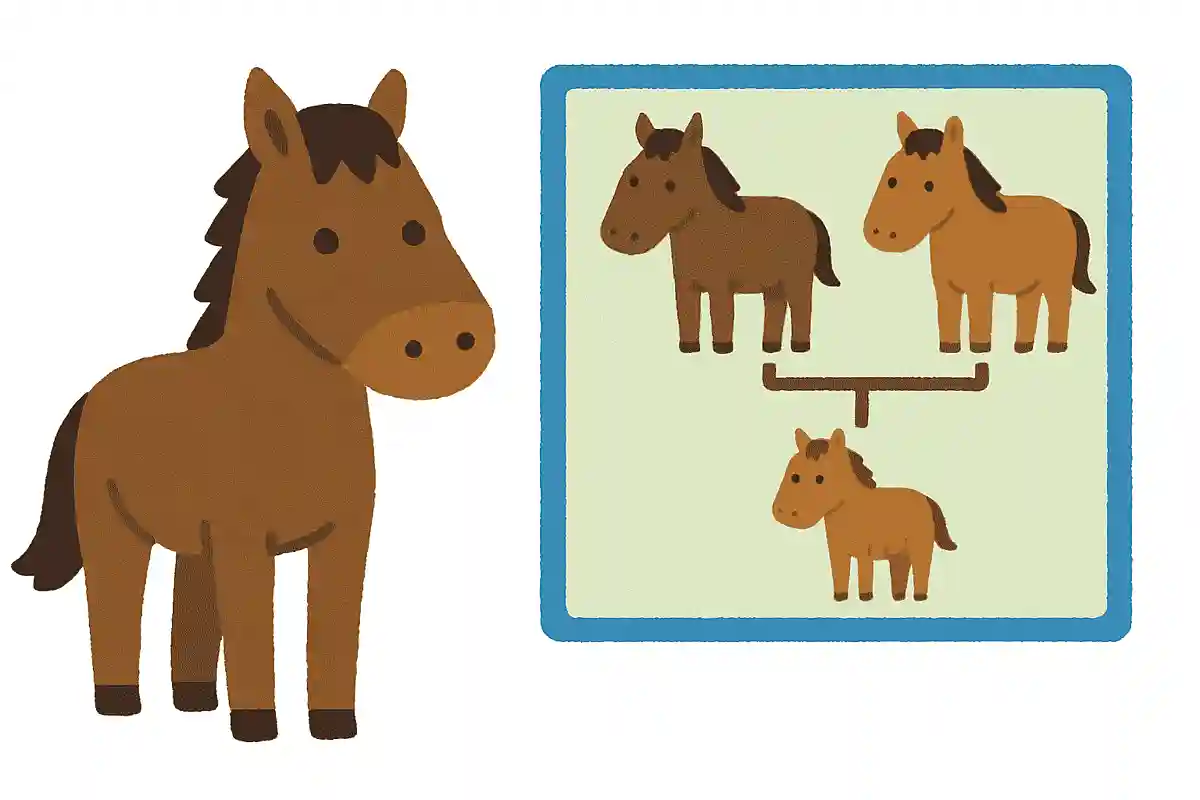
- coat color
- body weight
- Paternal and maternal lineages
See the answer
Paternal and maternal lineages
In Thoroughbred pedigrees, lineage such as the sire line and dam line is given the greatest emphasis. This is because lineage serves as an important indicator for assessing a horse’s ability, potential, and suitability. A racehorse’s pedigree is a key factor in estimating its racing capability, with particular attention paid to the performance of the sire and dam and the achievements of their progeny. Traits such as speed-oriented or stamina-oriented tendencies are often inherited, and trainers determine their development strategies by combining pedigree information with the horse’s conformation.
Why are horses’ pupils horizontally elongated?

- To see far
- To take a wide look around / To get a broader view of the surroundings
- to adjust the brightness
See the answer
To take a wide look around / To get a broader view of the surroundings
Horses are herbivores and need to broadly observe their surroundings to protect themselves from enemies. Their horizontally elongated eyes maintain a wide field of view, allowing them to see almost to the horizon and quickly detect danger. This is thought to have been acquired through evolution.
Which of the following statements about the horse’s stomach is correct?
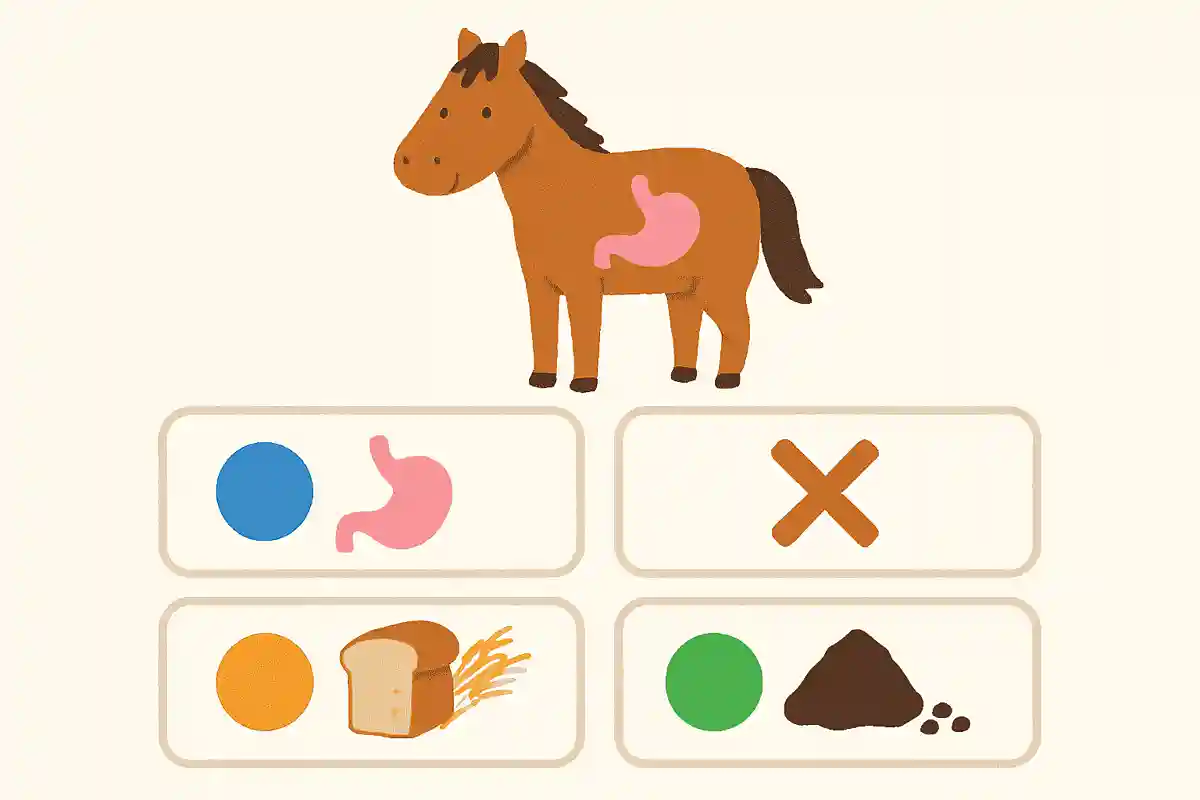
- The stomach is divided into four chambers.
- They ruminate, bringing their food back into the mouth multiple times.
- Relatively small and unable to digest a large amount at once.
See the answer
Relatively small and unable to digest a large amount at once.
Because a horse has only one stomach and it is relatively small, it cannot digest large amounts of feed at once. Compared to its body size, the horse’s stomach is very small, so it cannot process large meals in a single sitting. Therefore, horses are naturally adapted to eat small amounts continuously over long periods. In managed settings, leaving long intervals between meals can lead to gastric ulcers, so frequent feeding is considered important.
What is the main reason horses swish their tails?

- To express joy
- To keep the balance
- To drive away insects
See the answer
To drive away insects
The main reason horses swish their tails is to drive away insects like flies and mosquitoes. This is especially common in summer when there are many bugs, and they use their tails to protect themselves. A rough or vigorous tail swish can also be a sign of stress or discomfort.
Which of the following is commonly known as a smell that horses dislike?
- Scent of lemon
- Mint scent
- tobacco smoke
See the answer
tobacco smoke
Horses tend to dislike the strong smell of cigarette smoke and are sensitive to odors like smoke and chemicals that are also unpleasant to humans. They are relatively less sensitive to natural scents such as lemon or mint. They tend to avoid chemical odors and artificial fragrances.