

Icebreaker Ideas and Games Collection

We’re introducing classic, popular icebreakers and games!
Have you heard the term “icebreaker” before?
Put simply, it refers to activities that ease the tension and awkward silence that often arise among people meeting for the first time.
Whether you’re a student at the start of a new term or a new employee just joining a company—most of us have experienced that feeling when stepping into a new environment.
In this article, we’re sharing topics and games you can enjoy even with people you’ve just met!
If you want to build better relationships in a new group or team, or help nervous newcomers loosen up and have fun, give icebreakers a try!
- A roundup of recommended icebreakers for college students
- [In a Short Time] Icebreakers and Fun Games That Shine at Morning Meetings
- A collection of icebreakers you can enjoy with a small group
- [For University Students] A Roundup of Fun Games and Recreational Activities
- Icebreakers that get people moving (for both small and large groups)
- Games that liven up social and networking gatherings
- Brain-teasing game roundup
- Fun games recommended for making friends with people you’ve just met
- [For Adults] Fun recreational games. Perfect for short breaks too!
- Icebreaker ideas for large groups you can use in Zoom meetings
- Games you can play with just conversation. Classic and popular activities you can enjoy without any props!
- Collection of gesture game ideas and prompts
- [Play Right Away!] Exciting Recreation Games Recommended for Elementary School Students
Icebreaker Ideas and Games (21–30)
Poem of First Love

It’s a theme that lets you reflect on romance while enjoying a story packed with the sweet-and-sour freshness and poignancy of first love.
By thinking about why she exchanged emails and why she sent those words, you can imagine the movements of a person’s heart.
When she seemed to be happily spending time with the boy like a friend, why did I give up on my feelings? Beneath that might lie a lack of confidence or the inner struggle of not being able to muster the courage.
By discussing it with classmates, you can relive the characters’ emotions and overlay them with what you would have done yourself—that’s the appeal.
It’s a topic that invites lively exchanges of opinions, with the bittersweetness of love and personal growth as its themes.

Clap-Clap Game

Let’s try a clap-along game that also works as brain training, filling the room with the sound of rhythmic clapping.
The rules are very simple: when the facilitator’s hands come together, participants clap both hands once.
The facilitator can also add fake-out motions, pretending to clap without actually doing it, to make the game more exciting.
Once everyone gets used to it, increase the speed of the claps and keep a steady tempo—this will create a sense of unity among the participants.
Have fun and give it a try!

Survivors

A consensus game where you consider what decisions you would make to survive when suddenly faced with a disaster.
The theme is the real-life crash of Uruguayan Air Force Flight 571, inspired by the film “Alive.” Participants take on the role of a survivor and discuss how to respond to Roberto’s proposed actions, as well as how to overcome limited food supplies and the extreme cold.
Through discussion, players experience cooperation and differing values in a crisis, and because it tests a team’s ability to consolidate opinions and make judgments, it makes for an engaging, educational activity in schools and training programs.
It’s a theme that lets you enjoy the critical choices and viewpoints at key moments.
Six patients and medicine

It presents the ultimate choice: help one critically ill patient or save five moderately ill patients.
There is only one dose of medicine; the critical patient needs the entire dose, whereas the moderate patients can all survive if it is divided among them.
The dilemma of valuing a single life versus prioritizing the many exposes one’s values.
Key discussion points include whether all lives are equal in weight or whether social roles should be considered.
It is important for the whole class to debate and work toward a single final decision, making this a thought-provoking theme that lets students experience the challenges of ethics and difficult choices.
Runaway Trolley and Workers

A consensus game themed on a thought experiment proposed in 1967 by British philosopher Philippa Foot.
There are multiple workers on a railway track, and unless something is done, a major accident will occur; if you flip a switch, you sacrifice one person to save many lives.
Should you flip the switch, or leave things as they are? The key is first to consider the dilemma individually, then to reach a single conclusion as a group.
Because differences in positions and values become clear, it’s a compelling topic that sparks lively discussion.
Marshmallow Challenge

The classic “Marshmallow Challenge” is a staple of icebreakers and team-building.
It’s a simple game where a team works together to build a marshmallow tower—but it’s surprisingly deep.
The tower is complete once you can place a marshmallow at the very top.
However, there are restrictions: you can’t secure the base with tape, and cutting the marshmallow is not allowed.
Besides the marshmallow, the only materials you may use are spaghetti, tape, and string.
Discuss with your team how to proceed so you can successfully complete the tower.

LEGO Serious Play
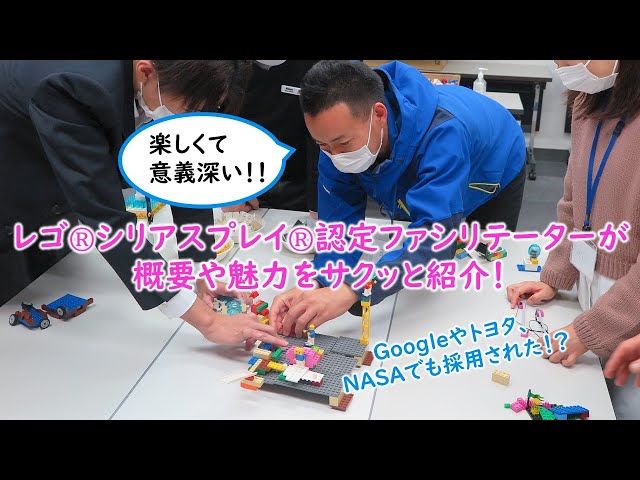
An educational program using Lego bricks called “LEGO Serious Play.” Build models with Lego bricks based on a given prompt, then present your creation.
After that, you’ll engage in dialogue by answering questions from participants.
Any prompt is acceptable, but abstract and open-ended ones are considered ideal—for example, “What challenges does our team face?” or “What is the ideal team?” Thoughts and visions that are hard to put into words can be conveyed through Lego models.
Through dialogue, you can also strengthen team cohesion.