

[Japanese-style BGM] Beautiful tones woven from Japanese tradition

Welcome to a new musical world where the spirit of Wa meets the breath of the modern era.
The shamisen’s powerful tones, the koto’s delicate melodies, the taiko’s resonant depths—Wafu BGM woven from tradition and innovation reminds us of our pride as Japanese.
In this article, we’ve carefully selected BGM brimming with the charm of Japan.
Whether you want to focus on work or study, or calm your mind, Japan’s beautiful sounds will accompany your moments.
With exhilarating rhythms and the exquisite harmony of traditional instruments, why not enrich your everyday life with vibrant color?
- [Japan] A collection of J-pop with a traditional Japanese (wa) vibe and Japanese-style taste
- A bright, Japanese-style song. A roundup of J-POP with a traditional Japanese flair.
- The Spirit of Japan: A Collection of Famous and Popular Shamisen Pieces
- Masterpieces of Japanese instrumental music. Recommended instrumental tracks.
- [Japanese-style Piano Pieces] A selection of recommended works with a pleasantly Japanese flavor
- Nostalgic yet new! Hit songs from the Showa era you’ll want to use as BGM
- [I Want Healing] Songs That Bring a Sense of Calm: Heartwarming Masterpieces of Japanese Music
- [Classical] Classical music BGM. Recommended classical music as background music for work and study.
- Stylish songs that are popular and recommended for vlog background music
- Recommended BGM for YouTube Shorts! Popular songs released in the Reiwa era
- Gently soaking into a weary heart... Healing songs released in the Reiwa era
- A nostalgic song—a timeless classic that somehow feels familiar and touches the heart.
- Gets you pumped! A curated selection of popular and classic Japanese songs perfect as background music for work
[Japanese-style BGM] Beautiful Tones Woven by Japanese Tradition (31–40)
Lots of BeatlesKoto Shiki no Kai

Have you ever listened to Western songs or J-pop played on the taishōgoto? Professional musicians perform on it, but amateurs also play it at recitals.
This is a Beatles medley performed by a hobby group.
The taishōgoto’s sound is soft and gives you a warm, relaxed feeling.
Genroku Cherry-Blossom Viewing Dancenagauta

In old period films, whenever the scene switched to a lavish banquet at a castle, this piece of music was invariably used as the background score.
Well-known rakugo storytellers like Shinosuke Tatekawa and the late Enraku Sanyutei used it as their entrance music.
This video features a performance by the Kumamoto Prefecture Traditional Japanese Music Association.
heartbeatYoshida Kyōdai
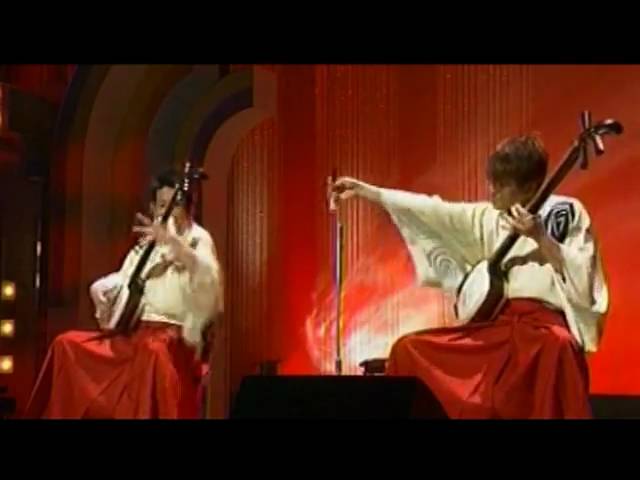
The Yoshida Brothers, Tsugaru shamisen players who made a splash with their major debut in 1999, are now active in a wide range of fields.
Their music is irresistibly captivating, and the performance they showcase in their monochrome music video is both beautiful and incredibly powerful.
Kagemusha2CELLOS

Next up is a distinctive performance… When it comes to Kurosawa films, they still have a wide range of fans both abroad and in Japan.
They’re also renowned for their exceptionally high level of craftsmanship, including the film music.
Here we have Kagemusha performed on two cellos.
Despite not using traditional Japanese instruments—and being played by foreign musicians—it still sounds unmistakably Japanese.
It absolutely reaffirms just how wonderful the composition is.
[Healing Effect] A soothing Japanese-style music medley that feels like an autumn festival [BGM for Work]Royalty Free Music
![[Healing Effect] A soothing Japanese-style music medley that feels like an autumn festival [BGM for Work]Royalty Free Music](https://i.ytimg.com/vi/cz5mL21fSGE/sddefault.jpg)
Recently, more and more musicians have been releasing their original compositions as copyright-free works.
This is a soothing medley of Japanese-style songs, carefully selected and blended from such performances to capture the atmosphere of autumn festivals.
It’s filled with truly practical tracks that evoke the open, airy feeling of a clear autumn festival night and the distant sound of festival music drifting through the air.
[Japanese-style BGM] Beautiful Tones Woven by Japanese Tradition (41–50)
Sakura Variationssōkyoku

Aside from New Year’s, the place you most often hear the koto is at cherry-blossom viewings.
And this piece is indispensable there.
Composed by Michio Miyagi, a leading figure in koto music, it features a refined and beautiful ensemble for two kotos.
It almost makes you feel like you’ve stepped into a Japanese restaurant.
Statement Four Wisdom Sanskrit HopeKōyasan Nanzan Shinryū

A performance based on the Koyasan Nanzan Shinryu sutras, composed, arranged, and structured by Ryukai Matsushima as before: “Shomyo Shichi Bongo: Hope.” It is a hymn that single-mindedly praises the teachings handed down from the principal deity of Esoteric Buddhism, Mahavairocana (Dainichi Nyorai), and his four kinds of wisdom.
Among shomyo pieces, it is one of the most popular—so powerful that you might find yourself hearing it anywhere in the world.
While it can be enjoyed purely as music in a Japanese-style BGM vein, it is, of course, also a profoundly venerable work.