

[Playable from lower grades] Japanese language games and activities

In elementary school language arts, there’s so much to learn—hiragana, katakana, kanji, and more.
Kids can get overwhelmed by how much they have to memorize and start to dislike studying… but before that happens!
How about easing their resistance with Japanese language games that are both fun and educational, so they can learn through play?
We’re introducing plenty of language games, activities, and apps focused on kanji and characters.
Some games are great for parents and children to enjoy together, so we also recommend trying them on weekends!
- Learn by Playing! Recommended Games with a Kanji Theme
- [Rec] Interesting! A roundup of wordplay games
- Fun quizzes for elementary school kids: a collection of questions everyone can enjoy together
- [Easy] Quizzes That Elementary School Students Can Solve! A Collection to Nurture Wisdom
- [For Elementary School Students] Cipher Quiz: Fun Puzzle Riddles
- [For Elementary School Students] Recommended Riddle Collection
- A game where you can learn the multiplication table while playing
- [Elementary School] Quick and Easy! Indoor Recreational Activities Perfect for Lower Grades
- Fun activities for junior high school students. Recreation games.
- [For Elementary School Students] A Collection of Games and Activities You Can Enjoy on Zoom
- Easy Riddles for Elementary School Students
- [Play Right Away!] Exciting Recreation Games Recommended for Elementary School Students
- [For Kids] Fun Either Way: A Collection of Rock-Paper-Scissors Game Ideas
[Playable from Lower Grades] Japanese Language Games and Activities (1–10)
Mojipittan

Mojipittan is a word-based puzzle game available across a wide range of formats, including video games and apps.
Some letters are placed on the board in advance, and you place other letters next to them to form words.
There’s also a strategic element, as you aim to create as many words as possible by making smart use of a limited set of letters.
It’s a game you can easily make yourself with a large sheet of grid paper and letter cards, which is another appealing point.
It helps you recall words you already know and also provides opportunities to learn new ones.

Bob Jiten Kids

It’s a game where you describe words and have the people around you guess them, helping you develop your ability to explain and to think.
Draw a card from the deck and describe the word written on it without using any katakana.
If someone else hears your description and guesses correctly, they earn a point, and then that person draws the next card and gives the explanation.
The words on the cards are basically loanwords typically written in katakana, so the tricky part is that you’ll be tempted to slip katakana into your explanation.
You can also add variations, like giving a penalty to anyone who accidentally uses katakana during their explanation.
Kanji Stroke Count Relay
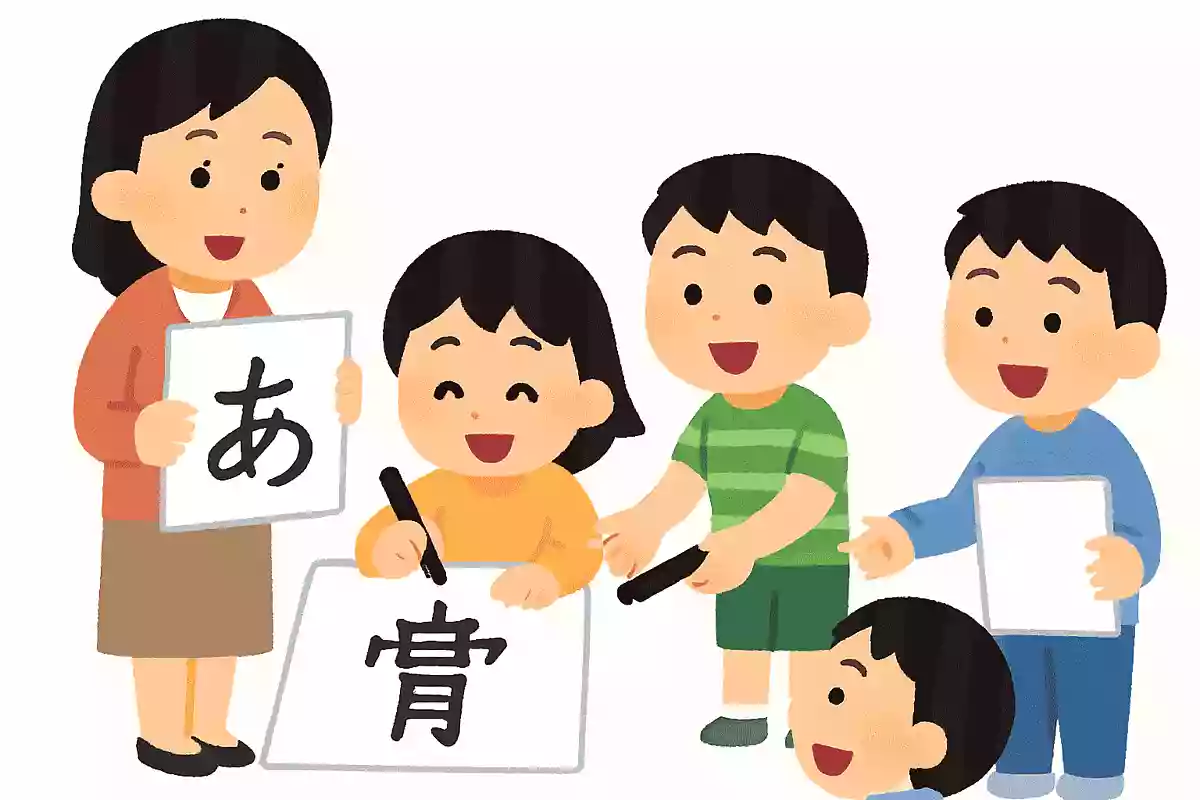
This is a simple game that uses the number of strokes in kanji.
Decide the order of play: the first person says a one-stroke kanji, the next person a two-stroke kanji, and so on, increasing the number of strokes in turn.
Set a time limit per person; if someone can’t answer within the time, they’re out.
You can form groups and compete to see how far you can go, or adapt various rules to suit the situation—that flexibility is part of the appeal.
It’s also a good opportunity to check the correct stroke order and stroke counts with others, since those are often remembered incorrectly.
[Playable from Lower Grades] Japanese Language Games and Activities (11–20)
Hiragana Shiritori

Shiritori is a game that most people have played: you take the last character of a word, announce a new word that starts with that character, and keep repeating.
Even simple shiritori helps you learn new words, but turning it into a quiz format makes it even more fun.
For example, announce one word and compete to see how many continuations you can come up with within a time limit—this lets you focus on recalling words.
Trying to think of a word that bridges two given words raises the difficulty and makes it even more enjoyable.
It’s also interesting to compare answers with others and discover new vocabulary.
Kanji Ateji Composition
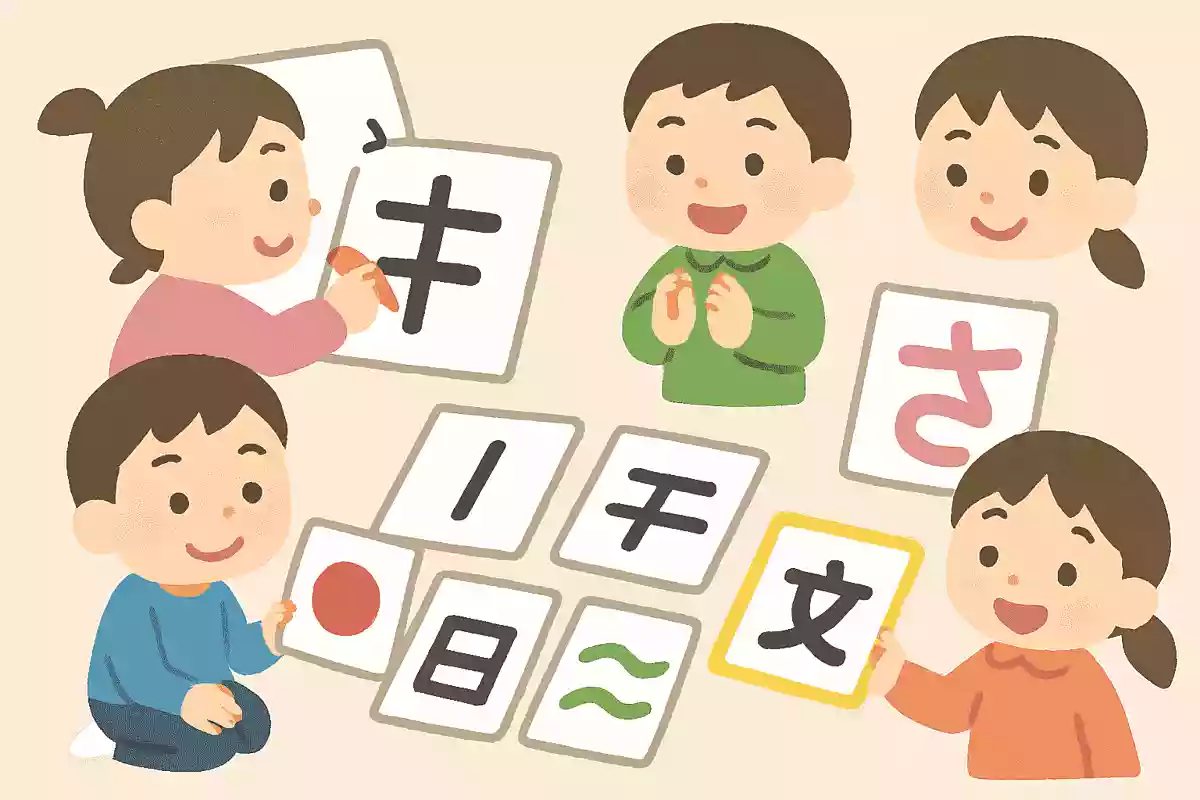
This is a game where you create sentences using kanji readings.
Participants come up with simple compositions, write them using kanji as phonetic substitutes, and then read each other’s sentences.
It’s fun just to figure out how each part is read, but it might also be interesting to turn it into a game where you compete on the number of kanji used.
As the game progresses, you can sense each person’s unique way of thinking—for example, one person might write “ta” as 田 while another writes it as 多.
It’s also an ideal game for helping you learn kanji readings.
Word search game

This is a fun game using the Japanese syllabary cards called the “Word-Finding Game”! Some children who struggle with language arts may have a limited vocabulary and find it hard to understand what they read.
In this game, you present prompts like “a four-letter word that starts with A,” and work together with the participants to come up with words.
It helps build vocabulary, and even unfamiliar words are more memorable when everyone creates them together.
It’s also a great idea to show real-life images of the words on a smartphone after you’ve made them!

Radical Guessing Game

When considering the origins and meanings of kanji, thinking about radicals is also an important point.
This game aims to help you learn those radicals in a quiz format.
Because the theme is straightforward, you can prompt players to think about radicals through a variety of question types.
A key is to mix easy and difficult items in a format where players identify the radical’s name.
It’s important to create that feeling of “I’ve seen it, but I don’t know its name,” and through that experience, players can come to understand the names and meanings of radicals more deeply.
If you also get players to consider which part of a character corresponds to the radical, it could become even more engaging.