

Nostalgic Children’s Songs, Folk Songs, and Nursery Rhymes: The Heart of Japan Passed Down Through Song
When we hear the gentle melodies of nostalgic children’s songs, folk songs, and nursery rhymes, memories from our early childhood come vividly rushing back, as if we’ve crossed time and space.
Perhaps you, too, have a “song of nostalgia” that has stayed with you since you were young.
In this article, we introduce iconic Japanese children’s songs (shoka), folk songs and nursery rhymes cherished and passed down across the regions, as well as beloved tunes often featured in school performances and recreational activities.
Shall we set off on a heartwarming sonic journey into the world of children’s songs that softly reflect Japan’s seasons, culture, and everyday life?
Playlist
| Nostalgic Children’s Songs, Folk Songs, and Nursery Rhymes: The Heart of Japan Passed Down Through Song | |||
|---|---|---|---|
| show_chart | Title | Playlist | Review |
| 1 | Please let me pass.warabeuta |  play_arrow play_arrow | Nursery rhymes and children's play songs from the approach to Kawasaki Daishi Temple |
| 2 | hometownSakushi: Takano Tatsuyuki / Sakkyoku: Okano Teiichi |  play_arrow play_arrow | A timeless song that sings of hometown scenery and memories |
| 3 | FlowerTaki Rentarō |  play_arrow play_arrow | Spring Scenery: The Allure of Cherry Blossoms and Songs on the Sumida River |
| 4 | Frog ChorusSakushi : Okamoto Toshiaki / Genkyoku: Doitsu min’yō |  play_arrow play_arrow | A song with an easy-to-remember melody that’s good for singing in a round |
| 5 | Piglet-raccoon dog-fox-catsakushi sakkyoku/yamamoto naozumi |  play_arrow play_arrow | A hand-play song with animals using shiritori, hugely popular with children |
| 6 | Momotarosakushi: fushō / sakkyoku: Okano Teiichi |  play_arrow play_arrow | The story of the traditional Japanese children's song “Momotaro” |
| 7 | Old Man with a BeardSakushi: Fushō / Sakkyoku: Tamayama Hidenobu |  play_arrow play_arrow | The charm and fun of the fingerplay song “Hige Jiisan” (Grandpa with a Beard) |
| 8 | The Puppy Police OfficerSakushi: Satō Yoshimi / Sakkyoku: Ōnaka Megumi |  play_arrow play_arrow | A police dog helping a lost kitten |
| 9 | Let’s clap our handssakushi: kobayashi jun’ichi/genkyoku: cheko minyō |  play_arrow play_arrow | A song that expresses joy with handclaps, loved by a wide range of generations. |
| 10 | snowMonbushō shōka |  play_arrow play_arrow | A masterful song, rich in sensitivity, that sings of the arrival of spring. |
| 11 | Mr. ElephantSakushi: Mado Michio / Sakkyoku: Dan Ikuma |  play_arrow play_arrow | A children’s song with lyrics by Michio Mado |
| 12 | King Kamehameha of the Southern Islandssakushi: itō akira / sakkyoku: morita kōichi |  play_arrow play_arrow | The gentle family song of the Hawaiian royal family |
| 13 | Gonbe-san’s BabySakushi: Tashiga Akira / Genkyoku: Amerika min’yō |  play_arrow play_arrow | A gentle, beloved children's song with lyrics by Akira Tajika |
| 14 | pine coneSakushi: Hirota Takao / Sakkyoku: Kobayashi Tsuyae |  play_arrow play_arrow | Autumn nursery rhyme of pinecones and a monkey |
| 15 | teru teru bozu (a traditional Japanese handmade doll hung to wish for good weather)Sakushi: Asahara Kyōson / Sakkyoku: Nakayama Shinpei |  play_arrow play_arrow | A nursery rhyme that places wishes in a rainy day's doll |
| 16 | Banana Parent and ChildSakushi: Seki Kazuo / Sakkyoku: Fukuda Wakako |  play_arrow play_arrow | The Banana Family’s Fun Song and Family Love |
| 17 | The Bear of the Forestamerika min’yō |  play_arrow play_arrow | A Nursery Rhyme about a Bear’s Adorable Encounter in the Forest |
| 18 | Brr, it’s so cold.warabeuta |  play_arrow play_arrow | Children’s songs for the cold season are simple and charming. |
| 19 | Summer MemoriesSakushi: Ema Akiko / Sakkyoku: Nakata Yoshinao |  play_arrow play_arrow | Nostalgic summer classics, the beauty of nature that resonates with the heart |
| 20 | Close It, Open ItMonbushō shōka |  play_arrow play_arrow | Fingerplay songs are popular in childcare and among the elderly. |
| 21 | the temple’s head monk |  play_arrow play_arrow | The tradition and charm of the hand-play song “Sesse-sse” |
| 22 | All mothersamerika min’yō |  play_arrow play_arrow | The Mysterious Song of the Horse and the Piglet, a Japanese Children's Song |
| 23 | Zuizui Zukkorobashi |  play_arrow play_arrow | A song that depicts the harsh era of “kirisute gomen.” |
| 24 | tidying up |  play_arrow play_arrow | A children's song that makes tidying up fun |
| 25 | Mr. Elephant |  play_arrow play_arrow | A children's song that affirms differences and cherishes being oneself |
| 26 | I accidentally broke the clarinet.Sakushi: Ishii Yoshiko / Sakkyoku: Fumei |  play_arrow play_arrow | The Song of the Boy Who Failed at Clarinet Playing |
| 27 | Adorable foalSakushi: Satō Hachirō / Sakkyoku: Niki Takio |  play_arrow play_arrow | A classic that warmly portrays a scene of a foal and a child |
| 28 | Spring MeadowSakushi: Sakata Hiroo Sakkyoku: Ichikawa Toshiharu |  play_arrow play_arrow | A children's song about a spring pasture where foals gallop. |
| 29 | Horse’s tail, pig’s tail.Sakushi: Abe Hitomi / Sakkyoku: Yamamoto Naozumi |  play_arrow play_arrow | An adorable nursery rhyme about a horse and a pig’s tails |
| 30 | horse (childish/affectionate term)Sakushi: Hayashi Ryūha / Sakkyoku: Matsushima Tsune |  play_arrow play_arrow | A song story depicting the affection between a foal and its mother horse |
| 31 | oshikura manju (a children’s pushing game) |  play_arrow play_arrow | Oshikura manju is a winter playground song. |
| 32 | Sakura, sakura |  play_arrow play_arrow | A famous song that represents Japan, praising the beauty of cherry blossoms |
| 33 | Choo-choo train |  play_arrow play_arrow | In the past, trains and ships were the main modes of transportation. |
| 34 | Ten thousand feet in the Alps |  play_arrow play_arrow | At the summit of Kogyari, enjoying a hand-clapping song. |
| 35 | seaSakushi: Hayashi Ryūha / Sakkyoku: Inoue Takeshi |  play_arrow play_arrow | Masterpieces depicting seascapes: the charm of heart-stirring school songs |
| 36 | Mother in the EveningSakushi: Satou Hachirou/Sakkyoku: Nakata Yoshinao |  play_arrow play_arrow | A timeless song that sings of a mother's warmth on an autumn evening |
| 37 | Ongo |  play_arrow play_arrow | Nostalgic children's songs of Osaka |
| 38 | The scenery of the whole world |  play_arrow play_arrow | A spring playground song from Osaka, the song of a nightingale |
| 39 | TulipSakushi: Kondo Miyako / Sakkyoku: Inoue Takeshi |  play_arrow play_arrow | Tulip song, love of color and diversity |
| 40 | One, two, three, four, two, five |  play_arrow play_arrow | A traditional counting nursery rhyme enjoyed with finger play |
| 41 | Oonami Konami |  play_arrow play_arrow | Popular music teaching materials for eurhythmics and jump rope |
| 42 | Goodbye, ankoro mochi. |  play_arrow play_arrow | A traditional song of wordplay that wishes for reunion |
| 43 | From inside the bamboo grove |  play_arrow play_arrow | A rhythmic play song that nurtures children's imagination |
| 44 | Horsetail shoots are poking up. |  play_arrow play_arrow | A wordplay masterpiece that lets you feel the breath of spring |
| 45 | Keep crossing the bridge one after another. |  play_arrow play_arrow | A playable nursery rhyme featuring a fox |
| 46 | Pretty good.warabeuta |  play_arrow play_arrow | Songs to enjoy with children through rhythm play |
| 47 | Opened, openedwarabeuta |  play_arrow play_arrow | A spring children's song, singing of nature and tradition |
| 48 | hazy moonlit night |  play_arrow play_arrow | Spring rapeseed blossom fields, cherishing traditional children's songs |
| 49 | Mother’s Song |  play_arrow play_arrow | A mother's love remains unchanged across eras. |
| 50 | Seagull Sailor |  play_arrow play_arrow | The era when sailor uniforms and songs were popular |
| 51 | Cute fishmonger |  play_arrow play_arrow | In the past, I used to buy ingredients from peddlers. |
| 52 | The Sparrow School |  play_arrow play_arrow | Sparrow School, a song that now feels nostalgic |
| 53 | Donguri Korokoro |  play_arrow play_arrow | Nursery rhymes nurture children’s hearts and emotions. |
| 54 | Come, firefly |  play_arrow play_arrow | Fireflies’ glow, a scene of Japanese summer |
| 55 | The gentle green breeze |  play_arrow play_arrow | Nostalgic songs and greenery, memories of spring long ago |
| 56 | skiing |  play_arrow play_arrow | Nostalgic Memories of Winter Sports and My Father’s Songs |
| 57 | Itsuki Lullaby |  play_arrow play_arrow | A plaintive song of an apprentice child, a folk song from Kumamoto |
| 58 | Red sky at dusk |  play_arrow play_arrow | The melody remains in the daily lives of Japanese people. |
| 59 | The monk of the mountain temple |  play_arrow play_arrow | The Monk’s Strange Imaginary Song World |
| 60 | Height comparison |  play_arrow play_arrow | The marks on the pillar that recorded a child’s growth are now a thing of the past. |
| 61 | The Ball and the Lord |  play_arrow play_arrow | The sorrowful history hidden in a children's song |
| 62 | yomogi-jōbu nowarabeuta |  play_arrow play_arrow | Singing about Japan’s seasons and children’s growth |
| 63 | Toy Cha-Cha-ChaSakushi: Nosaka Akiyuki, Yoshioka Osamu / Sakkyoku: Koshibe Nobuyoshi |  play_arrow play_arrow | A fun nursery rhyme about a toy parade, very popular with children |
| 64 | The Hill Where Mandarin Orange Blossoms Bloom |  | A beautiful piece depicting the scenery of a mandarin orange orchard. |
| 65 | Seven-year-old child |  play_arrow play_arrow | Raising young crows is an all-or-nothing act of love |
| 66 | Harvest Moon |  play_arrow play_arrow | The Rabbit Song: A Lonely Tale of a Solitary Girl |
| 67 | Come, spring |  play_arrow play_arrow | A children's song awaiting spring in snow-deep Niigata |
| 68 | Red Shoes |  play_arrow play_arrow | The girl with the red shoes: a sad fate and a mother’s love |
| 69 | The Hare and the Tortoise |  play_arrow play_arrow | The Tortoise and the Hare: Teaching the Importance of Effort |
| 70 | Desert of the Moon | 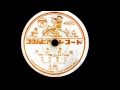 play_arrow play_arrow | A folk song with exotic flair modeled after Onjuku Beach. |
| 71 | red dragonfly |  play_arrow play_arrow | Sad Memories of the Red Dragonfly and My Older Sister |
| 72 | Doll with Blue Eyes | 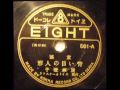 play_arrow play_arrow | Blue-eyed dolls as a bridge of friendship between Japan and the United States |
| 73 | Friendly Path | 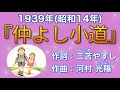 play_arrow play_arrow | In the past, children’s commute to school was free and safe. |