

Kyoto’s folk songs, children’s songs, and nursery rhymes: the enduring spirit of our hometown passed down through song.

A special feature on folk songs and nursery rhymes from Kyoto Prefecture, one of Japan’s premier tourist destinations and home to countless historic sites.
Kyoto has long been a stage for history and is rich in diverse cultures.
Even within the category of “folk songs,” the periods in which they were created vary widely, and there are many genres of songs that reflect local lands and customs.
If you’re a local, many of these may ring a bell.
And if you live in the Kansai region, you might even encounter songs whose melodies are the same but whose lyrics differ.
Shall we unravel Kyoto’s history through its songs?
- [Kyoto Songs] Masterpieces that sing about Kyoto — songs themed on the ancient capital. The enduring heart of our hometown passed down in song.
- Folk songs, children’s songs, and nursery rhymes of Osaka: the enduring spirit of our hometown carried on in song
- Ranking of Popular Folk Songs
- Collection of winter nursery rhymes, folk songs, and children's songs. Includes fun winter hand-play songs too.
- Children’s songs, school songs, and nursery rhymes with a river theme. Beloved classics about nostalgic watersides.
- Japanese Shoka, Children's Songs, and Nursery Rhymes | Timeless masterpieces that resonate in the heart, passed down across generations
- [Parenting] Parent-child bonding! Hand-play songs and traditional nursery rhymes collection
- Fukuoka’s folk songs and children’s rhymes: History and sentiments conveyed by the nostalgic melodies of home
- Japanese counting songs: nostalgic temari (handball) songs and children’s folk songs
- [Folk Songs of Yamagata] The Heart of Our Hometown Passed Down in Song: Feelings Woven into Nostalgic Melodies
- Folk songs, children’s songs, and nursery rhymes of Kumamoto: the enduring spirit of our hometown passed down through song.
- Folk songs, children's songs, and nursery rhymes of Hiroshima: the enduring heart of our hometown, passed down through song.
- Childcare: Today's recommended fun songs
Kyoto’s folk songs, children’s songs, and nursery rhymes: The heart of our hometown passed down in song (21–30)
Fukuchiyama Ondo

It is one of the folk songs handed down in Fukuchiyama, Kyoto Prefecture.
Speaking of Fukuchiyama, Fukuchiyama Castle—completed in 1579 with Akechi Mitsuhide as its lord—still stands majestically today.
This song vividly evokes the Fukuchiyama of old, which prospered as a key transportation hub linking north and south.
Night cherry blossoms in Gion

“Gion no Yozakura” is a piece of Yamato-gaku, a genre of new Japanese music that emerged in the early Showa period.
Yamato-gaku was founded by Mr.
Okura Kishichiro to create a “completely new kind of Japanese music unlike anything before.” Today, rather than being passed down as a children’s song, it is more commonly used as an accompaniment for Japanese dance.
I sliced the daikon and ended up slicing too much.

It’s a hand-play song passed down in Kyoto, where you pretend your arm is a daikon radish and play by miming cutting it.
You angle your arm like a staircase, walk your fingers up and down it, and the punchline is a tickle under the arm at the end.
The thrill comes from wondering when the tickle will happen.
It feels like a song rooted in everyday life, evoking a nostalgic, good old time.

Snow, Konkon / Snowflake
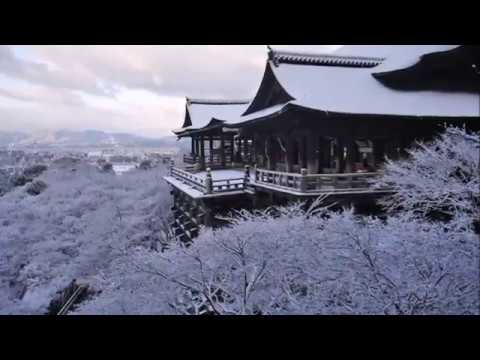
In the northern part of Kyoto Prefecture, it snows and accumulates every year, but in the south it happens maybe once every few years, if at all.
When someone says “It’s snowed at Kinkaku-ji,” photographers go into a frenzy.
There’s even a nursery rhyme about snowfall, so it must have been rare even in the old days.
over the hump

It’s one of the well-known hand play songs.
With a fox and a raccoon dog appearing, it gives a lively impression.
Since mountain animals show up, it was probably sung in mountainous regions.
In other areas, it seems there are cases where rabbits are featured instead.
In conclusion
We’ve gathered a collection of songs rich in local flavor. When people hear “Kyoto,” many probably picture the city itself, but Kyoto Prefecture actually stretches quite far from south to north. Since it faces the Sea of Japan, there are folk songs related to fishing as well. Perhaps this revealed a new side of Kyoto.