

[Kindergarten (older class)] What kind of season is March? Let’s make events and natural objects with origami!

This time, we’re introducing March origami projects we’d like the oldest kindergarteners to try.
By now, children in their final year at kindergarten have had plenty of origami experience.
In addition to the basics like mountain and valley folds, many can handle slightly more complex steps, such as making slight diagonal folds or opening a fold partway.
With a solid foundation, they can follow verbal instructions or even create pieces on their own by looking at crease patterns—showing wonderful readiness for elementary school.
Try posting step-by-step crease diagrams in the room to encourage children to engage on their own initiative.
If there’s also a space where children can freely display what they’ve made, it will likely motivate them to create the next piece as well.
- [For 4–5 year olds] A collection of recommended origami ideas for March—featuring seasonal events and natural motifs
- [Origami] Easy spring-themed origami ideas to enjoy with 4-year-olds
- [Origami] Simple Origami Ideas to Feel the Spring with 3-Year-Olds
- [For Preschoolers] Let’s Make It Together with the Kids! Origami Ideas for February
- [For 5-year-olds] Let’s make origami! A collection of fun folding ideas
- [Origami] Simple Origami Folding Ideas to Savor Spring with 5-Year-Olds
- [Childcare] Recommended crafts and activities for March, such as Hina Matsuri (Doll’s Festival) and cherry blossoms
- For older kindergarteners: Let’s make it! A collection of recommended origami ideas for February
- Origami ideas perfect for April that will captivate older kindergarteners!
- Recommended for preschoolers! A collection of origami ideas perfect for April
- [Childcare] Perfect for March! A collection of craft ideas recommended for 5-year-olds
- [Kindergartners (Older Group)] Folding is Fun! Recommended January Origami Idea Collection for Senior Kindergarteners
- Perfect for September childcare! A collection of origami ideas recommended for older preschoolers
Kindergarten (older class): What kind of season is March? Let’s make events and natural objects with origami! (11–20)
Fun to roll! Dandelion origami
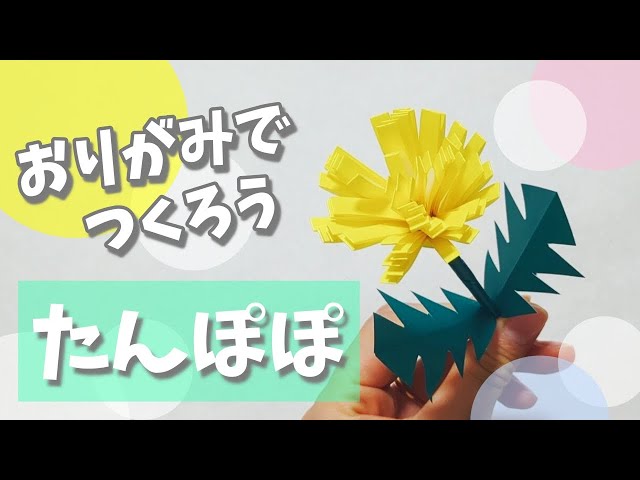
This is a voluminous dandelion origami made by rolling strips.
The petals spread out radially, giving a glamorous look.
Fold the origami paper in half and cut it, then fold each piece in half again.
Apply glue to the edge, join to form a ring, and make fine 5 mm cuts to create the petals.
Roll another piece of paper to make the stem, and fold and snip it to finish the leaves.
Wrap the petals around the stem and fluff them out for added dimension—it also works well as interior decor.
Combining yellow and orange will make it even more vibrant.

ladybug

Here’s an idea for making a ladybug out of origami, perfect for spring.
Fold a square of origami paper in half, then fold both sides toward the center.
Fold up the bottom by about one-third, and fold only the top layer back down to create the ladybug’s head.
By tucking in several corners, you’ll achieve a cute, rounded shape.
When drawing the ladybug’s spots and face, it’s great to let children use their own creative ideas.
There’s also a method that lets you open the wings, so if you want to add movement, try that variation for extra fun.
Displaying the finished ladybugs will bring a warm touch of spring and spread a cheerful mood.
randoseru (Japanese elementary school backpack)

The origami school backpack, which expands the sense of anticipation for a new life, is a perfect project for the spring school entrance season.
First, crease the paper to divide it vertically into four equal sections.
Fold in the quarter-width sections from the top and bottom, then make cuts along the creases to create the flap.
Cut the marked areas to make the shoulder straps.
As you fold the remaining parts, adjust the shape to form the backpack’s silhouette.
For a cute finishing touch, you can add a traffic safety cover.
If the folding steps for shaping the backpack are difficult, work together and consult with friends as you go.
Displaying the completed backpack will express the excitement of starting school.
cherry blossom petals

Origami cherry blossom petals are a beautiful craft that evokes the arrival of spring.
Fold the paper toward the center.
As you imagine the shape of cherry blossom petals, round off the corners with gentle folds to create a soft look.
At this point, pay attention to the steps where you fold the paper diagonally—that’s the key.
Finally, make small cuts along the outer edge and open it up; you’ll have airy, fluffy cherry blossom petals.
Adding these small cuts is important for a more realistic finish.
If you line up and paste several blossoms you’ve made, it will look like a tree in full bloom and bring a spring-like atmosphere.
It’s a perfect craft for commemorating school entrance or graduation, so enjoy making it!
Japanese bush warbler
@origamiplaza You can make it with a single sheet of origami! Easy! How to make a ‘Japanese bush warbler’ 💚 For detailed instructions, please check the link in my profile (YouTube) 🧡OrigamiJapanese bush warblerJapanese bush warblerBush WarblerSpringSmall bird#origami#bushwarblerorigamiorigami plaza
♬ Original Song – Origami Plaza ❁ origami-plaza – Origami Plaza ❁ origami-plaza
The bush warbler, beloved as a bird that heralds the arrival of spring, is perfect for March origami crafts.
Start by folding the paper in half and opening it back up.
Proceed carefully as you fold, keeping the head, beak, and wings in mind.
Since some precise folds are required, it’s a good idea to work together and consult with friends as you go.
To give it a more warbler-like roundness, tuck in the lower part slightly to refine the shape.
Finally, add a black sticker to complete its cute eye.
This origami activity helps train fine motor skills while sparking interest in springtime nature.
It’s also recommended as a decoration for the Doll Festival or graduation season.
Hina dolls

Here’s an origami idea that’s perfect for the Hina Matsuri season.
Use two colors of origami paper to make the kimono, combining a different color for the hem to create a festive look.
Make the face with white paper, then cut black paper into the shape of hair and attach it.
It requires some fine work, but if you take your time, it will turn out neatly.
Create fan and hat parts from origami and attach them to complete a more authentic hina doll.
Finally, attach a supporting piece of paper on the back so the doll can stand for display.
It’s a project that lets you train your fine motor skills while getting familiar with the culture of Hina Matsuri.
[Kindergarten Senior] What kind of season is March? Let’s make events and natural items with origami! (21–30)
dandelion

This is an origami piece inspired by the dandelion, one of the plants that represent spring.
Prepare yellow origami paper, make a crease in the center, and fold it inward.
Open the paper from the inside as you continue folding, and shape it into a square.
Fold the inner layers to create the dandelion pattern and give it a more three-dimensional look.
Since there are some delicate steps here, it’s recommended to work together with a parent or guardian.
Use scissors to cut slits for the petals and round the edges to create a soft, fluffy-looking dandelion.
Cut a green rectangular sheet into the shape of a stem, and create grass with a repeating diamond pattern to make it look more realistic.
Line up the finished dandelions on a wall for display, and you’ll have a warm, spring meadow-like piece.