

[Kindergarten (older class)] What kind of season is March? Let’s make events and natural objects with origami!

This time, we’re introducing March origami projects we’d like the oldest kindergarteners to try.
By now, children in their final year at kindergarten have had plenty of origami experience.
In addition to the basics like mountain and valley folds, many can handle slightly more complex steps, such as making slight diagonal folds or opening a fold partway.
With a solid foundation, they can follow verbal instructions or even create pieces on their own by looking at crease patterns—showing wonderful readiness for elementary school.
Try posting step-by-step crease diagrams in the room to encourage children to engage on their own initiative.
If there’s also a space where children can freely display what they’ve made, it will likely motivate them to create the next piece as well.
- [For 4–5 year olds] A collection of recommended origami ideas for March—featuring seasonal events and natural motifs
- [Origami] Easy spring-themed origami ideas to enjoy with 4-year-olds
- [Origami] Simple Origami Ideas to Feel the Spring with 3-Year-Olds
- [For Preschoolers] Let’s Make It Together with the Kids! Origami Ideas for February
- [For 5-year-olds] Let’s make origami! A collection of fun folding ideas
- [Origami] Simple Origami Folding Ideas to Savor Spring with 5-Year-Olds
- [Childcare] Recommended crafts and activities for March, such as Hina Matsuri (Doll’s Festival) and cherry blossoms
- For older kindergarteners: Let’s make it! A collection of recommended origami ideas for February
- Origami ideas perfect for April that will captivate older kindergarteners!
- Recommended for preschoolers! A collection of origami ideas perfect for April
- [Childcare] Perfect for March! A collection of craft ideas recommended for 5-year-olds
- [Kindergartners (Older Group)] Folding is Fun! Recommended January Origami Idea Collection for Senior Kindergarteners
- Perfect for September childcare! A collection of origami ideas recommended for older preschoolers
[Kindergarten Senior] What kind of season is March? Let’s make events and natural items with origami! (21–30)
horsetail

Tsukushi (horsetail), a plant that heralds the arrival of spring, makes a wonderfully seasonal craft when folded from origami.
Cut a sheet of origami paper in half, fold it in half again, crease well, then unfold.
Fold one side in along the crease, adjust to about one-third, and fold again.
Fold the remaining section as well, aligning carefully with the color boundary to shape it firmly.
Fold it inward to the right, and when folding it back up from the bottom, make sure to form a triangular tip at the edge—this is the key point.
Finally, refine the finished shape and draw the horsetail’s markings for a realistic look, as if it’s sprouting in a spring field.
Although it may seem like many steps, the folding itself is simple, and children will enjoy watching the shape come together with each fold.

cabbage white (butterfly)

A cabbage white butterfly made with origami gives a bright and cute impression.
After creasing the top and bottom of the paper, fold toward the center.
Tuck from the back to shape it, then open it to the front again.
Make creases at the top and bottom, fold in half, then open it once more to check the creases.
Using these creases as a guide, slowly open it from the inside while imagining the butterfly’s wings.
When shaping the wings, rounding the corners will create a softer look.
Finally, draw patterns with a pen for a more realistic finish.
Since some steps require fine adjustments, it’s recommended to make it together with teachers or friends.
three-legged sanpo (a traditional Japanese three-legged offering tray)

A three-legged sanpō used for festivals and events becomes a three-dimensional and elegant piece when made with origami.
Fold the paper in half, crease firmly, then open it.
Fold the paper toward the center and tuck it inward to shape it.
Open it from the inside so it forms a rectangle, and make the base sturdy.
By tucking the paper inward to create triangular parts, the legs take shape.
Finally, fold it down while adjusting the form, and your three-legged sanpō is complete.
The latter steps include many fine processes, but try folding along with teachers or friends.
It’s also recommended to place it in front of Hina dolls or use it to hold small offerings.
A three-dimensional cherry blossom made from a single sheet
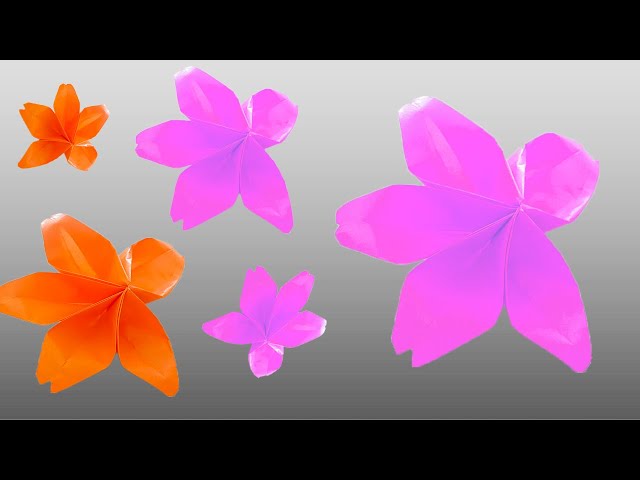
Let’s make a three-dimensional cherry blossom using a single square sheet of origami paper.
Fold the paper into a triangle, and create crease lines as you shape it into a cherry blossom.
When cutting with scissors, be careful not to make mistakes—cut along the fold lines.
Once you open it up, fold along the creases so it forms a three-dimensional flower shape.
Using a toothpick to lift and shape the petals may help the process go more smoothly.
Changing the color of the origami to make colorful cherry blossoms could make it brighter and more fun.

Sakura hanging ornaments

Let’s bring a spring breeze into your room with hanging cherry blossom decorations.
In this idea, you fold origami into a specified shape, draw half a petal design, and cut away the excess with scissors.
Make four identical pieces, sandwich a string at the center, glue them together, and you’ll have a finished ornament.
To form the specified origami shape, first fold it into a triangle, then overlap the left and right sides and fold into a triangle again to create a crease.
Unfold it once the crease is made.
Next, fold the top corner down to meet the bottom edge, make a crease, and unfold again.
Fold the top corner once more along the crease you just made and crease it.
Then, fold the right side of the paper inward along the line that connects the very bottom of the vertical centerline to the far right end of the most recent crease.
Fold it back outward along the crease, and repeat the same steps on the left side.
You’re done!

Cute three-dimensional cherry blossoms!

Three-dimensional decorations really catch the eye at various events! This cherry blossom made with five sheets of origami lets you enjoy both depth and realism.
First, fold the origami into a triangle, then fold both ends up toward the center.
Crease from the lifted sections toward the outer edges, and open each one into a pocket shape along those creases.
Fold the protruding parts inward and fold the whole piece in half, then apply glue to the folded section to shape it into a rounded, bouquet-like form.
That completes one cherry blossom petal; make five of these and glue them together to finish the cherry blossom.
You can hang it, set it down, and display it in various ways!

Assemble and cute cherry blossom origami

Prepare five sheets of origami paper and fold them to make a three-dimensional cherry blossom you’ll want to show off when it’s finished.
Fold the paper into a triangle, then fold the left and right corners toward the center line.
Fold the top triangular tip downward, then fold both sides further toward the center.
Fold the tip of the center section up to meet the top corner and tuck it into the pocket.
Shape the whole piece into a cherry blossom petal and open the pocketed section to create a 3D form—one petal is complete.
Make five petals in the same way, glue them together, and you’ll have one cherry blossom.
The blossom’s three-dimensional look and color will enhance the feeling of spring.
Display it in your room or entryway and enjoy the season.