

Difficult Piano Pieces: From Classical to Jazz Piano
For those with a deep appreciation for the piano, there often comes a time—once a certain level of knowledge and technique has been acquired—when they gravitate toward listening to more challenging pieces.
Among the many genres, classical and jazz piano in particular feature numerous highly demanding works that have long stood as formidable obstacles for many performers.
This time, we’ve picked out some especially difficult piano pieces.
From jazz piano that emphasizes rapid runs, to classical works with extreme leaps in the scale, and even contemporary classical pieces that combine both traits, we’ve selected from a wide range of styles—so be sure to check them out.
Playlist
| Difficult Piano Pieces: From Classical to Jazz Piano | |||
|---|---|---|---|
| show_chart | Title | Playlist | Review |
| 1 | ToccatinaNikorai Kapūsuchin |  play_arrow play_arrow | Toccattina of high difficulty composed by Kapustin |
| 2 | RailwaySharuru=Varantan Arukan |  play_arrow play_arrow | Alkan’s piece “Le chemin de fer” (The Railroad) is highly difficult. |
| 3 | Transcendental Études No. 5 “Feux follets” (Will-o’-the-Wisps)Furantsu Risuto |  play_arrow play_arrow | An extremely difficult piece at the very top of the most important list for fingerwork |
| 4 | IslameyMirii Barakiefu |  play_arrow play_arrow | Balakirev’s fiendishly difficult piece, Islamey |
| 5 | Turkish MarchVorufuganggu Amadeusu Mōtsaruto |  play_arrow play_arrow | Mozart’s “Turkish March” is a difficult piece that requires dexterous fingerwork. |
| 6 | Mephisto WaltzFurantsu Risuto |  play_arrow play_arrow | Liszt’s difficult piece, Mephisto Waltz |
| 7 | Grand Cadenza of Piano Concerto No. 3Serugei Rafumaninofu |  play_arrow play_arrow | Rachmaninoff’s notoriously difficult piano concerto |
| 8 | La CampanellaFurantsu Risuto |  play_arrow play_arrow | A masterpiece by Liszt that requires a high level of artistry |
| 9 | SpainChikku Koria |  play_arrow play_arrow | The allure of Chick Corea’s masterpiece, Spain |
| 10 | 12 Etudes, Op. 25 No. 6Furederikku Shopan |  play_arrow play_arrow | Chopin’s difficult piece, Etude Op. 25 No. 6 |
| 11 | Transcendental Études No. 4 “Mazeppa”Furantsu Risuto |  play_arrow play_arrow | Liszt’s Transcendental Études, which demand high endurance |
| 12 | Concerto for piano soloSharuru=Varantan Arukan |  play_arrow play_arrow | Highly difficult piano pieces composed by Alkan |
| 13 | Etude Collection for Piano, Volume 2, No. 13: “Devil’s Staircase”Rigeti Jeruju |  play_arrow play_arrow | Ligeti’s experimental piano piece |
| 14 | Piano Sonata No. 5Arekusandoru Sukuryābin |  play_arrow play_arrow | A highly difficult piano sonata composed by Scriabin |
| 15 | Three Movements from PetrushkaĪgoru Sutoavinsukī |  play_arrow play_arrow | Three Movements from Petrushka, Stravinsky’s challenging piece |
| 16 | Piano Concerto No. 2Serugei Purokofiefu |  play_arrow play_arrow | Prokofiev's Piano Concerto No. 2 is particularly difficult. |
| 17 | Wanderer FantasyFurantsu Shūberuto |  play_arrow play_arrow | Struggling to compose a difficult Schubert piece |
| 18 | Gaspard of the NightMōrisu Raveru |  play_arrow play_arrow | Ravel’s fiendishly difficult Gaspard de la nuit |
| 19 | Chromatic Grand GallopFurantsu Risuto |  play_arrow play_arrow | Introduction of difficult piano pieces in the list |
| 20 | Revolutionary ÉtudeFurederikku Shopan |  play_arrow play_arrow | Technical Virtuosity and Artistic Expression in Chopin’s Revolutionary Étude |
| 21 | Concert Paraphrase on Rigoletto, S.434Franz Liszt |  play_arrow play_arrow | Rigoletto Concert Paraphrase |
| 22 | Spanish Suite No. 1, Op. 47 ‘Asturias’Isaac Albéniz |  play_arrow play_arrow | Captivating piano works of the Spanish Suite |
| 23 | Toccata from Le Tombeau de CouperinMaurice Ravel |  play_arrow play_arrow | Ravel’s masterpiece commemorating World War I, an innovation in Baroque style |
| 24 | From Eight Concert Etudes: No. 8 “Finale”Nikolai Kapustin |  play_arrow play_arrow | A Captivating Fusion of Jazz and Classical |
| 25 | Kreisleriana, Op. 16 No. 7Robert Schumann |  play_arrow play_arrow | A passionate minor-key piece: Schumann’s anguish |
| 26 | Concert Etudes, 8 Pieces: No. 5 “Joke”Nikolai Kapustin |  play_arrow play_arrow | A fusion piece of classical and jazz |
| 27 | 4 Etudes No. 4, Op. 7-4 in F-sharp majorIgor Stravinsky |  play_arrow play_arrow | A lively and innovative short musical piece that captivates listeners |
| 28 | Twelve Etudes in All Minor Keys No. 2 in D minor, in a Morossian rhythmCharles Valentin Alkan | 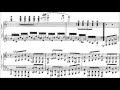 play_arrow play_arrow | A piano solo piece characterized by triple meter |
| 29 | Scherzo Focoso, Op. 34Charles Valentin Alkan |  play_arrow play_arrow | A magnificent piano piece where advanced technique and passion intertwine |
| 30 | Concert Etude “Knight,” Op. 17Charles Valentin Alkan |  play_arrow play_arrow | Alkan’s masterpiece piano piece |
| 31 | Children’s Corner No. 4: “The Snow Is Dancing”Claude Debussy |  play_arrow play_arrow | A snowy scene depicted from a child's perspective |
| 32 | Three Concert Études, S.144 No. 2 “Lightness”Franz Liszt |  play_arrow play_arrow | Liszt’s Concert Études, difficulty: advanced level |
| 33 | “Arpeggio,” No. 4 from the Grandes études de PaganiniFranz Liszt |  play_arrow play_arrow | Liszt, Grand Piano Variations on a Theme of Paganini |
| 34 | “Grandes études de Paganini,” No. 6: “Theme and Variations”Franz Liszt |  play_arrow play_arrow | A masterpiece of piano arrangement of a work by Paganini |
| 35 | Hungarian Rhapsody No. 2Franz Liszt |  play_arrow play_arrow | Liszt’s fiendishly difficult piece, “Hungarian Rhapsody” |
| 36 | Hungarian Rhapsody No. 6Franz Liszt |  play_arrow play_arrow | Hungarian Rhapsody No. 6 is advanced difficulty |
| 37 | Grandes études de Paganini, S.141 No. 3 “La Campanella”Franz Liszt |  play_arrow play_arrow | Liszt’s extremely difficult piece La Campanella |
| 38 | Mephisto Waltz No. 1, S.514 “Dance in the Village Inn”Franz Liszt |  play_arrow play_arrow | Introduction to Liszt’s Passionate Waltz Pieces |
| 39 | Years of Pilgrimage, Book II: Italy, S.161 — No. 7 “Après une lecture de Dante – Fantasia quasi Sonata”Franz Liszt |  play_arrow play_arrow | Liszt: Années de pèlerinage – Italy. For a recital. |
| 40 | Transcendental Étude No. 5 “Will-o’-the-Wisp”Franz Liszt |  play_arrow play_arrow | Liszt's Feux follets, a masterpiece of transcendental technique and poetic expression |
| 41 | Transcendental Etude No. 7 ‘Heroic’Franz Liszt |  play_arrow play_arrow | Introduction to the Difficult Piece: Liszt’s Transcendental Étude No. 7 |
| 42 | 12 Etudes, Op. 10 No. 2Frederic Chopin |  play_arrow play_arrow | Chopin’s études require finger flexibility. |
| 43 | 12 Etudes Op. 25-6Frederic Chopin |  play_arrow play_arrow | Chopin’s difficult piece; the thirds (interval chords) are hard. |
| 44 | Etude Collection (Studies) No. 4, Op. 10-4 in C-sharp minorFrederic Chopin |  play_arrow play_arrow | Passionate music with advanced technique is captivating. |
| 45 | Ballade No. 1 in G minor, Op. 23Frederic Chopin |  play_arrow play_arrow | Chopin’s Ballade No. 1 is difficult for the right hand. |
| 46 | The Rite of SpringIgor Stravinsky |  play_arrow play_arrow | A musical revolutionary work by The Rite of Spring |
| 47 | Goldberg Variations (Aria and 30 Variations), G major, BWV 988J.S.Bach |  play_arrow play_arrow | A famous piece by Bach, notable for its difficult octaves |
| 48 | Gaspard of the Night, No. 1: OndineMaurice Ravel |  play_arrow play_arrow | Introducing Ravel’s piano piece “Ondine” |
| 49 | Gaspard de la nuit, No. 3: ScarboMaurice Ravel |  play_arrow play_arrow | Ravel’s formidable piece Scarbo demands expressive power. |
| 50 | Play of WaterMaurice Ravel |  play_arrow play_arrow | Ravel's 'Jeux d'eau' requires advanced expressive capability. |
| 51 | 15 Virtuoso Études, Op. 72 No. 2Moritz Moszkowski |  play_arrow play_arrow | A Romantic masterpiece, where virtuosity and expressiveness shine. |
| 52 | Eight Concert Etudes, Op. 40: No. 1 “Prelude”Nikolai Kapustin |  play_arrow play_arrow | Kapustin’s jazz-classical fusion piece |
| 53 | Eight Concert Etudes, Op. 40: No. 3 “Toccatina”Nikolai Kapustin |  play_arrow play_arrow | Introduction to Kapustin’s Difficult Piece, Toccattina |
| 54 | Toccata in C major, Op. 7Robert Schumann |  play_arrow play_arrow | Performance Techniques for Schumann’s Fiendishly Difficult Toccata |
| 55 | 12 Transcendental Etudes, Op. 11: No. 10 “Lezginka”Sergey Lyapunov, |  play_arrow play_arrow | Lyapunov’s Transcendental Etudes |
| 56 | 12 Transcendental Etudes, Op. 11 No. 10 “Lezginka”Sergey Lyapunov, |  play_arrow play_arrow | Lyapunov: Caucasian Folk Dance |
| 57 | Turkish MarchWolfgang Amadeus Mozart | play_arrow | A masterpiece influenced by Turkish-style music |
| 58 | Champion CynthiaMasuda Junichi |  play_arrow play_arrow | A grand composition whose powerful piano melody stirs the heart |
| 59 | Etude ‘Railway’ Op.27bCharles Valentin Alkan |  | An étude by Alkan themed on railways, of high difficulty |
| 60 | TARKUS for pianoEmerson Lake&Palmer |  | A piano arrangement of a progressive rock masterpiece |
| 61 | Grand Etudes after Paganini, No. 3 ‘La Campanella’Franz Liszt |  play_arrow play_arrow | Liszt’s masterpiece with the highest difficulty among his études |
| 62 | Piano Sonata in B minor, S.178Franz Liszt |  play_arrow play_arrow | Liszt's piano sonata requires highly advanced technique |
| 63 | Piano Sonata No. 23, Op. 57 “Appassionata,” Third MovementLudwig van Beethoven |  play_arrow play_arrow | The third movement of Beethoven’s Piano Sonata “Appassionata” |