

[For Intermediate Players] Challenge Yourself! Recommended Masterpieces That Shine at Piano Recitals


A recital you perform in after you’ve been playing piano for a good while.
Based on having participated a few times already, this may be the time when ideals for your recital piece start to take shape—like “I want to play that piece I heard last year!” or “I’ve played a lot of slow, relaxed pieces so far, but I want to try something up-tempo!”
In this article, we’ll introduce piano pieces that really shine on stage and are perfect for players who have cleared the beginner level and are moving into the intermediate range.
We hope this helps you choose your next recital piece as you compare options with your own ideals in mind.
- [Intermediate Level] Cool Piano Pieces You Can Play [Great for Recitals Too]
- [Piano Recital] Perfect Pieces for Middle Schoolers! A Curated Selection of Impressive, Audience-Pleasing Works
- [For Adults] Recommended for Piano Recitals! A Curated Selection of Impressively Sounding Masterpieces
- [Intermediate Level] A curated selection of piano masterpieces featuring strikingly brilliant melodies!
- Piano Masterpieces: Surprisingly Easy Despite Sounding Difficult!? A Curated Selection Perfect for Recitals
- [For Advanced Players] A Curated Selection of Classical Masterpieces to Tackle at Piano Recitals
- [Piano Recital] Recommended for Boys! A Curated Selection of Cool, Impressive, and Popular Pieces
- [For Elementary School Students] Brilliant, Showy Masterpieces That Sound Impressive at Piano Recitals
- [Intermediate] Recommended Piano Duets | A Curated Selection of Cool and Dazzling Pieces
- Beginner to Intermediate: Chopin pieces with relatively low difficulty. Recommended works by Chopin.
- [Low Difficulty] Recommended Tchaikovsky Piano Pieces [Intermediate]
- [Piano Recital] Recommended for Middle Schoolers! A Comprehensive Introduction to Classical Masterpieces
- For Advanced Players: Showstopping Classics to Play at a Piano Recital
[For Intermediate Players] Challenge! Recommended Masterpieces That Sound Impressive at Piano Recitals (21–30)
Consolation (Comfort) No. 3Franz Liszt

One piece from Consolations, a piano collection composed by the piano magician Franz Liszt.
Unlike many of Liszt’s other works that require his signature “transcendental virtuosity,” this set contains more serene pieces and is known for being relatively approachable within his oeuvre.
No.
3 is especially famous and is a popular choice for recitals.
Aim for evenness in the left-hand accompaniment, sing out the elegant melody, and perform with deep expression.

Etude Op.10 No.3 “Farewell”Frederic Chopin

Among the highly artistic études composed by Frédéric Chopin, the Etude Op.
10 No.
3, known as “Tristesse” (“Farewell”), is particularly well-known and is used in a variety of contexts such as television, commercials, and films.
With its beautiful melodic line and elegant rhythm, it is a soothing masterpiece that captivates listeners.
While the theme section is relaxed, the middle section gradually gains motion and brings a succession of chords that require advanced technique.
Although it is called an étude, it is perfect not only for finger training but also for honing expressiveness and musicality.
With future advancement in mind, be sure to take on the challenge!
Holberg Suite No. 1: PreludeEdvard Grieg

Edvard Grieg, the Norwegian-born genius of the Romantic era.
In 1884, he composed this masterpiece to commemorate the 200th anniversary of the birth of Norwegian intellectual Ludvig Holberg.
The work consists of five movements modeled after a Baroque suite, with the first being a vigorous prelude.
It overflows with a lofty atmosphere reminiscent of Bach’s works, and its sparkling melodies are sure to capture the audience’s heart.
By steadily building your finger technique and working carefully, you’ll be able to fully express its dazzling world.
Why not practice with the image of performing confidently at a recital?
Two Rhapsodies, Op. 79 No. 1Johannes Brahms

Johannes Brahms’s masterpiece, Two Rhapsodies Op.
79 No.
1.
It’s a piece you often hear at piano recitals featuring junior high and high school students.
Overall, it ranks at an advanced level of difficulty, but somewhat surprisingly, there aren’t many finger crossovers and the hand positions are stable, so it may feel relatively approachable to play.
That said, as the piece unfolds, you’ll find markings like both crescendo and diminuendo on a single note, which tends to test fundamental piano performance techniques.

Fantaisie-Impromptu in C-sharp minor, Op. 66Frederic Chopin

Among Chopin’s works, this piece is well known and popular at competitions and recitals.
It was originally a piece that was never meant to be released, but after Chopin’s death, it came to light when his friend Julian Fontana had it published.
The contrast between the fast passages at the beginning and the tranquility in the middle is beautiful.
The rapid playing right from the start is considered difficult, but move your fingers slowly and let your body learn it.
With the piano, practice is everything!

ParadeMaurice Ravel
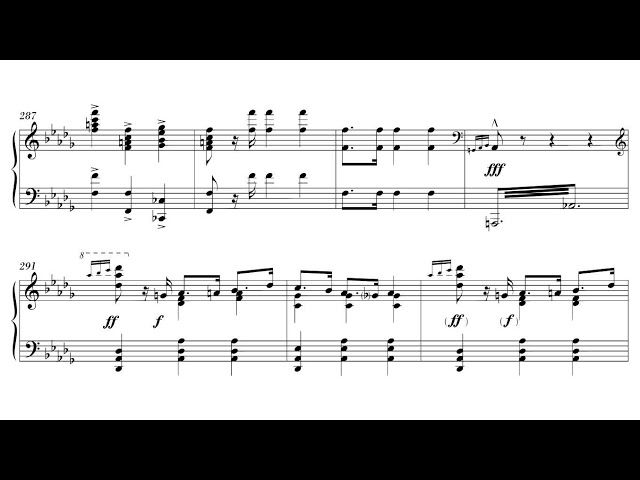
A piece whose powerful, dramatic sound stirs the listener’s heart, as if heralding the beginning of a grand tale.
It is a work by Toshio Horiuchi, who teaches in Hiroshima Prefecture and has composed numerous band pieces.
From the delicate interplay of sounds in the quiet sections to the breathtaking build toward a climax where the full ensemble charges forward as one, the piece offers a deeply immersive experience—like living through the prologue of a legend in music.
Composed in 2006 as a set piece for the All Japan Band Competition, it is featured in the album “Reference Performances of Set Pieces for the All Japan Band Competition 2005‑2008.” Demanding not only individual technique but the expressive power of the entire band, this masterpiece is one you’ll want to perform when you and your ensemble wish to weave a single, sweeping story together.
Fantasy Pieces: Flight, Op. 12 No. 2Robert Schumann

Robert Schumann’s masterpiece “Fantasiestücke, No.
2 ‘Aufschwung,’ Op.
12.” It’s often performed at piano recitals, so many of you may be familiar with it.
In terms of difficulty, it’s slightly harder than Chopin’s ‘Minute Waltz,’ making it a popular choice as a piece for intermediate players.
A key point in this work is the right hand from measure 17.
If you focus too much on clearly bringing out the top voice, the sound can become hard, so try to play with an awareness of the horizontal flow.