

[For Intermediate Players] Challenge Yourself! Recommended Masterpieces That Shine at Piano Recitals


A recital you perform in after you’ve been playing piano for a good while.
Based on having participated a few times already, this may be the time when ideals for your recital piece start to take shape—like “I want to play that piece I heard last year!” or “I’ve played a lot of slow, relaxed pieces so far, but I want to try something up-tempo!”
In this article, we’ll introduce piano pieces that really shine on stage and are perfect for players who have cleared the beginner level and are moving into the intermediate range.
We hope this helps you choose your next recital piece as you compare options with your own ideals in mind.
- [Intermediate Level] Cool Piano Pieces You Can Play [Great for Recitals Too]
- [Piano Recital] Perfect Pieces for Middle Schoolers! A Curated Selection of Impressive, Audience-Pleasing Works
- [For Adults] Recommended for Piano Recitals! A Curated Selection of Impressively Sounding Masterpieces
- [Intermediate Level] A curated selection of piano masterpieces featuring strikingly brilliant melodies!
- Piano Masterpieces: Surprisingly Easy Despite Sounding Difficult!? A Curated Selection Perfect for Recitals
- [For Advanced Players] A Curated Selection of Classical Masterpieces to Tackle at Piano Recitals
- [Piano Recital] Recommended for Boys! A Curated Selection of Cool, Impressive, and Popular Pieces
- [For Elementary School Students] Brilliant, Showy Masterpieces That Sound Impressive at Piano Recitals
- [Intermediate] Recommended Piano Duets | A Curated Selection of Cool and Dazzling Pieces
- Beginner to Intermediate: Chopin pieces with relatively low difficulty. Recommended works by Chopin.
- [Low Difficulty] Recommended Tchaikovsky Piano Pieces [Intermediate]
- [Piano Recital] Recommended for Middle Schoolers! A Comprehensive Introduction to Classical Masterpieces
- For Advanced Players: Showstopping Classics to Play at a Piano Recital
[For Intermediate Players] Challenge! Recommended Masterpieces That Sound Impressive at Piano Recitals (41–50)
Sicilienne, Op. 78Gabriel Fauré

A short and graceful piece composed in 1893 by Gabriel Fauré, one of France’s foremost composers.
Originally written as orchestral music for the theater, it was later arranged for cello and piano.
Based on the dance form known as the siciliana, the work is characterized by a gentle, flowing, and beautiful melody.
By cherishing its elegant atmosphere and being mindful of the moments of silence, performers can achieve an interpretation that combines stage-worthy delicacy with profound emotional depth.
[For Intermediate Players] Challenge! Recommended Masterpieces That Sound Impressive at Piano Recitals (Nos. 51–60)
Piano Sonata No. 12 in F major, K. 332 (K6 300k), No. 1Wolfgang Amadeus Mozart

This is a work whose elegant melodies and rhythms, left by a genius of the Classical era, resonate deeply in the heart.
Composed in 1783 and structured in three movements, it is notable for its refreshing F-major sonority and gentle variations.
The beautiful music, woven from an approachable theme and refined counterpoint, is sure to soothe listeners.
The second movement, which was also used in the film “Immortal Beloved,” is characterized by delicate ornamentation and a richly expressive melody.
Combining Mozart’s characteristic brightness and lightness with technical intrigue, this piece is recommended for everyone who enjoys playing the piano.
Impromptu, Op. 90 No. 4Franz Schubert

An impromptu by Franz Schubert, captivating for its graceful melodies and richly expressive harmonies.
Composed in 1827, this work is renowned as a masterpiece that epitomizes Schubert’s mature period.
It begins with arpeggios, and in the middle section the tonality shifts, drawing listeners into a dreamlike musical journey.
Its delicate yet powerful melody will further enhance the performer’s expressive range.
It’s also a highly recommended piece for those looking to refine their piano technique.
Lyric Pieces, Book VIII, Op. 65: No. 6, Wedding Day at TroldhaugenEdvard Grieg

Wedding Day at Troldhaugen, included in the eighth book of Lyric Pieces—a collection of piano works that Norwegian composer Edvard Grieg wrote over more than 30 years.
Troldhaugen is the name of the place where Grieg and his wife Nina lived, and this piece is dedicated to Nina.
The various themes in the piece differ completely in both tempo and character, making it ideal for developing expressive skills.
If you imagine specific scenes in your own way as you play, you’ll be able to perform with greater emotional richness.

Humoresques, Op. 101 No. 7Antonin Dvořák

Antonín Dvořák’s masterpiece, “Eight Humoresques,” is notable for its gentle, relaxed melodies.
This time, I’d like to introduce No.
7 from the set, “Eight Humoresques, Op.
101.” The key points of this piece are the score reading and the modulation section.
As for reading the score, it presents quite a challenge for beginners.
And then there’s the modulation: octaves appear suddenly, so be sure to warm up your fingers well before tackling it.

Impromptu FP 176 No. 15 in C minor “In Praise of Édith Piaf”Francis Poulenc
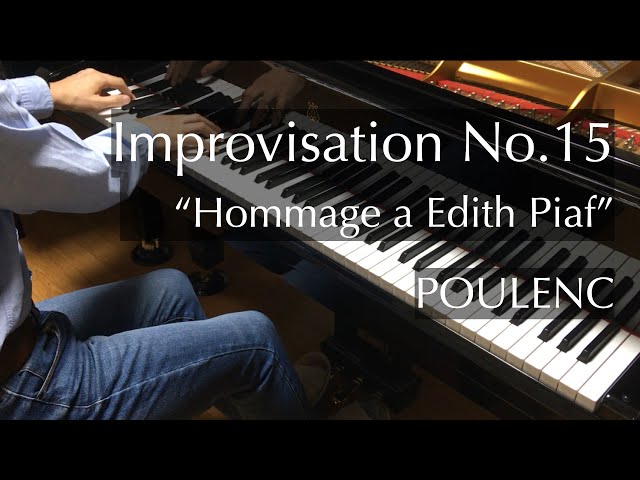
Francis Poulenc’s masterpiece, Impromptu FP 176 No.
15 in C minor “Hommage à Édith Piaf.” Édith Piaf, the quintessential French chanson singer.
This piece embodies Poulenc’s deep respect for the beloved Piaf.
In terms of difficulty, it’s somewhere between D and E on the PianoVerse scale.
The way you execute the grace notes will greatly affect the overall result, so it’s best to practice with particular attention to them.
Impromptu, Op. 90 No. 2Franz Schubert

One of Franz Schubert’s most captivating works is Impromptu Op.
90 No.
2.
With its flowing triplet scales and beautiful melody, it leaves a strong impression.
The dramatic contrast between major and minor keys draws listeners in.
Composed in 1827, this piece shines on the recital stage, combining elegance with expressive depth.
It’s also a work where you can really feel your technique improving—why not give it a try?