

How Much Do You Know? Food Quiz for Elementary School Students

We’ve put together a collection of quizzes all about food!
These quizzes cover seasonal vegetables and fruits, meat and fish, and fun trivia related to food—carefully selected so that elementary school students can enjoy solving them with interest.
Most are multiple-choice with three options, so give them a try without any pressure.
By learning through quizzes, we can foster gratitude for life and appreciation for the producers who make our food possible.
As a first step in food education, let’s have fun building knowledge through quizzes!
- [3-Choice Quiz] A quiz about foods that will make you hungry
- [Food Edition] Who Am I? Quiz Collection
- Quiz for elementary school students: Easy! Fun! Question collection
- Deepen your knowledge of food! A three-choice trivia quiz
- [Common Sense & Trivia] True-or-False Quiz with Knowledge for Elementary School Students
- [Knowledge Expander!] A Three-Choice Quiz about Fish for Elementary School Students
- Trivia and fun facts about food (summary)
- [For Elementary School Students] Animal Quiz to Learn Knowledge and Fun Facts
- [For Kids] November Trivia Quiz & Fun Facts: Let’s Learn While Having Fun!
- [Fun with Kids] Food Silhouette Quiz
- Become a trivia master with a multiple-choice quiz for elementary schoolers! A fun problem collection that captivates both kids and adults
- Trivia quiz with useful tips to know: fun facts that come in handy at school or at home [for kids]
- September Trivia Quiz & Fun Facts! A Fun Autumn Quiz for Kids
How much do you know? Food Quiz for Elementary School Students (1–10)
What’s the difference between white konnyaku and black konnyaku?

- taste
- hardness
- same
See the answer
same
They may look completely different, but the taste and texture are exactly the same. In the traditional method of making konnyaku from raw konjac tubers, seaweed is intentionally mixed into black konnyaku to mimic the original appearance, and those black specks are the seaweed.

What are the characteristic nutrients that are abundant in cabbage?

- Vitamin C
- Vitamin U
- Calcium
See the answer
Vitamin U
Vitamin U, which is abundant in cabbage, is also known as cabagin. Haven’t you heard it in commercials for stomach medicine? Cabagin is a nutrient that helps prevent gastric and duodenal ulcers, and it is also used in medications and treatments.
What do you call fish like sea bass, Spanish mackerel, and yellowtail whose names change as they grow?

- grown fish
- a fish that is called by different names as it grows (literally, “career-advancing fish”); e.g., Japanese amberjack/yellowtail (buri)
- evolution fish
See the answer
a fish that is called by different names as it grows (literally, “career-advancing fish”); e.g., Japanese amberjack/yellowtail (buri)
The names of “shusse-uo” (career fish) change depending on their size and length. The yellowtail (buri), which is eaten as sashimi or in hot pot, has as many as five different names from juvenile to adult. The names and size ranges also vary by region.
How Much Do You Know? Food Quiz for Elementary School Students (11–20)
What is the meaning of eating toshikoshi soba on New Year’s Eve?

See the answer
Something that prayed for longevity and health
The most common explanation is that because soba noodles are thin and long, they are eaten to pray for health and longevity. Another interpretation is that, since soba noodles break easily, they symbolize cutting off bad ties and severing the misfortunes of the past year.
By the name of which flower is wild boar meat also known?

- cherry blossom
- maple leaves
- Button
See the answer
Button
Boar meat is likened to the peony flower and called by that name because of its deep red color. It’s well known that boar hot pot is called “botan nabe.” “Momiji” refers to venison, and “sakura” refers to horse meat.
Which of these vegetables are in season in winter?
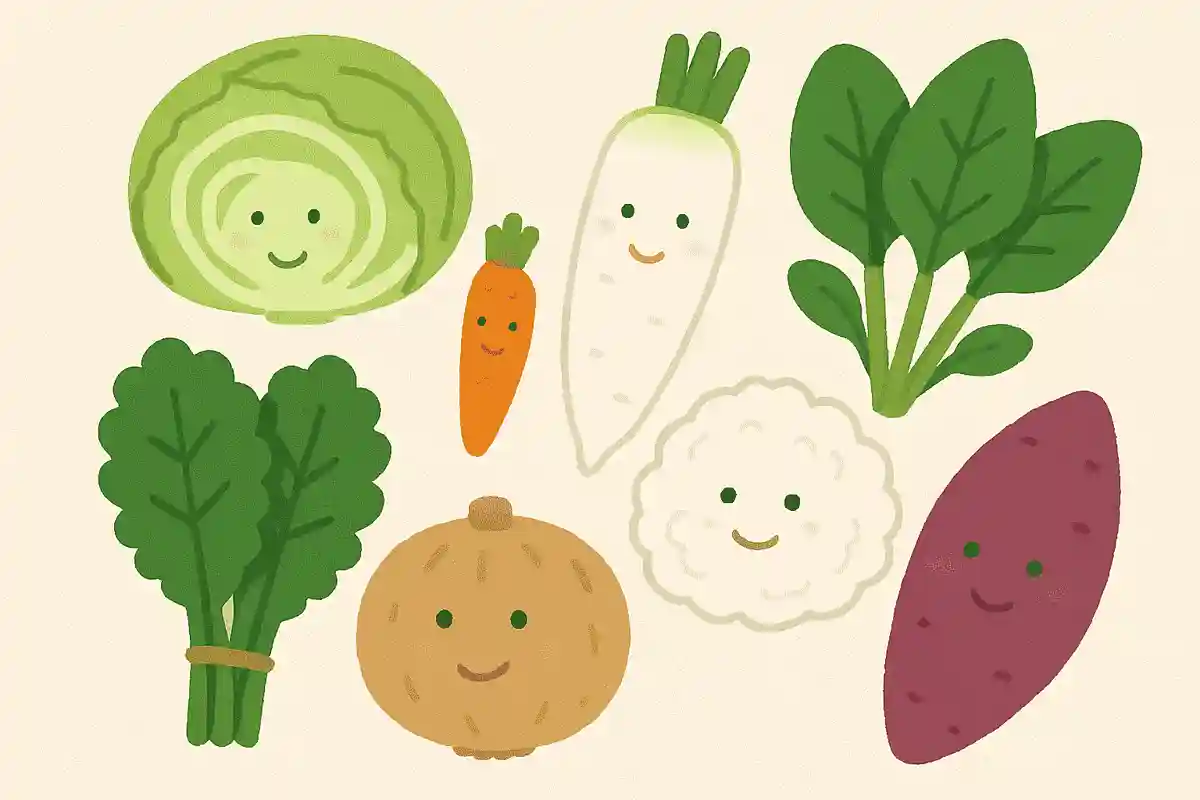
- Chinese cabbage
- onion
- asparagus
See the answer
Chinese cabbage
When you think of hakusai (Chinese cabbage), what comes to mind is hot pot ingredients, right? These days it’s sold year-round, but its peak season is winter—October through February is when it tastes best. There are plenty of delicious ways to enjoy it besides hot pot; it’s even tasty raw in salads.
What is the film that forms on the surface when you heat milk made of?

- protein
- Calcium
- iron (dietary iron / iron content)
See the answer
protein
That film that forms when you heat milk is actually coagulated protein. Proteins have the property of solidifying when heat is applied; in the case of milk, heating causes the proteins to trap fat, forming a skin. You can eat the skin as is!