

[For Elementary School Students] Brain Training with Kanji Decomposition Quiz! Guess the Complete Kanji from Its Parts

Each kanji character hides an interesting origin of its own.
By learning how they came to be, kanji feel more familiar and become easier to remember naturally.
How about trying a kanji breakdown quiz with your elementary school child? Splitting kanji into radicals and parts to figure out the completed character is as fun as solving a puzzle.
Even kanji that look difficult can become simple and fascinating once you break them down! This time, we’ll introduce kanji breakdown quizzes that elementary school students can enjoy.
- Where Do You Split It? A Word-Splitting Quiz That Even Elementary Schoolers Love
- A four-character idiom quiz that elementary schoolers will love! Questions become fun once you understand the meanings
- Learn by Playing! Recommended Games with a Kanji Theme
- [For Elementary School Students] Country Names in Kanji Quiz. A quick, fun quiz
- [For Elementary Students] Flower Kanji Quiz! How many flowers do you know?
- The world’s fewest: A collection of one-stroke kanji. Learn them in a quiz format!
- [For Elementary School Students] Cipher Quiz: Fun Puzzle Riddles
- Recommended for lower grades! A fun, educational quiz for elementary school students
- A quiz of interesting obscure kanji: characters that look easy but are hard to read
- [Interesting] Summary of Kanji Reading Quiz Questions
- [Satisfying When Solved] Challenging Quizzes Recommended for Elementary School Students!
- Recommended for upper grades! A fun, educational quiz for elementary school students
- [Hard-to-Read Quiz] Single-character difficult kanji — including surprisingly simple ones!
[For Elementary School Students] Brain Training with Kanji Decomposition Quiz! Guess the Complete Kanji from Its Parts (1–10)
stand + sun/day
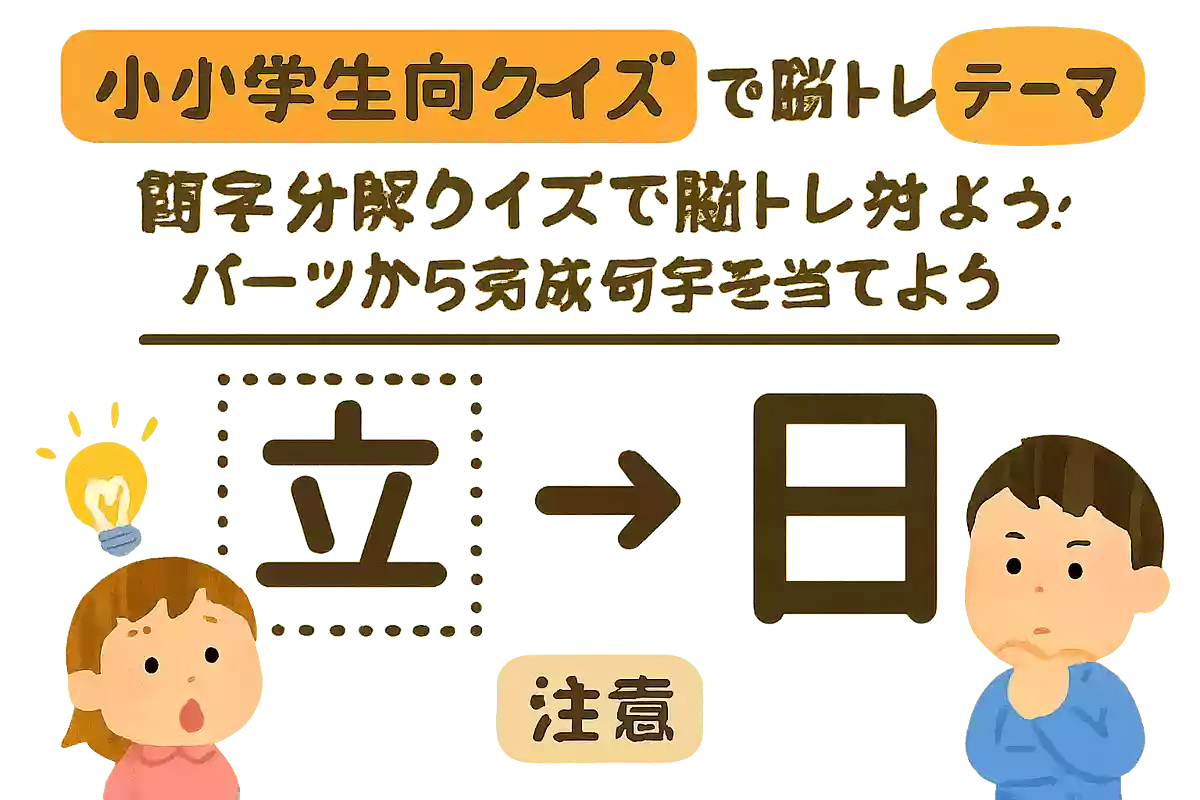
It’s something you can hear with your ears.
See the answer
sound
With the combination of “立” (stand) and “日” (sun), the kanji 音 (sound) is completed. 音 is a kanji learned in the first grade of elementary school. The origin of the kanji comes from 言 and 一. It seems that the 立 and 日 inside the kanji 音 are not actually the source. In fact, 言 carries the meaning of words of prayer to the gods and the act of making a vow to them. The mouth component in 言 is said to represent a lidded container for holding the prayer text or norito recited to the gods. Sensing the gods’ reply to the prayer kept in that container as “sound” is said to be the origin of 音.

horn + sword/knife + cow/ox
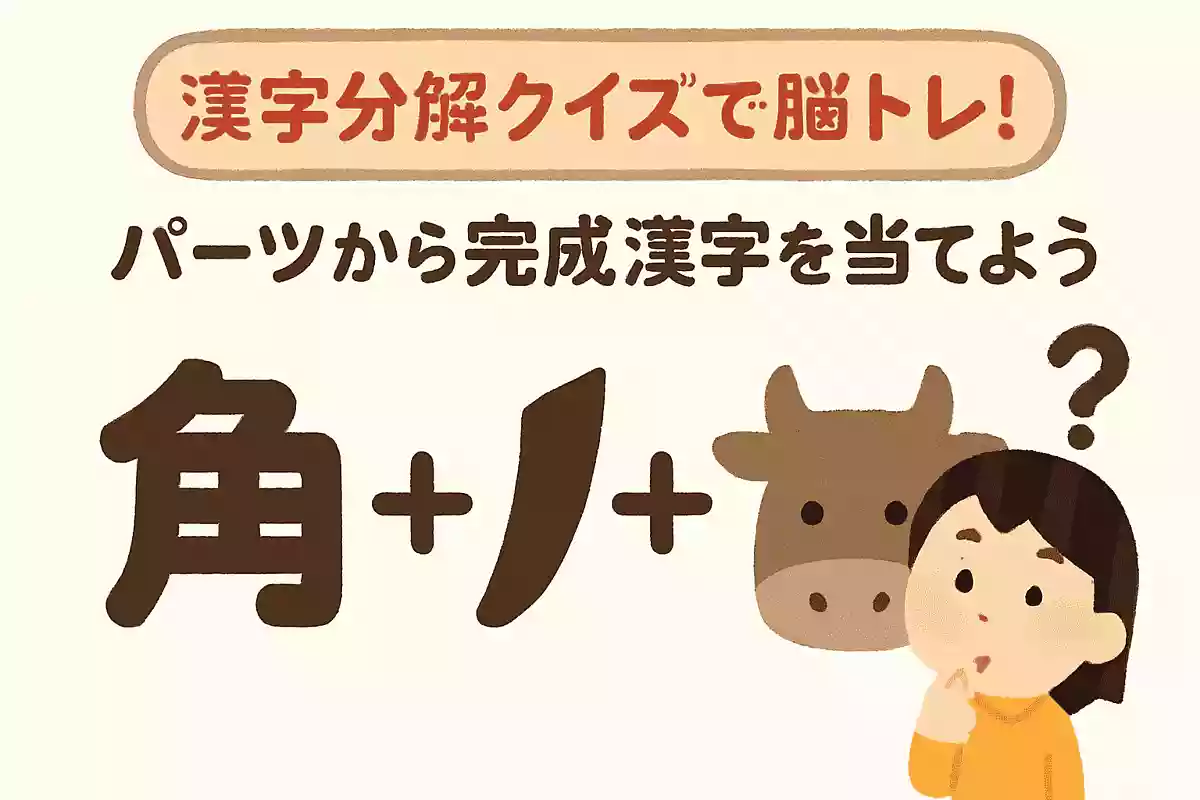
It’s a kanji that means “to divide” or “to break into pieces.”
See the answer
Solution
The kanji formed by combining “horn” (角), “sword” (刀), and “cow” (牛) is 解. In addition to the fun of solving puzzles by breaking kanji into radicals and parts and assembling them, it’s also key that you can make associations from the meanings of each component. Focusing on the meanings and connections of the characters provides clues that lead you to the answer. It’s a brain-training puzzle for elementary school students that lets you enjoy using your head.

Tree + Eye + Heart
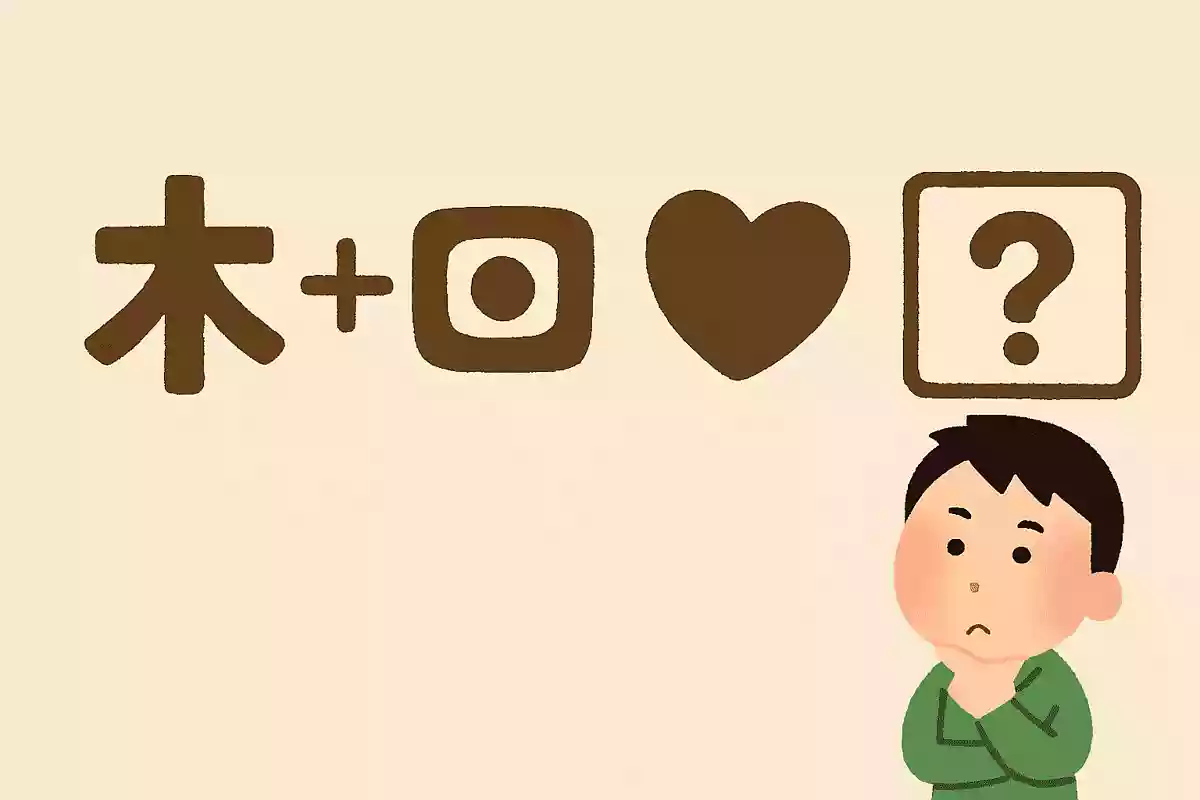
You use it when you think about someone with your heart.
See the answer
thought
The character 想 is made up of the kanji for “tree,” “eye,” and “heart.” Since it contains the “heart” radical, it perfectly matches the image of what 想 expresses. 想 describes the act of calling to mind someone else. You can sense the image of picturing a person’s form or appearance in your heart. Compared to 思う, which is read the same way (“omou”), 想 is used when stronger feelings or emotions are involved.
[For Elementary School Students] Brain Training with Kanji Decomposition Quiz! Guess the Complete Kanji from the Parts (11–20)
me + cloth + deceased + moon + king
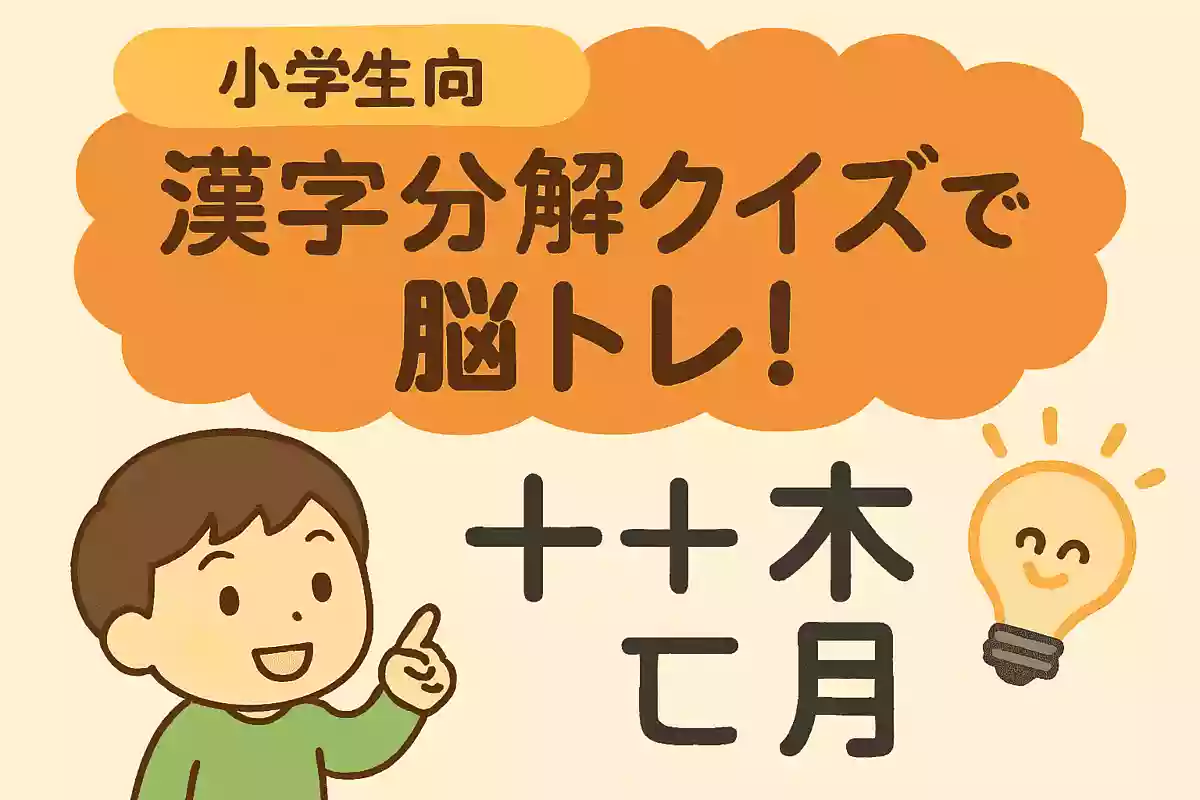
An idiom used when wishing or hoping for something. To ◯◯ participating in the training camp.
See the answer
hope
The kanji formed by combining 'メ' and '布', and '亡', '月', and '王' is '希望' (hope). The moment when scattered characters fit together perfectly is as exciting as solving a magical puzzle! If you play while thinking about the connections between kanji, your mind becomes more and more active as you have fun. It’s a brain-training challenge that elementary school students can get hooked on.
mouth + big + heart + person
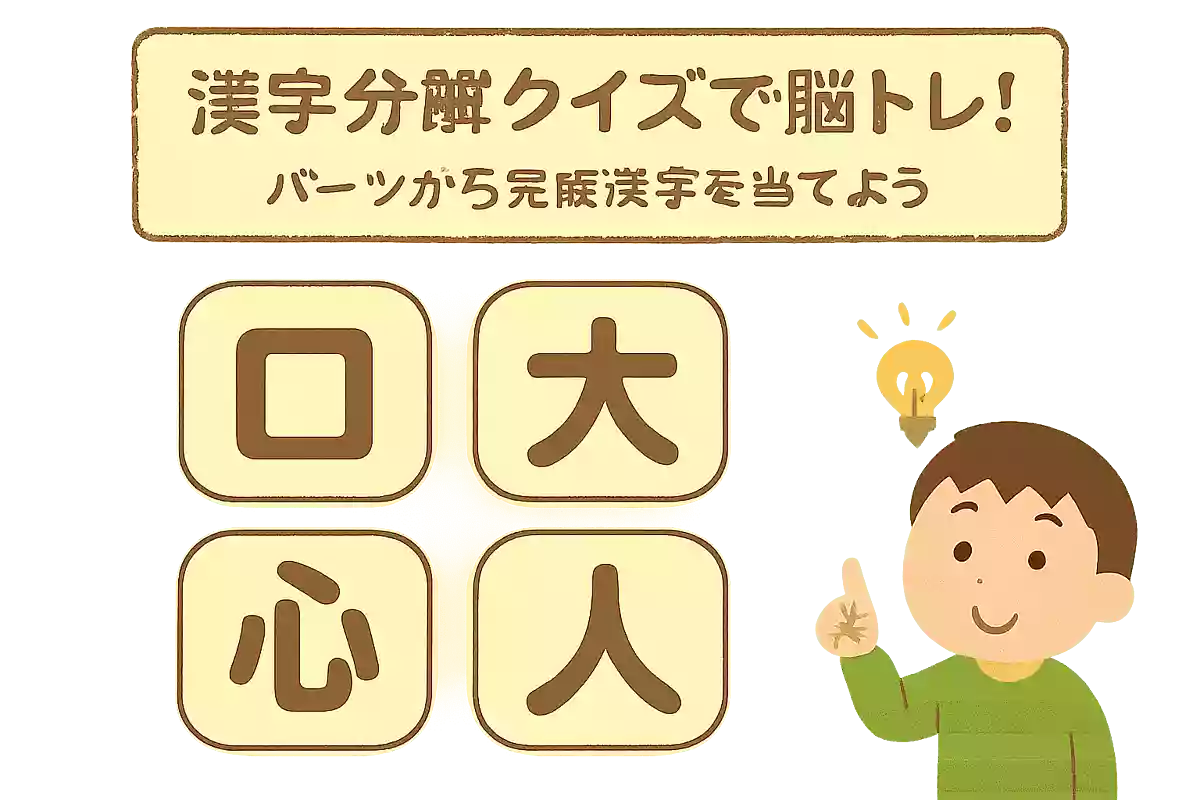
About the person who helped me. The ◯◯ who saved my life.
See the answer
benefactor
Combine 口 (mouth) and 大 (big), and 心 (heart) and 人 (person), and you get the character 恩人 (benefactor). The moment scattered characters come together as one and form meaning is filled with the joy of thinking. By noticing the connections and origins of kanji while solving, the brain is activated, making it a fun brain-training activity for elementary school students.
woman + child + word/speech + flat/peace
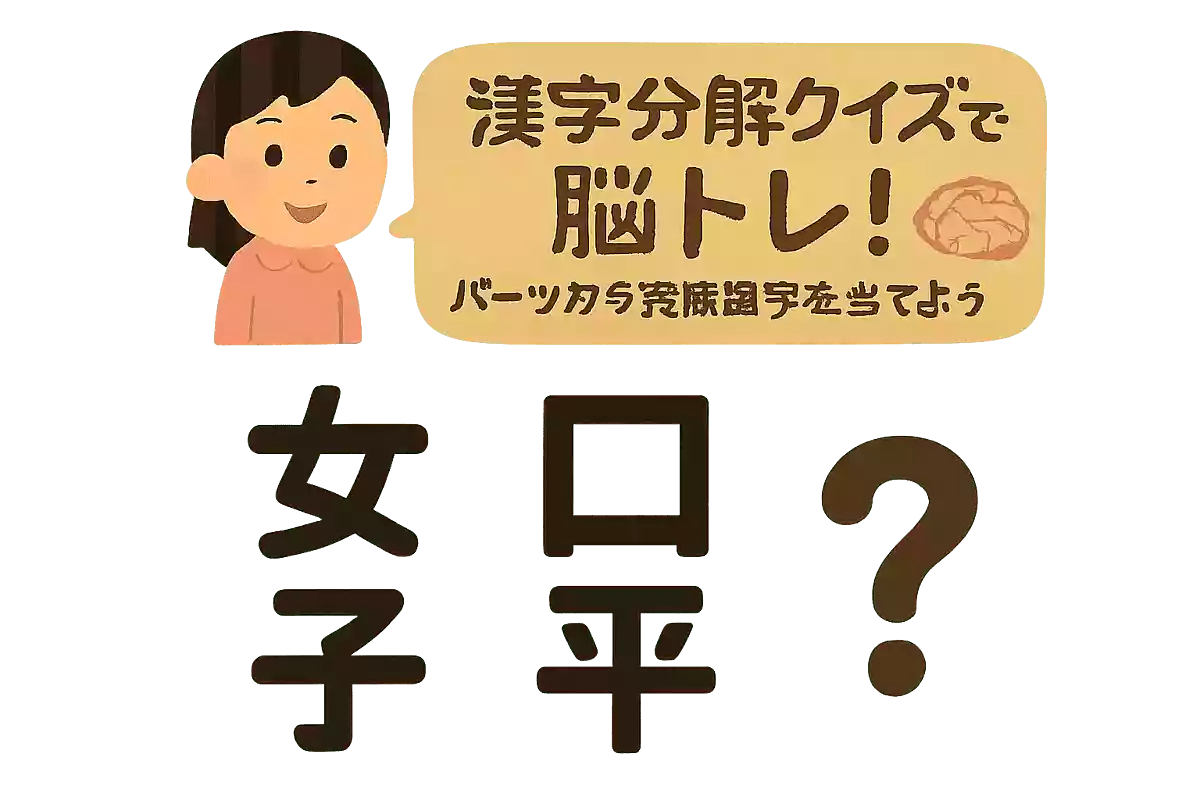
An idiom meaning very high praise. The picture I drew was a big hit with everyone.
See the answer
well received
In this kanji deconstruction quiz, you combine the parts “女 + 子 + 言 + 平” to complete the hidden kanji. Since “女” and “子” make “好,” and “言” and “平” make “評,” you’ll realize it reads “好評” (well-received). The fun of thinking about how the kanji fit together is like the excitement of solving a puzzle. It’s a kanji training activity for elementary school students that stimulates the brain while they play.
Japan + stand/rise + sun/day + say/word + self/oneself
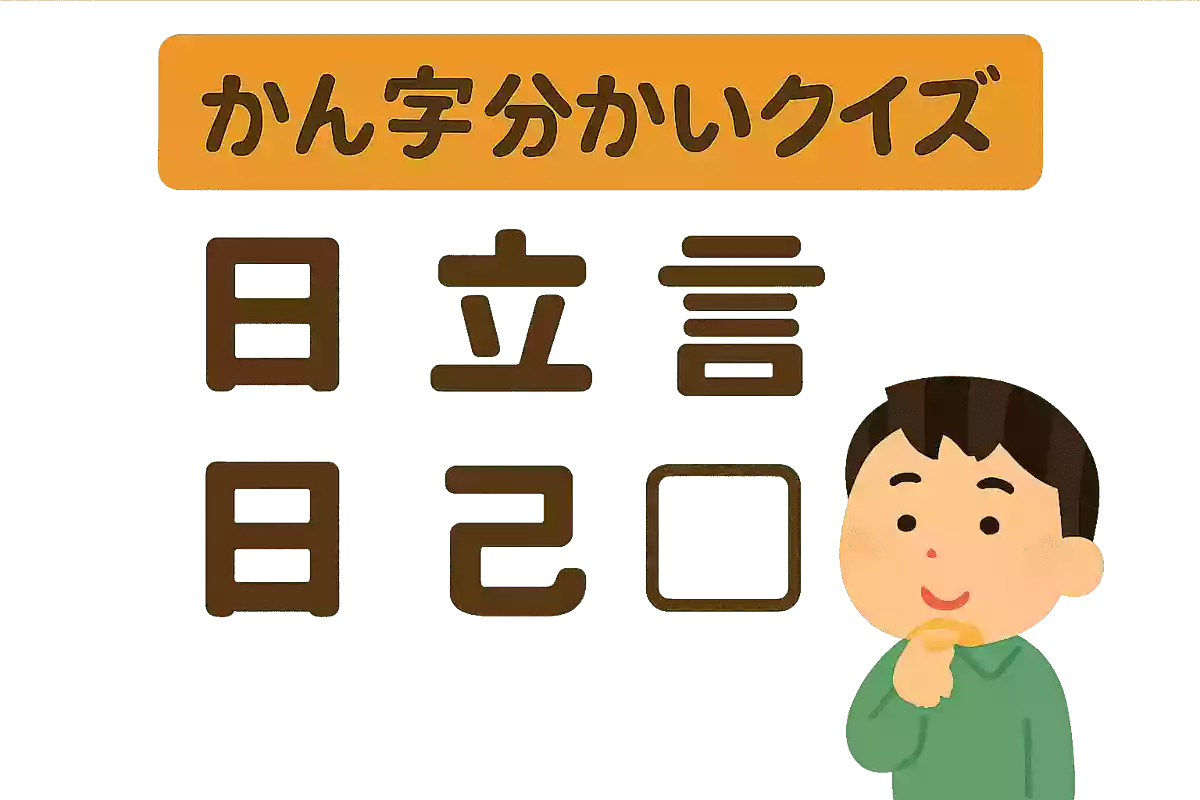
An idiom used when memorizing something: to ◯◯ kanji.
See the answer
memorization
The kanji formed by combining “日” and “立,” “日” and “言,” and “己” is “暗記” (anki, meaning memorization). It’s fun like a puzzle where you break kanji into radicals or parts and reassemble them, offering a simple yet addictive appeal. By playing while thinking about how characters connect, it naturally stimulates the brain—making it a brain-training activity suitable for elementary school students.