

[For Elementary School Students] Brain Training with Kanji Decomposition Quiz! Guess the Complete Kanji from Its Parts

Each kanji character hides an interesting origin of its own.
By learning how they came to be, kanji feel more familiar and become easier to remember naturally.
How about trying a kanji breakdown quiz with your elementary school child? Splitting kanji into radicals and parts to figure out the completed character is as fun as solving a puzzle.
Even kanji that look difficult can become simple and fascinating once you break them down! This time, we’ll introduce kanji breakdown quizzes that elementary school students can enjoy.
- Where Do You Split It? A Word-Splitting Quiz That Even Elementary Schoolers Love
- A four-character idiom quiz that elementary schoolers will love! Questions become fun once you understand the meanings
- Learn by Playing! Recommended Games with a Kanji Theme
- [For Elementary School Students] Country Names in Kanji Quiz. A quick, fun quiz
- [For Elementary Students] Flower Kanji Quiz! How many flowers do you know?
- The world’s fewest: A collection of one-stroke kanji. Learn them in a quiz format!
- [For Elementary School Students] Cipher Quiz: Fun Puzzle Riddles
- Recommended for lower grades! A fun, educational quiz for elementary school students
- A quiz of interesting obscure kanji: characters that look easy but are hard to read
- [Interesting] Summary of Kanji Reading Quiz Questions
- [Satisfying When Solved] Challenging Quizzes Recommended for Elementary School Students!
- Recommended for upper grades! A fun, educational quiz for elementary school students
- [Hard-to-Read Quiz] Single-character difficult kanji — including surprisingly simple ones!
[For Elementary School Students] Brain Training with Kanji Decomposition Quiz! Guess the Complete Kanji from the Parts (11–20)
word + self + now + heart
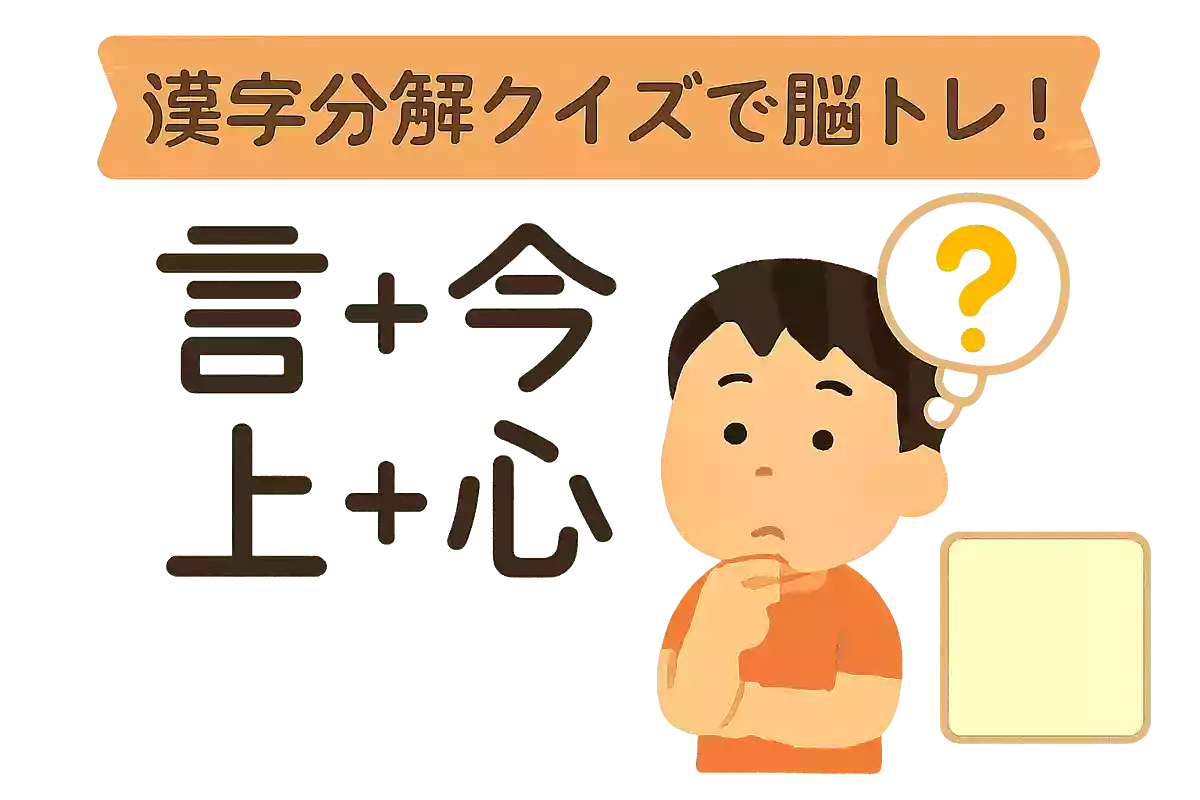
A special day. Tomorrow is the ◯◯th day since our founding.
See the answer
commemoration
Combine “言” with “己” and “今” with “心,” and you get the kanji “記念.” The moment when the scattered parts come together as one feels as exciting as opening a secret door. By solving while thinking about how the characters connect, your mind becomes more and more active—making it a brain-training puzzle that even elementary school students can get hooked on.

In conclusion
The appeal is that while enjoying kanji breakdown quizzes, you end up learning without even realizing it. By understanding how characters originated, you may become more interested in new ones. For elementary school students, why not try incorporating this as one way to make learning enjoyable—turning kanji from something to be memorized into something to think about and understand?