

[For Elementary School Students] Recommended Riddle Collection


Puzzle-solving questions, which are perfect for training children’s thinking and creativity, are presented in a variety of situations.
Some of you may be looking for problems that beginners or elementary school students can tackle casually.
In this article, we’ve selected puzzle-solving questions for elementary school students.
You can enjoy a variety of puzzles, such as ones where you infer answers from illustrations or text, and ones themed around escape games.
Give these puzzles a try—they’re fun and also connect to learning.
- [For Elementary School Students] Cipher Quiz: Fun Puzzle Riddles
- [Easy] Quizzes That Elementary School Students Can Solve! A Collection to Nurture Wisdom
- Fun quizzes for elementary school kids: a collection of questions everyone can enjoy together
- [Satisfying When Solved] Challenging Quizzes Recommended for Elementary School Students!
- Easy Riddles for Elementary School Students
- [Advanced Level] Difficult Riddles for Elementary School Students
- [Playable from lower grades] Japanese language games and activities
- Recommended riddles for elementary school students. A collection of kid-friendly riddles.
- [Elementary School] Treasure Discovered! A Collection of DIY Puzzle Treasure Hunt Ideas
- Take on the challenge like a puzzle! A collection of logic quizzes that also work as brain teasers.
- Math quiz for elementary school students
- [Interesting] Collection of Matchstick Quiz Problems
- Simple! A quiz for kids. Let’s develop their thinking skills!
[For Elementary School Students] Recommended Riddle Collection (21–30)
Matchstick puzzle: Using 12 matches, create six enclosures of equal size.

See the answer
Make it a regular hexagon
Imagine pens that hold one animal each, and think about building them with 12 matchsticks. We tend to try making them as squares, but let’s shift that thinking. A triangular pen only needs three matchsticks, so… with a clever combination, you can form a regular hexagon. It’s a surprisingly tricky puzzle!
Matchstick puzzle: Move one stick to make 1.
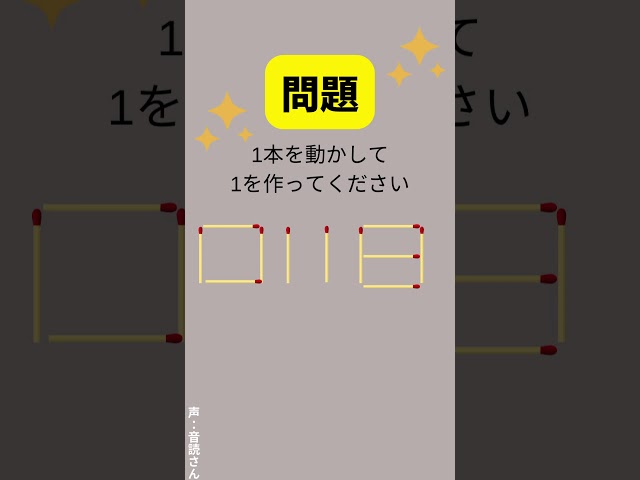
See the answer
Move the rightmost matchstick to make “ONE.”
When you're told to “make a 1,” you’d naturally think you have to create the actual shape of the numeral “1,” right? But if you think about 1 in different ways—like “hitotsu,” “first,” “one”—your thoughts start to wander and then you go, “Aha!” That’s why it works. It’s a bit tricky for people who don’t know how to spell the English word ONE.
Matchstick puzzle: Move one stick to make it half.

See the answer
If you move the bottom matchstick of the 0 to below the space between the 1 and 0 and change its orientation, it becomes a “5.”
Because it’s half of ten, I can at least think to somehow make the shape of a “5,” but how should I move it? There’s no restriction saying “you mustn’t change the orientation,” so the shift in thinking to “let’s try changing the orientation!” is the key to solving the problem. Still, it’s a really well-crafted puzzle. I’d love to pose it to friends in my class who enjoy quizzes.
Matchstick puzzle: Move 2 sticks to change the direction of the goldfish.

See the answer
Move the two sticks at the bottom right to make the goldfish face upward.
When we see the phrase “change direction,” we tend to assume it means “turn 180 degrees”—right to left, up to down, and so on. If someone said “either up or down is fine” for this problem, it would click right away, wouldn’t it? Still, it’s kind of curious that with just this many matchsticks, the figure can look like a goldfish.
Matchstick puzzle: Move 3 sticks to make 3 squares.

See the answer
Move the two vertical matchsticks at the top to the left and right, and move the horizontal matchstick in the top center downward.
Since you only need to make three squares, it seems like there could be infinitely many answers, but if you want a neat arrangement with no surplus or shortage, there’s only one solution. Because there are no constraints regarding the leftover matchsticks, that might be the tricky part of this problem. Please try it with the mindset of “Let’s make exactly three squares with no more and no less!”
An elementary school problem that even University of Tokyo students couldn’t solve

Even University of Tokyo students have sometimes failed to solve these, yet elementary schoolers have! Here we introduce quizzes that look difficult but can actually be solved if you think flexibly.
There are eight questions in total.
If you change your perspective, they’re all quite simple, so they’re recommended even for elementary school students.
Rather than strict logical reasoning, most of these problems call for a shift in thinking—more like “arithmetic.” In other words, they require creative thinking.
Why not try tackling them together—kids and adults—and have fun getting excited over them?

A riddle quiz that looks easy but is extremely difficult

Even simple quizzes can sometimes require deep thinking and reasoning skills.
Let’s look at the illustrations to understand what the questions are asking and think about the answers.
Once you figure out the answer, try explaining the correct solution in your own words—this helps you understand the quiz you worked on even better.
This particular quiz might be a strong suit for upper elementary school children.
If adults think it through together with them, it could create a sense of unity and make the quiz even more enjoyable.
