Recommended riddles for elementary school students. A collection of kid-friendly riddles.
Riddles that help you build thinking and creativity while pondering the answers are loved by a wide range of ages, from children to adults.
Some of you may be looking for fun riddles that elementary school children can try.
In this article, we’ve gathered a selection of riddles tailored for elementary school students.
We’ll introduce a wide variety, including ones that make use of what kids learn at school and ones that help them gain new knowledge.
Try these riddles with family and friends—everyone can have fun and get excited together.
Riddles recommended for elementary school students: A collection of kid-friendly riddles (1–10)
Riddles for lower-grade elementary school students

This is a video that collects simple riddles for lower elementary school students.
The kanji used in the questions are all easy, so even children can try them on their own.
There are lots of fun questions, so please give it a try!
School Riddles

School Riddles are perfect for children with flexible minds and creative thinking.
Using familiar school tools and scenes as hints, the process of finding a twisty answer becomes a treasure trove of imagination.
For example, a question like “What kind of cow is at school?” is fun enough to make not only kids but also parents smile.
Thinking together is sure to deepen parent–child communication.
Even children who’ve never tried riddles before will quickly become fans once they discover how fun they are.
Give School Riddles a try—where learning and play come together.
A riddle that’s hard for adults

Adults seem to command a variety of words and know everything, don’t they? These are riddles that are tricky for adults who know lots of words, because they make use of paraphrasing and similar wordplay.
Many answers use simple words you’d use in everyday conversation, so recalling light, everyday talk and straightforward expressions will lead you to the solution.
When you can’t figure out the answer, you tend to think up complicated phrasing—these riddles exploit that habit, making you drift farther from the answer the more you overthink.
Math riddle

Math is a subject where we arrive at answers through calculation, so we tend to strongly associate it with numeric answers.
However, this quiz asks for things that aren’t numbers, which can be quite disorienting for those who assume it’s all about calculation.
The shapes of numbers and calculations are important for reaching the answer, so read the problems carefully and picture the numbers in your mind.
There are also mixed patterns where something you assumed was a number turns out to be a paraphrased word, or something you thought was a word turns out to be a number, so it’s crucial to switch your mindset between calculation and language as needed.
Prefecture Riddles

Riddles about Japan’s prefectures that are perfect for elementary school students make great materials for learning geography while having fun.
Among the many types of quizzes, those that ask about local landmarks and specialties are especially informative, and combining them with a map of Japan can help children remember more easily.
For example, a question like “Which prefecture always carries a bloodstained betting ticket?” uses a pun, but the process of thinking through the answer encourages deeper learning.
From the answer “Chiba-ken, chi-baken” (a wordplay on Chiba Prefecture and ‘blood-stained betting ticket’), children might even make discoveries that connect to their social studies lessons.
It’s a great way for parents and children to enjoy learning together, so give it a try.
Funny riddles

For nurturing children’s creativity, we recommend riddles that are so funny they’ll make you laugh.
There are 26 enjoyable questions, each with a time limit.
Some are a little tricky and might cause a bit of frustration, but that just makes the sense of accomplishment even greater when you solve them.
If you get stuck, try looking around for hints.
It’s content you can enjoy with family and friends, and it works great as a form of communication, too.
Take on these riddles packed with small discoveries and put your everyday learning to use.
Animal riddles

This collection of riddles, perfect for elementary school students, nurtures both critical thinking and an interest in learning.
The animal-themed questions in particular are fun for kids and offer a great chance to gain knowledge.
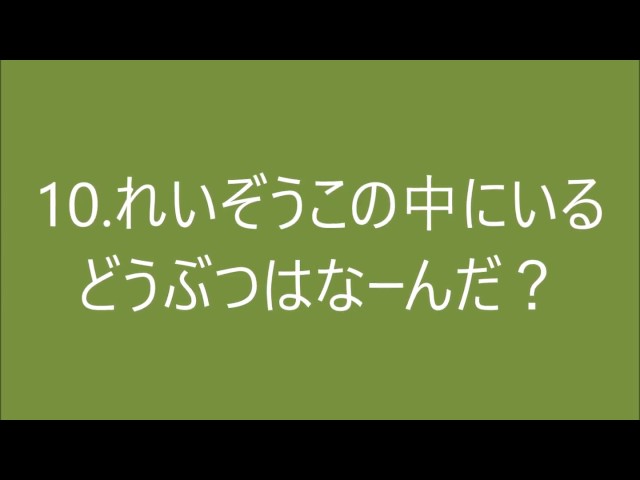
For example, the riddle “Which animal is hiding in the refrigerator?” leads them to the answer “zō” (elephant), teaching them the playful side of the Japanese language.
There are also many riddles provided by Yahoo! Kids and Daiei, allowing children to learn about a variety of animals.
By thinking together, kids can have a great time and deepen their understanding of animals.

Food Riddles

These are riddles where you think of something that fits the clue, with the friendly theme of food as a key point.
By considering alternative ways of saying the words in the question or visualizing numbers, you can get closer to the answer.
I think the content will spark interest in foods—not only those you eat regularly, but also items you may know by name yet have never tried—through the answers to the riddles.
Sometimes the flavor of a food serves as a hint, so being familiar with a variety of tastes may be the key to getting the right answers.
Brain-training riddle

Brain-training riddles that stimulate elementary school students’ creativity and thinking skills are recommended for nurturing rich ideas.
We’ve picked out problems that deepen knowledge while using your head in a fun way.
For example, riddles themed around stairs or the future encourage a shift in perspective.
These questions also spark communication when adults puzzle over and answer them together, and problems about familiar objects or abstract concepts deepen knowledge and understanding.
In addition, using illustrations provides visual enjoyment.
The process in which children think for themselves and check their answers can also serve as a wonderful opportunity for interaction among children, as well as with family members and seniors in the community.
Simple riddle

Riddles are perfect as a fun exercise to develop children’s thinking skills.
There’s a video that gathers a wide range of questions, from easy ones to slightly challenging ones.
For example, a simple riddle: “I sing in trees.
I am green.
I eat insects.
What am I?” You can enjoy tackling the quiz in a relaxed atmosphere while getting your mind working.
It’s packed with content that even adults will want to try.
Be sure to watch the video and have fun!