

[Recreation] Challenge! A roundup of tongue twisters recommended for elementary school students

Let’s all have fun and exercise our mouths!
We’ve put together some tongue twisters we definitely want elementary schoolers to try.
When you read them, you might think, “These aren’t hard at all,” but when you actually say them, you end up stumbling… Tongue twisters are such a curious kind of game!
You can compete with friends to see who can say them properly, or challenge yourself with harder ones to test your limits—there are lots of ways to play!
Even if you can’t say them smoothly at first, if you keep at it, your articulation might get better and better!
- Tongue twisters that will make you laugh out loud! Super funny
- [Diction Training] A Collection of Tongue Twisters to Improve Articulation
- Challenging tongue twisters: Introducing high-difficulty phrases and sentences!
- Nagoya dialect tongue twisters are exquisite! A fun collection where your tongue gets tied in knots with regional dialects
- [Easy] Quizzes That Elementary School Students Can Solve! A Collection to Nurture Wisdom
- Fun quizzes for elementary school kids: a collection of questions everyone can enjoy together
- Bursting into laughter! A roundup of Hakata dialect tongue twisters
- A collection of long tongue twisters. Also recommended for practicing announcements and narration.
- [Rec] Interesting! A roundup of wordplay games
- Perfect for pronunciation practice! A collection of English tongue twisters.
- [For Elementary School Students] Cipher Quiz: Fun Puzzle Riddles
- Recommended for upper elementary grades! Exciting indoor recreation and games
- [For Kids] Let’s Play in English! A Collection of Fun Recreational Activities and Games
[Rec] Challenge! A compilation of tongue twisters recommended for elementary school students (21–30)
Art room, technology room, operating room, art preparation room, technology preparation room, operating preparation room

Because the words for “room” and “preparation room” keep popping up, the moment you read it aloud your mouth can’t keep up and you can’t help but laugh.
Both kids and adults can enjoy it playfully while picturing familiar school classrooms and hospital rooms.
Each time you read it, the rhythm and the timing of your pauses shifts a little, so the more you repeat it, the more fun it becomes to use your voice.
If you read while conjuring different images for “art,” “technology,” and “surgery,” it feels like more than mere diction practice—you can savor a sense of story, too.
Once you read it, it’s addictive, so definitely give it a try.

red bell pepper, green bell pepper, yellow bell pepper

At first glance, this tongue twister looks easy if you’re just reading the words.
But the final “yellow paprika” is a surprisingly tough opponent.
Up to that point, every word starts with “a,” then it suddenly switches to “ki,” and you’re almost guaranteed to bite your tongue.
Still, if you can get past that spot, you should be able to link it all together smoothly.
The key to success is to focus on the “ki” and pronounce it clearly! By the way, all three colors of paprika actually exist.
The blue paprika refers to the green variety, and despite its appearance, it’s said to be less bitter and quite tasty.

During magic, martial arts pain, surgery 2

Because the same “-jutsu” sound repeats, it’s amusing to say aloud—it makes your mouth feel like it’s spinning.
Both kids and adults can enjoy trying it together to the rhythm.
If you picture things like “the strangeness of magic,” “the pain of martial arts,” and “the tension of surgery” as you read, it can feel a bit like a mini story, and might even make you chuckle.
With repetition, the rhythm and pace of your voice change, letting you enjoy the fun of speaking and laughing at the same time—this tongue twister is addictive after just one read.
Both deer and serow are members of the deer family, but a sea lion is not a deer.

It’s a tongue twister packed with the word “shika” that many of you probably know.
The “kamoshika” and “ashika” that pop up in the middle get your head tangled—and your tongue, too.
I bet a lot of people also struggle with the transition between “shikashi” (however) and “ashika.” When you try it, I recommend practicing by splitting it into the first and second halves.
By the way, a kamoshika (Japanese serow) is actually in the bovine family, not the deer family.
Surprising, right? Even though its name includes “shika” (deer)!
There are two chickens in the garden.

A tongue twister that cleverly uses homophones is “Niwa ni wa niwa niwatori ga iru,” which means “There are two chickens in the garden.” As you say it, you start to lose track of whether you’re saying “niwa” as in “garden” or “niwa” as in “two,” and if you repeat it enough, it even starts to sound like “wani” (crocodile), which makes it even more confusing.
When you try it, imagine two chickens in a garden as you speak.
By the way, did you know that “niwatori” originally means “a bird that’s in the garden”? That background makes the tongue twister all the more tricky.

Snowplow in operation

If you live in a northern region, you’re surely familiar with snowplows.
Sometimes, a sign on the back of a snowplow reads “Snow removal in progress.” That scene is captured in the tongue twister “Snowplow snow-removal in progress.” The trickiest part is the second “snow” segment—your tongue tends to get tangled and it’s hard to say smoothly.
On the other hand, if you can get past that point, you’ll likely nail it.
By the way, the tip is to barely pronounce the “tsu” sound.
Give it a try—you might be surprised!
Blue scroll, red scroll, yellow scroll.
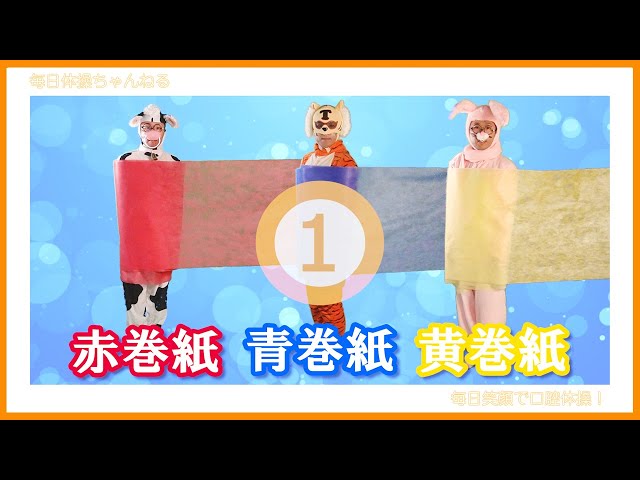
There are all sorts of tongue twisters that use colors! “Aka-makigami, ao-makigami, ki-makigami” (red scroll paper, blue scroll paper, yellow scroll paper) is one of them.
The color part is fine, but the tricky bit comes right after with makigami.
People often end up saying makimaki or makimami, and it’s especially hard to connect smoothly into the ga sound! One tip is to take a tiny mental pause between the color and makigami.
The rule of tongue twisters is to say them quickly in one go, but even giving yourself a bit of mental space can make a difference.
Practice it over and over so you can say makigami cleanly all the way through!
