

[Recreation] Challenge! A roundup of tongue twisters recommended for elementary school students

Let’s all have fun and exercise our mouths!
We’ve put together some tongue twisters we definitely want elementary schoolers to try.
When you read them, you might think, “These aren’t hard at all,” but when you actually say them, you end up stumbling… Tongue twisters are such a curious kind of game!
You can compete with friends to see who can say them properly, or challenge yourself with harder ones to test your limits—there are lots of ways to play!
Even if you can’t say them smoothly at first, if you keep at it, your articulation might get better and better!
- Tongue twisters that will make you laugh out loud! Super funny
- [Diction Training] A Collection of Tongue Twisters to Improve Articulation
- Challenging tongue twisters: Introducing high-difficulty phrases and sentences!
- Nagoya dialect tongue twisters are exquisite! A fun collection where your tongue gets tied in knots with regional dialects
- [Easy] Quizzes That Elementary School Students Can Solve! A Collection to Nurture Wisdom
- Fun quizzes for elementary school kids: a collection of questions everyone can enjoy together
- Bursting into laughter! A roundup of Hakata dialect tongue twisters
- A collection of long tongue twisters. Also recommended for practicing announcements and narration.
- [Rec] Interesting! A roundup of wordplay games
- Perfect for pronunciation practice! A collection of English tongue twisters.
- [For Elementary School Students] Cipher Quiz: Fun Puzzle Riddles
- Recommended for upper elementary grades! Exciting indoor recreation and games
- [For Kids] Let’s Play in English! A Collection of Fun Recreational Activities and Games
[Rec] Challenge! A compilation of tongue twisters recommended for elementary school students (21–30)
There are two chickens in the garden.

Here’s an introduction to tongue twisters packed with the fun of wordplay.
“Niwa ni wa niwa niwatori” (“There are two chickens in the garden”) has similar-sounding syllables, so you might easily stumble over it—but that’s exactly what makes it fun! With each repetition, a rhythm emerges, and saying it out loud is delightful.
It’s a simple, cute phrase that both kids and adults can try together.
Picture the chickens in the garden, say it quickly, and laughter will spread.
You can practice pronunciation while playing, so be sure to enjoy it as you go!

elevated bridge pier

This is a tongue twister that uses words evoking the pillars that support an overpass.
Because similar or identical sounds like “kōkakyō” and “kyōkyaku” repeat in succession, your mouth gets tangled when you say it aloud, making you laugh without meaning to.
Children can take it on playfully, imagining peeking under the bridge or picturing turtles and little birds walking along the elevated bridge.
If you read it while picturing “a row of bridge piers of an overpass lined up in succession,” it feels more narrative than just a string of repeated words.
The more you repeat it, the more your sense of rhythm and mouth movements are trained, letting you enjoy both the fun of speaking out and the spirit of challenge each time you read—so try incorporating it into recreational activities.
[Rec] Challenge! A collection of tongue twisters recommended for elementary school students (31–40)
The customer next door is a customer who often eats persimmons.

Everyone must have tried it at least once! “Tonari no kyaku wa yoku kaki kuu kyaku da” is a tongue twister that uses lots of K sounds.
The trick to saying it well is to clearly distinguish between ka and kya.
When you try to say it fast, kaki can turn into kyaki, and kyaku can turn into kaku.
In those cases, start slowly and practice while opening your mouth wide.
That way, your mouth movements will create distinct pronunciations, and you’ll make fewer mistakes!

I heard Kayō Yamamoto used to go to this high school.

There’s a relatively short and easy tongue twister: “Koko no kōkō ni Yamamoto Kayo ga kayottottarashii ken ne.” Yamamoto Kayo is a local TV personality active mainly in Fukuoka and beloved by locals.
In the tongue twister, it means “It seems Kayo Yamamoto used to attend this high school.” It’s a tongue twister that really reflects Fukuoka, especially the Hakata dialect.
If it feels hard, try taking a quick breath at the ‘ga’ part.

I gotta buy some KitKats.

There’s a tongue twister that plays on the KitKat product name: “Kit Kat kattokan to ikankatta noni, anta ga kattokan katta node, ikankatta kanda wa.” It’s pretty confusing, isn’t it? In simple terms, it means something like, “We were supposed to buy a Kit Kat, but you didn’t buy it in advance, so that was no good.” The phrases “katto” and “katta” keep appearing, so pay attention to those and give it a try.
Red seared short ribs, Blue seared short ribs, Yellow seared short ribs
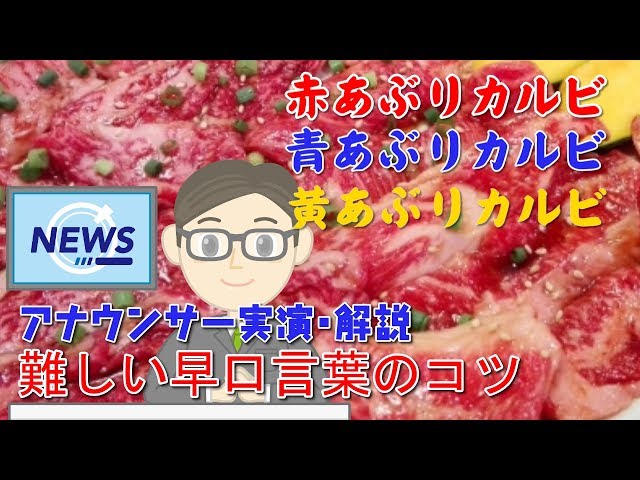
This adds the classic tongue-twister pattern of putting a color in front to “aburi karubi,” a phrase that’s already hard to say on its own, making it even more difficult.
Imagining red, blue, and yellow aburi karubi lined up somehow doesn’t seem appetizing, which adds to the humor.
The tricky part of aburi karubi is the sequence of the Japanese r-sounds and voiced consonants, so be mindful of your mouth shape as you practice.
With the addition of colors, vowels like “a” and “o,” as well as the K-row sounds, also come into play, making it even more important to pay attention to mouth positioning.

super-duper drippy catcher

It’s a tongue twister that makes you wonder why on earth the baseball catcher is all soaked and sopping wet.
The word “mecha-mecha” (super/very) also adds to the humor of the situation, conjuring up an image of someone so drenched it’s obvious at a glance.
You can tell he’s a catcher at the moment he’s holding up his mitt, so imagining him still getting into position while dripping wet brings a mix of concern and laughter.
Focusing on the mouth shapes for “mecha,” “bicha,” and “catcher” should make it easier to say.