

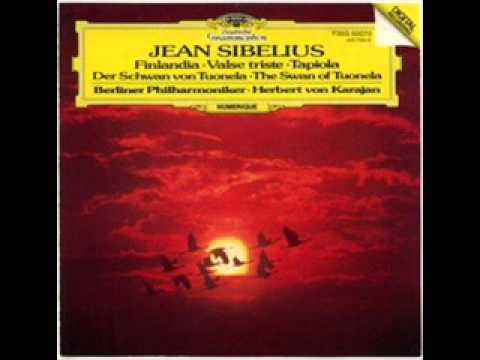
Sibelius’s famous piece. Popular classical music.

Jean Sibelius, the renowned composer born in Finland.
A composer and violinist, Sibelius wrote a vast body of works ranging from symphonies to piano pieces and choral music.
Many of his compositions express a deep love for his homeland, Finland.
His symphonic poem Finlandia is a representative example, and in addition he wrote over a hundred songs with piano accompaniment, stage music, and choral works inspired by the Finnish national epic.
Here, we’ve selected some of Sibelius’s masterpieces from among those works!
Sibelius’s masterpieces. Popular classical music (1–10)
Symphonic Poem “Finlandia”Shiberiusu
Composed in 1899, this work is widely loved as a piece that symbolizes the desire for Finland’s independence and the unity of its people.
It is characterized by its dramatic structure and beautiful melodic lines, in which Finland’s majestic nature and tumultuous history are sublimated into music.
In Finland, December 8 is celebrated as “Finnish Music Day,” when special concerts are held to honor Sibelius’s achievements.
Breathing with the spirit of Finland, this work continues to be performed around the world as a deeply moving masterpiece that resonates in the heart.
Swan of TuonelaShiberiusu

Inspired by the Finnish national epic Kalevala, this work is notable for the plaintive melody of the English horn.
Together with the low strings, it depicts a swan quietly swimming along a river that symbolizes the land of the dead.
Sibelius first composed the piece in 1893 and later revised it in 1897 and 1900.
Characterized by an atmosphere of stillness and melancholy, it evokes Finland’s nature and mythology through music.
It’s a recommended piece not only for those interested in classical music but also for anyone seeking a moment of quiet.
Andante festivoShiberiusu

Commissioned in 1922 to commemorate the 25th anniversary of a sawmill’s founding, this work was originally composed as a string quartet and later expanded for string orchestra with timpani.
In 1939 it was broadcast by radio to New York for the World’s Fair, and it is known as the only recording conducted by Sibelius himself.
Possessing a calm and solemn atmosphere, the piece is characterized by sustained chords and a slow tempo that evoke Finland’s nature and landscapes.
Conveying deep emotion and reverence, it has also been performed as a message of peace and holds special significance at Finland’s national ceremonies.
It is recommended not only for those interested in classical music but also for anyone seeking a sense of calm.
Symphony No. 2Shiberiusu

A masterpiece that expresses Finland’s climate and national character through music.
Conceived during a stay in Italy, it premiered in Helsinki on March 8, 1902.
The work consists of four movements, imbued with Finland’s beautiful nature and the people’s fervent desire for liberation from Russian rule.
The first movement features pastoral melodies; the second unfolds with dreamlike scenes.
The third interweaves a fierce scherzo with tranquil pastorales, and the final movement resounds with a triumphant fanfare.
This is a highly recommended piece for anyone wishing to experience a grand musical world infused with the spirit of Finland.
Five PiecesClare Hammond

In the midst of World War I, during this period Sibelius left many relatively small-scale works such as piano pieces, violin solos, and choral works.
The Five Pieces were composed among these.
Each movement bears a title related to trees—When the Rowan Blossoms, The Lonely Pine, The Aspen, The Birch, and The Spruce—prompting the Japanese pianist Izumi Tateno to name the set the Tree Suite, by which title it has also become widely known.
Symphonic Poem “A Saga”Shiberiusu

This work is a symphonic poem depicting the youthful struggles of Finnish composer Jean Sibelius.
The cold timbre of the strings evokes the harsh nature of the Nordic region, and the low-register theme symbolizing the narrator of the story is particularly striking.
The structure, in which scenes of dance and marching gradually develop, seems to reflect Sibelius’s inner world.
Born in 1865, Sibelius is still cherished today as a national hero of Finland.
It’s a recommended piece for those captivated by Finnish landscapes and mythology.
Symphonic Poem “The Bard”Shiberiusu

Jean Sibelius, known as one of Finland’s foremost composers, was born on December 8, 1865, and created music deeply influenced by Finnish landscapes and mythology.
This work is a short orchestral piece composed in 1913, with the harp playing a significant role.
It has a serene, meditative atmosphere, evoking the world of medieval troubadours and legendary Nordic poetry.
As Sibelius himself described it as “an old Scandinavian ballad from the Viking era,” it is marked by profound lyricism and tranquility.
It’s a highly recommended piece for anyone wishing to experience Finland’s nature and culture.