

Interesting Japanese songs recommended for men in their 60s

This time, I’d like to introduce a collection of amusing Japanese songs recommended for men in their 60s.
Back in the Showa era, there were lots of silly songs, but they kind of grow on you, get stuck in your head, and you find yourself humming them without thinking—there are quite a few songs like that, right?
- Hilarious: Funny songs. Tracks that kill at karaoke and put a smile on your face.
- [2026 Edition] Songs Loved by People in Their 60s: Classic Hits from Their Youth
- [For People in Their 60s] Karaoke Songs That Get the Crowd Going: Ranking [2026]
- Recommended Japanese karaoke songs for men in their 60s
- Karaoke songs that are sure to get a 60-something man fired up
- [2026] Japanese karaoke songs that get men in their 50s pumped up
- Cheering songs recommended for people in their 60s: classic and popular Japanese hits
- [Karaoke] Recommended Songs for Men in Their 80s: A Collection of Showa-Era Classics You’ll Want to Belt Out
- Get the Laughs! Funny Karaoke Songs That Hype Up the Crowd
- [Recommended for people in their 70s] Classic nostalgic hits: A collection of youth songs
- A love song that makes a man in his sixties relive his youth. Timeless classics that rekindle the romances of those days.
- Tear-jerking songs recommended for men in their 60s: classic and popular Japanese hits
- Japanese karaoke songs that are easy for men in their 60s to sing
Interesting Japanese songs recommended for men in their 60s (21–30)
Yellow Submarine OndoKanazawa Akiko

It’s a song that, originally, somehow turned a Beatles track into an ondō and had Akiko Kanazawa sing it—a chemical reaction that ended up working brilliantly.
Come to think of it, there was also Masato Shimon’s Japanese version of the Star Wars theme with added lyrics, but that’s remembered for different reasons.
The singing, of course, is outstanding.
Enka chanchaka-chanHirano Masaaki

It’s a song that strings together one-liners from various enka hits up to that time, weaving in clever call-and-response interjections to create a medley.
When the song was popular, the Drifters often imitated it in their skits on shows like “Zen’in Shūgō,” using it as a running gag.
Theme of the Mean/Spiteful Old Ladysurappusuteikku
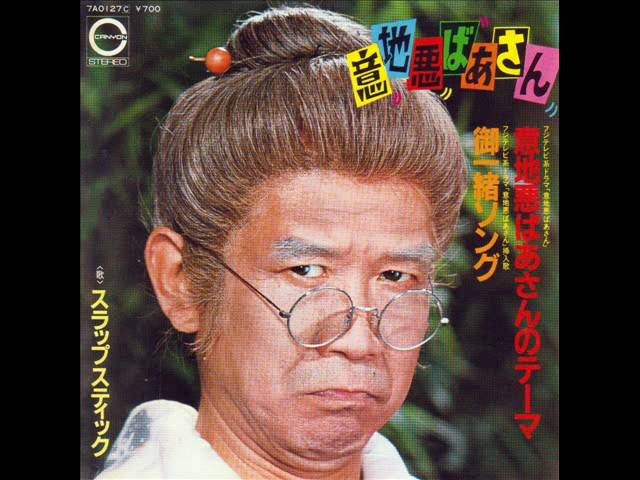
A catchy and fun song that became a big hit as the theme for ‘Mean Old Lady.’ Slapstick was a band formed by top voice actors of the time, and I think this is probably their most famous song.
Saizansu MamboToni Tani

With an abacus in hand and a jaunty rhythm, this is one of Tony Tani’s hit songs, famous for the line “What’s your name?” Tony Tani himself now feels retro, and the abacus as an item also gives off a retro vibe nowadays.
Amiami dadaba AmidababaAkashiya Sanma

In the Take-chan Man segment, which became the main event within Oretachi Hyōkin-zoku, Akashiya Sanma took on a variety of villain roles after the very early days, and every one of them became famous.
Most of the characters had their own funny theme songs, but here I’d like to highlight the B-side of the Amida Babaa song, which, as far as I know, wasn’t used in the show.
It’s understated, but it’s an amazing track.
Nonsensical Songbakushou mondai
It’s a song from Ponkickies that, for some reason, ended up being a hit when Bakausha Mondai sang it.
The song is extremely short, and as the title suggests, it’s kind of “nonsense” — maybe the fact that it actually works better when you sing it casually and goof around with it is what made it so good.
Thank you so, so much for your hard work.Za Dorifutāzu

Among the Drifters’ songs, this one has catchy wordplay and phrases with a brisk tempo, making it a popular track.
Many of the Drifters’ songs are arrangements of existing tunes, and perhaps they were just very good at arranging.
They were quite fond of military songs, and it’s not widely known that they have many tracks related to that genre.
Even Dorifu Daibakushō is a parody of a military song.