

[Path to Improvement] Techniques That Make You Want to Play! A Summary of Table Tennis Skills [Techniques]

Table tennis is a sport so fast-paced it leaves you holding your breath—“blink and you’ll miss it” fits perfectly.
It’s beloved as a school club activity, of course, and it’s also hugely popular as an Olympic sport.
Many of you are probably keeping an eye on Japanese players who battle rivals from around the world day in and day out! In this article, we’ll be introducing table tennis techniques—a collection of skills! From the basics to the signature moves of famous players, we’ll cover a wide range.
If you’re about to start playing table tennis or want to get better, this should be a helpful reference!
- A roundup of recreational activities and games using paper cups
- A roundup of magic tricks perfect for one-shot gags. Become the hero of the party!
- Recommended Recreations and Indoor Games for High School Students
- [Showtime] Soccer skills that make you want to try them! [Techniques]
- Horizontal bar skills: Moves you’ll want to try at least once! A roundup of popular techniques.
- [Rec] Challenge! A roundup of jump rope tricks and techniques
- Skateboard Tricks Overview: From Basic Moves to Signature Tricks
- [Rec] Challenge! A roundup of kendama tricks
- [Ground Tricks] Snowboard Tricks Introduction and Tutorial Video Compilation [Snowboarding]
- Fun Ball Sports: A Roundup of Ball-Based Play, Games, and Sports
- [For Junior High Students] A Summary of Sports You Can Do in the Gym
- [For General Audience] Trivia & Fun Facts Quiz on the Olympics and Paralympics
- Olympic quotes that pierce the heart! Words of tears and inspiration
[The Path to Improvement] Techniques That Make You Want to Play! Table Tennis Skills Summary [Technique] (1–10)
knuckle serve

A knuckle serve is a technique that, if you remember it, will broaden your tactical options.
Knuckle means “no spin,” right? In other words, put simply, a knuckle serve is a serve intentionally hit without spin.
The key to this knuckle serve is taking a step forward as you strike.
From that motion, practice so you can not only hit a knuckle serve but also transition into other serves.
That way, you can mislead your opponent into expecting a knuckle serve while actually delivering a different one.

Loop drive

An advanced form of the drive is the loop drive.
A loop drive is a drive with forward (topspin) rotation.
You strike it by moving the racket from low to high.
Basically, it’s not a shot to win points outright, but one used to keep the rally going.
So practice it together with the speed drive, which has a similar motion but produces a faster ball.
Being able to switch between them should improve your winning percentage.
By the way, you can tell if your loop drive is executed well by whether there’s no loud impact sound.
If there’s no sound, it’s a success.
Topspin stop

Let me introduce a technique also known as “yanagi”: the top-spin stop.
First, a stop is a shot that makes the ball die near the net.
With the top-spin stop, you add upward spin to bring the ball to a stop.
Naturally, this makes it hard for your opponent to return, bringing you much closer to victory.
However, there is a countermeasure against the top-spin stop: return it decisively with strong power.
Practice both executing it and handling returns.
The Road to Improvement: Techniques That Make You Want to Play! Table Tennis Skill Summary [Techniques] (11–20)
YG serve

Let me introduce the YG serve, which can be considered an enhanced version of the pendulum serve.
In a standard pendulum serve, you generate spin by wrapping your wrist inward.
In contrast, with the YG serve you pre-bend your wrist, then generate spin by returning it from that position.
Comparing the two, the YG serve is said to make it easier to produce stronger spin.
However, because it requires a distinctive stance, the pendulum serve is generally easier to use on the spur of the moment.
By the way, “YG” stands for “Young Generation.”
back serve
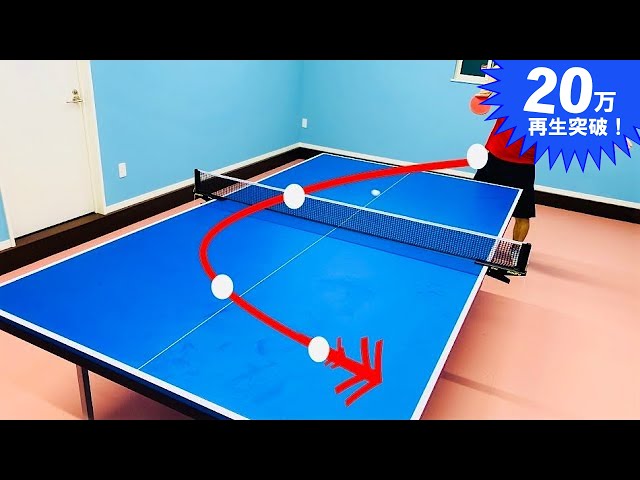
Here’s a serve that’s guaranteed to be useful if you remember it: the backhand serve.
As the name suggests, it’s a serve hit with the backhand.
It puts a strong left sidespin on the ball, making it hard for your opponent to return it as they intend.
Plus, since not many players use the backhand serve, you’ll likely face opponents who’ve never returned one before.
The key to this serve is to hit it from a position close to the table.
It depends on how the match is unfolding, but give it a try.
Flick
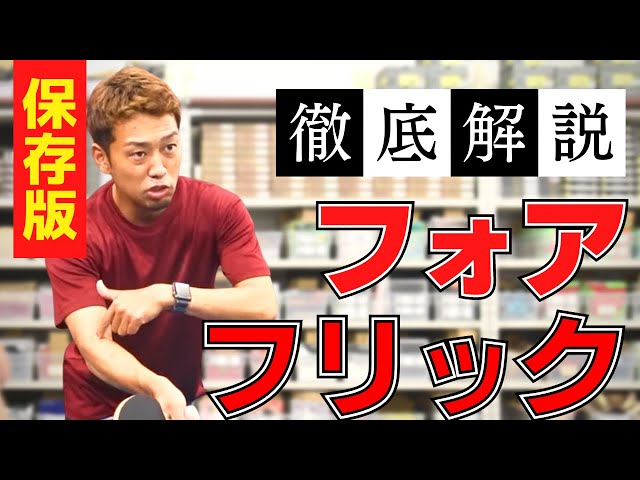
If you want to boost your attacking power, learn the flick.
“Flick” originally means to snap or tap something lightly.
You’ve probably heard of flick input on smartphones—that basic motion is a good reference.
When your opponent serves or plays a short ball, meet it over the table and gently flick it back.
This makes it harder for your opponent to respond.
Of course, if you hit too hard, you’ll lose control.
Rather than swinging the racket, try moving it with an upward, lifting sensation.
Lobbying
Lobbing is a technique that comes in handy in matches between advanced players.
A lob is a return hit from a distance that travels in a high arc.
It’s used to return powerful serves.
In Japan, Jun Mizutani is well known for his proficiency with this shot.
When you lob, your opponent will likely respond with another powerful shot.
That often leads you into a loop where you answer again with a lob.
Be sure to practice it—including what to do when your opponent uses it against you.