

![[Path to Improvement] Techniques That Make You Want to Play! A Summary of Table Tennis Skills [Techniques]](https://i.ytimg.com/vi_webp/uIcWmvmovCw/maxresdefault.webp)

Table tennis is a sport so fast-paced it leaves you holding your breath—“blink and you’ll miss it” fits perfectly.
It’s beloved as a school club activity, of course, and it’s also hugely popular as an Olympic sport.
Many of you are probably keeping an eye on Japanese players who battle rivals from around the world day in and day out! In this article, we’ll be introducing table tennis techniques—a collection of skills! From the basics to the signature moves of famous players, we’ll cover a wide range.
If you’re about to start playing table tennis or want to get better, this should be a helpful reference!
- A roundup of recreational activities and games using paper cups
- A roundup of magic tricks perfect for one-shot gags. Become the hero of the party!
- Recommended Recreations and Indoor Games for High School Students
- [Showtime] Soccer skills that make you want to try them! [Techniques]
- Horizontal bar skills: Moves you’ll want to try at least once! A roundup of popular techniques.
- [Rec] Challenge! A roundup of jump rope tricks and techniques
- Skateboard Tricks Overview: From Basic Moves to Signature Tricks
- [Rec] Challenge! A roundup of kendama tricks
- [Ground Tricks] Snowboard Tricks Introduction and Tutorial Video Compilation [Snowboarding]
- Fun Ball Sports: A Roundup of Ball-Based Play, Games, and Sports
- [For Junior High Students] A Summary of Sports You Can Do in the Gym
- [For General Audience] Trivia & Fun Facts Quiz on the Olympics and Paralympics
- Olympic quotes that pierce the heart! Words of tears and inspiration
[The Path to Improvement] Techniques That Make You Want to Play! Table Tennis Skills Summary [Technique] (1–10)
tsutsuki
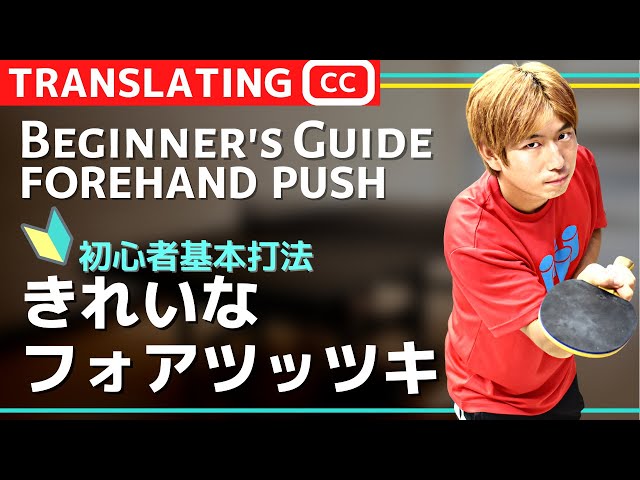
Let me introduce a technique with a somewhat unique name: the tsutsuki.
In tsutsuki, you take a ball with backspin early and return it with a pecking motion, just as the name suggests.
Its hallmark is that you can send the ball back while keeping the backspin intact.
It’s not flashy and looks simple, but you’ll likely find it unexpectedly challenging.
Try it with a relaxed grip, as if gently receiving the ball.
Be careful: if you contact the ball too high, it will float more than necessary.

Chiquita

The Chiquita is a technique used by many top players both in Japan and abroad.
Chiquita refers to taking the ball over the table and returning it with a backhand while imparting spin.
Its strength lies in being able to apply both vertical and horizontal spin.
It’s also known for making it easier to ignore the spin already on the incoming ball.
In fact, there are various patterns of the Chiquita, so I’d like you to practice them one by one.
However, be careful: a weak Chiquita is easily countered by your opponent.
hook serve

For those who are confident in their serves, I recommend the reverse pendulum serve.
This serve involves turning your wrist inward to impart spin in the opposite direction from a regular serve.
It’s very effective for confusing your opponent.
It also makes it easy to add fake motions, so your opponent won’t know which serve is coming until the last moment.
Even if they do read it, they’ll find it harder to return with a strong shot.
Try practicing with the image of brushing the right side of the ball.
knuckleball

If you’re a defensive chopper, you’ll want to master the knuckle chop.
As the name suggests, it’s a chop with little to no spin.
Rather than scoring points outright, it’s used to catch your opponent off guard and draw errors.
Practice switching between a normal chop and a knuckle chop.
The key to a good knuckle chop is to avoid using your wrist and not rotate the tip of the racket.
If you use your wrist, the racket will turn and unintentionally add spin, so be careful.
crouching serve

If you want to master a flashy, cool-looking move, the crouching serve is perfect.
The idea is to squat down so deeply that, at the moment you strike the serve, the table is right in your line of sight.
Of course, it’s not just for show—there’s a real purpose.
By crouching as you serve, you can use that upward momentum to impart powerful spin on the ball.
As a result, the ball should travel fast and low over the table.
Your opponent will likely have a hard time returning it.
cut block

Let me introduce an advanced defensive technique: the cut block.
This is often used when the ball is hit to the opposite direction, and you return it with a motion similar to a backhand push.
It’s not a shot you aim for intentionally, but it’s useful to know for those critical moments.
The key is to catch the ball quickly just after the bounce.
Also, don’t tense up—try to return it with a gentle, rebounding feel.
Shoot Drive

When you watch matches between professionals, you sometimes see the ball bounce and then fly off in an unexpected direction, right? That’s the shoot drive.
By putting spin that’s upward and to the right, it makes that kind of movement possible.
It’s an advanced variation of the already difficult drive technique, so many people struggle with it.
Take your time and work on it patiently.
If you focus on contacting the ball with the left side of your racket, your success rate may improve.