

[Beginner] Recommended for adult piano beginners! Beautiful & stylish piano pieces


The piano’s clear, shimmering tone that soothes our hearts.
Now that we’re adults, many people are rediscovering its appeal and thinking, “I don’t just want to listen—I want to play it myself!” More and more are starting lessons: those who found practice a chore and piano lessons a burden as children, but now, as adults, want to practice again and learn to play.
In this article, we introduce beautiful and stylish piano pieces recommended for adult beginners and for those returning after a break.
From classical to Western pop, Japanese songs, video game music, and film scores, we’ve curated a wide selection to help you find a favorite piece.
- Recommended for piano beginners! 10 sheet music picks that adults can enjoy too
- [Beginner] Start Here: Classic Practice Pieces Recommended for Adult Piano Beginners
- Piano Masterpieces: Surprisingly Easy Despite Sounding Difficult!? A Curated Selection Perfect for Recitals
- [For Adults] Recommended for Piano Recitals! A Curated Selection of Impressively Sounding Masterpieces
- It’s so cool if you can play these on the piano! A selection of irresistibly charming masterpieces.
- For Beginners: Easy to Play and Sounds Impressive! Pieces That Shine at Piano Recitals
- Beginner to Intermediate: Chopin pieces with relatively low difficulty. Recommended works by Chopin.
- Poignant and beautiful! A collection of recommended piano pieces
- Even beginners can play them easily on the piano! A curated selection of popular and latest J-POP songs.
- [Piano Etudes] Recommended for Beginners! A Curated Selection of Easy, Playable Pieces
- Self-Study Piano Lessons! A Complete Introduction to Easy and Recommended Sheet Music for Adults
- [Beginner] Recommended Piano Pieces to Play at a Recital
- [Beginner] Also great for piano recitals! Classical pieces that look cool when you can play them
[Beginner] Recommended for Adult Piano Beginners! Beautiful & Stylish Piano Pieces (91–100)
Burgmüller 25 Études Op. 100 No. 11 “The Wagtail”Johann Burgmüller

This piece in 2/4 time is characterized by a light, charming melody reminiscent of a little bird.
A rhythmic motif of “ta-ta-tan,” effectively using staccato and sixteenth notes, vividly evokes birdsong and adorable movements.
Published in Paris in 1851, the work lasts only about 30 seconds, yet captivates with a beautiful melody woven from right-hand scales and left-hand accompaniment.
By focusing on supple wrist motion and precise fingertip control, you can bring out the piece’s elegance even more.
Even beginners will find it enjoyable to tackle thanks to its lively rhythm and friendly, accessible melody.
Lullaby, Op. 49 No. 4Johannes Brahms
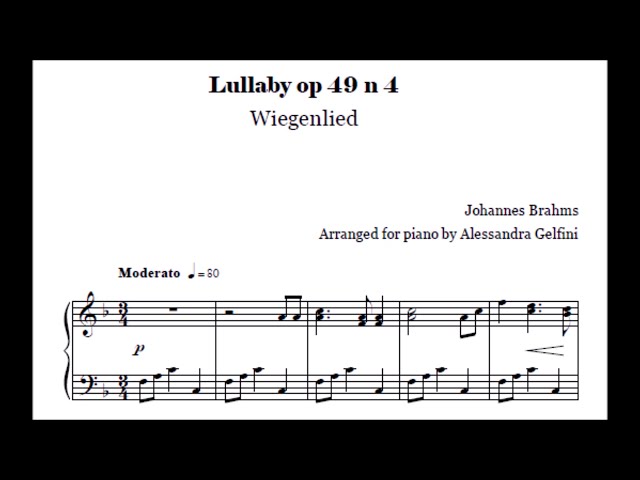
Among classical works, there are several pieces that bear the title “Lullaby.” Among them, alongside those by Schubert and Mozart, one of the most famous is Johannes Brahms’s “Lullaby, Op.
49 No.
4,” widely known as “Brahms’s Lullaby.” Its gentle, sparsely noted melody—typical of lullabies that lull children to sleep—is easy to play on the piano, making it perfect for beginners.
However, precisely because it is simple, the beauty of tone and flow becomes crucial.
Let’s aim for a soothing performance that helps listeners feel at ease and drift off to sleep.

Remember MeKristen Anderson-Lopez/Robert Lopez
This song colors a heartwarming story born from a Disney and Pixar animated film.
It features elements of traditional Mexican mariachi music, with an impressively simple and beautiful melodic line.
With a gentle atmosphere themed around family bonds and memories with loved ones, it plays an important role in the narrative.
Its range is narrow and the melody is simple, making it approachable even for those who have only recently started playing the piano.
In 2018, at the 90th Academy Awards, this piece won Best Original Song, and its universal theme and familiar melody have made it beloved by people across generations.
It’s a perfect choice for anyone who wants to deepen their family ties through music.
The BeatlesLet It Be

When a man is starting to practice singing with self-accompaniment, the first Western song I’d love him to try is the Beatles’ “Let It Be.” It’s a classic with a piano intro that speaks for itself.
The accompaniment is actually simple—you can play it if you learn just four chords, and since it’s in C major, it uses only the white keys, making it easy to remember.
You can’t play the intro and interlude with chords alone, but with a bit of effort and practice, you should be able to master them quickly.
If you enjoy Western music, start your practice with “Let It Be”!

Sonatina No. 9, First MovementMuzio Clementi

For those seeking classical music with a bright, dazzling, and passionate resonance, I’d like to introduce a lively piece by Muzio Clementi.
Published in 1797, this work begins with forceful, energetic phrases and unfolds into light, flowing scale patterns.
Set at an Allegro (fast) tempo, it demands nimble fingerwork and dynamic expressiveness.
The well-balanced interplay of harmonious, beautiful chords and crisp staccato (bouncing tones) creates a splendid sense of brilliance and elegance.
With its clear, approachable melody, this piece is highly recommended for anyone who wants to fully savor the expressive range of the piano or add a vibrant, spirited work to their repertoire.
A Doll’s Dream and AwakeningTheodor Oesten

Allow us to introduce a delicate and beautiful miniature in which the opulence of Romanticism blends with childlike innocence.
Composed by the French pianist Théodore Oesten, this piece gracefully portrays a doll awakening from sleep and beginning to dance.
Structured in three sections, it opens with a gentle lullaby, passes through a dreamy melody, and unfolds into a charming dance.
Published in 1862, the work is also widely known in Japan as the melody signaling that water has finished filling in Noritz-brand water heaters.
Its tender melody and rich variety of moods are captivating, offering a full taste of the piano’s expressive range.
It is recommended for those seeking a brilliant sound and approachable tunes, as well as for listeners who enjoy music that vividly conjures scenes before the eyes.
12 Variations on “Ah, vous dirai-je, Maman” (Twinkle, Twinkle, Little Star Variations)Wolfgang Amadeus Mozart

The masterpiece by the prodigy Wolfgang Amadeus Mozart, Twelve Variations on “Ah, vous dirai-je, Maman” (“Twinkle, Twinkle, Little Star”).
It’s a classic that everyone hears at least once in childhood.
While the famous section is simple enough for beginners to play, the difficulty spikes sharply from the second variation onward.
That said, the overall difficulty ranks in the upper tier of intermediate, and since easy passages appear frequently, it can be considered relatively approachable to perform.
