

[For Seniors] Enjoy the Arrival of Spring Indoors! Recommended April Origami


April is a season when many people take their first steps into new environments, with events like school entrance ceremonies and company induction ceremonies.
Elderly care facilities such as day service centers may also be welcoming new seniors.
This time, we’re introducing recommended origami for April.
Because origami uses the fingers extensively, it’s also used as rehabilitation after a stroke and as a form of brain training.
Everything we’re introducing today is themed around April.
Enjoy creating pieces in origami recreation that let you feel the arrival of spring!
- [For Seniors] Embraced by Spring: Wall Decoration Ideas to Enjoy in April
- [For Seniors] Perfect Finger Exercises! Seasonal Flower Origami
- [For seniors] Enjoy spring: April craft ideas
- For Seniors: Come, Spring! Recommended March Craft Ideas for Daycare Services
- [For Seniors] Spring Wall Decorations: A Collection of Ideas to Brighten Up Your Room
- [For Seniors] Feel the Arrival of Spring: A Collection of Cherry Blossom Craft Ideas
- [For Seniors] Enjoy Cherry Blossoms Indoors: Wall Decoration Ideas
- [For Seniors] Introducing May-themed Origami!
- [For Seniors] Enjoyable Brain Training! Recommended Origami for February
- [For Seniors] Enjoy Something New Every Day! Today’s Origami
- [For Seniors] Haiku for March: Enjoying a Spring Moment with Famous Verses
- [For Seniors] Recommended for day services! Simple and cute small craft ideas
- For Seniors: Feel the Arrival of Warm Spring. Introducing Origami Ideas
[For Seniors] Enjoy the Arrival of Spring Indoors! Recommended April Origami (71–80)
Lotus Blossoms and a Ladybug

Small pink flowers that bloom from around April to June.
When Chinese milk vetch blooms, you can feel the transition from spring to early summer.
This time, we’re sharing an idea for a wall decoration featuring ladybugs flying over a field of Chinese milk vetch.
Make templates from thick paper, then create the petals and calyx.
Combine the petals to form a single flower.
To add a three-dimensional effect, gently round the tips of the petals using scissors.
Make the stems and leaves, and attach each piece to complete the design.
The ladybugs are also crafted to look three-dimensional, so please use that as a reference.
It’s an idea that will instantly brighten the walls of a senior care facility—give it a try!

white clover

White clover, often seen in spring in parks and gardens, is a plant that evokes gentleness and lightness.
Cut a rectangular sheet of origami paper into small pieces and round them to create petal shapes.
By adding a curve to the tips of the petals, you can achieve a realistic-looking flower.
Use long, thin strips of paper to make the stem, and represent the distinctive leaves of white clover.
Arrange heart-shaped pieces of origami in green gradient tones to create the clover.
Finally, decorate with a ladybug made of origami to finish.
Combining white clover and clover makes for a decoration that conveys the arrival of spring, even from the wall.

Tulips and windmills

The wall decorations of tulips and windmills that evoke a spring atmosphere feature a bright, warm design.
Cut red and yellow origami paper to make the tulip petals.
Add small slits at the tips of the petals and glue them overlapping to create a three-dimensional effect.
Make the stems and leaves with green origami, and when arranged on the wall, it gives the impression of a field of spring plants spreading out.
For the windmills, cut out the base and cross-shaped parts and assemble them into a windmill.
Finely cut the propeller section, add windows and embellishments, and glue them on to enhance the three-dimensional look.
The vivid colors of the tulips and the windmill design create wall decorations that convey the warmth of spring.
[For Seniors] Enjoy the Arrival of Spring Indoors! Recommended Origami for April (81–90)
Tulip hina

Tulips are one of the essentials of spring, and the way their brightly colored flowers bloom so vigorously conveys the joy of the season.
This craft combines tulip blossoms with Hinamatsuri (Girls’ Day) motifs to create a project that feels distinctly springlike.
The base is construction paper cut into a tulip shape; onto this, you add origami clothing and decorations to complete the Hinamatsuri theme.
For the two main figures, make slits and then glue them together to give them a three-dimensional look so they stand out from the rest—that’s the key point.
Finish it off with leaf parts and surrounding tulips to create an overall festive look.

Poppy

Poppies, which bloom from spring to summer, are also known as hinageshi or gubijinsō, and they produce colorful, round, and charming flowers.
This craft aims to create poppies that feel like the joy of spring, making them look three-dimensional as if they’re popping out from the backing paper.
You cut origami into petal shapes and assemble them into a flower, layering the pieces after making slits to give the flower a three-dimensional form.
Once the petal outline is done, place yellow in the center, and finally combine it so it looks like it’s blooming from the stem and leaf pieces attached to the backing paper, and you’re finished.
plum blossoms
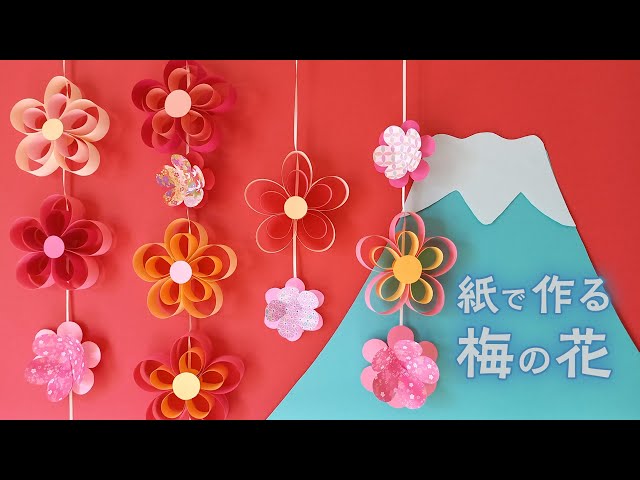
This is a three-dimensional decoration that combines paper strips, using plum blossoms—symbols of the coming of spring—as its motif.
Bundle together the ends of two strips in different lengths and colors, then align the remaining ends to form a double curve, like a petal.
Next, combine the petals and attach a circle of paper in the center to complete the plum blossom.
While red and pink are classics, it’s also fun to try various colors and see how the impression changes.
Arranging blossoms in different sizes will further emphasize the three-dimensional effect.
school cap

Perfect for the new school term! Here’s an idea for making a “school hat” out of origami.
First, place the colored side of the paper facing up and fold it in half.
With it in this position, lift the top layer and fold it down to align with the bottom edge, then fold it once more.
Flip the paper over, and fold the top two corners down to the middle of the bottom edge to form a triangle.
Next, fold the left and right sides inward, about 1 cm away from the center line.
While holding down the small triangle created by the folds, pull up the overlapping top edges you tucked in and open them as you fold.
Slightly fold the top (head) part of the hat inward, flip the paper over, and tuck in any parts sticking out from the brim so they don’t show—and you’re done!
