

[Get Friendly with Games] Math Games, Apps, and Activities

There are probably many people who still struggle with math even as adults.
If only we had gotten more comfortable with it back when we were little—maybe starting from basic arithmetic—we might not feel so intimidated by math now, right?
In this article, we introduce math games for children that help them get familiar with arithmetic from the early years of elementary school—fun activities that teach math through play.
We’ve lined up a wide range of options, from games kids can play solo to ones for groups, including apps and card games.
Of course, adults can enjoy them too, so be sure to try playing together with your child!
- How many can you solve? Brain-flexing math riddle quiz
- A game where you can learn the multiplication table while playing
- Math quiz for elementary school students
- A math quiz for adults. Can you solve it?
- [Play Right Away!] Exciting Recreation Games Recommended for Elementary School Students
- [For Elementary School Students] Cipher Quiz: Fun Puzzle Riddles
- [Interesting] Collection of Matchstick Quiz Problems
- Learn by Playing! Recommended Games with a Kanji Theme
- [Elementary School] Quick and Easy! Indoor Recreational Activities Perfect for Lower Grades
- [Playable from lower grades] Japanese language games and activities
- Recommended for upper elementary grades! Exciting indoor recreation and games
- [Elementary School] Recommended Ideas for Morality Games: Learn Through Play
- [Easy] Quizzes That Elementary School Students Can Solve! A Collection to Nurture Wisdom
Getting Friendly with Games: Math Games, Apps, and Activities (11–20)
Multiplication Sugoroku

A game where you move forward the number of spaces equal to the product of two numbers: Multiplication Sugoroku.
Prepare several cards with numbers on them, draw two cards, multiply the numbers, and move forward that many spaces.
It’s fun to craft your own sugoroku board, and best of all, multiple people can play together.
Many of you have probably experienced the joy of playing sugoroku with others.
The key is to keep the numbers on the cards small so players don’t leap too far ahead at once.

Column addition game

It’s not just about solving problems—you develop your thinking skills, too.
This “Two-Digit Addition Column Game” is played like a card game.
You place number cards from 0 to 9 into a vertical addition grid and repeatedly do two-digit additions.
Its key feature is trying to get the answer as close to 100 as possible.
You swap the cards you’ve taken with the remaining ones while aiming for 100, so it’s not simply about doing as many additions as you can.
It might help build applied math skills.
Learn Addition and Multiplication Tables! Scissor Calculation Game

The math learning board game that uses a numbered board and dice is called “The Scissor Calculation Game: Learn Addition and the Times Tables!” To give a quick overview: for example, you choose a number on the vertical axis, roll the dice to get a number on the horizontal axis, add them together, and place your piece on the square with the answer.
If, on the straight line connecting the piece you placed with the numbers you selected on the horizontal and vertical axes, there is an opponent’s piece, you can capture it.
The player who has more of their pieces on the board at the end wins.
It makes you think quite a bit, so it could be good brain training for adults too.
Trump addition game
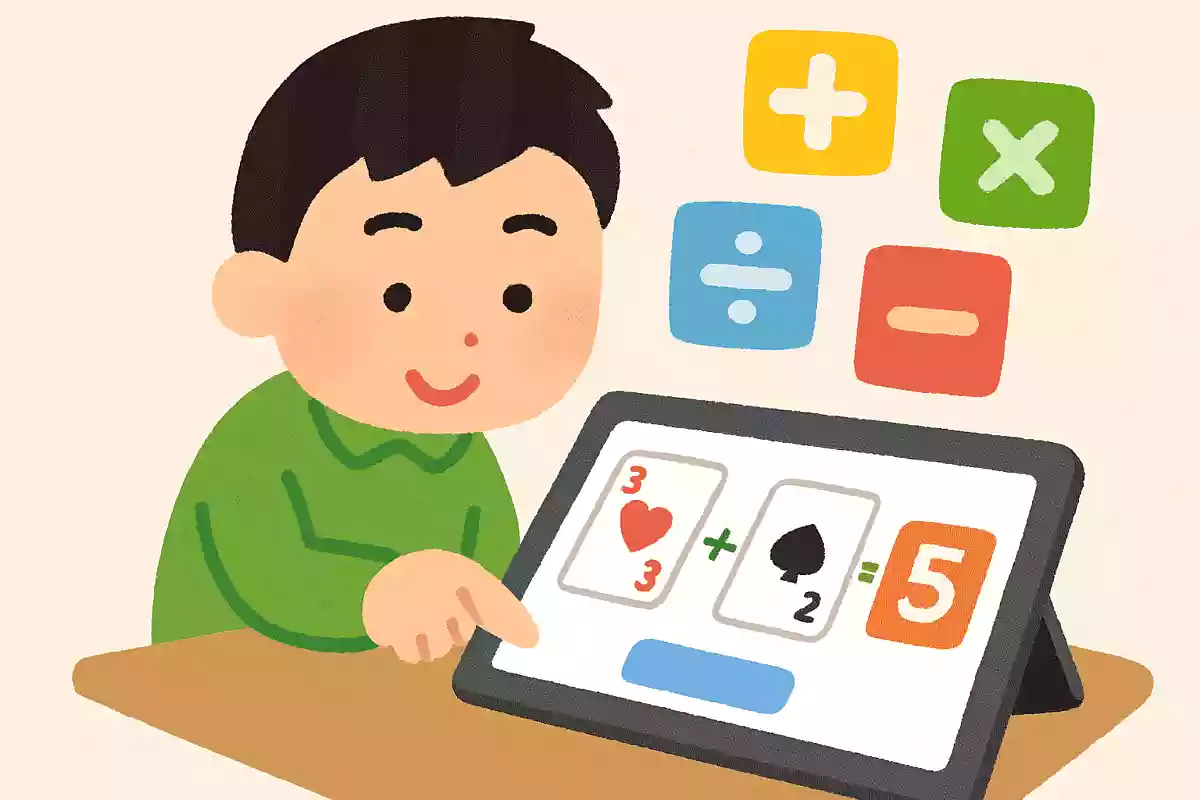
A game where you place four face-down cards each for numbers 1 through 6, then flip cards while doing mental arithmetic to reach the target number.
It’s like a mix of Concentration and mental math.
If you hit the target number exactly, you get to keep the cards.
If you exceed the target, you lose and the next player takes a turn.
When all face-down cards are gone, the player with the most cards wins! By remembering where you flipped certain cards and figuring out which numbers you need to win, you build memory and situational judgment—and of course you train your mental arithmetic skills too!
Halli Galli

I think elementary school kids who’ve learned addition will have a blast playing the quick-reflex game “Halli Galli”! It’s a game that trains mental calculation and reaction speed: each card shows 1 to 5 pieces of fruit, players deal out the cards evenly, and take turns flipping them over.
If the total number of the fruit on top adds up to 5, whoever rings the bell on the table first wins that round and takes all the face-up cards.
In the end, if you run out of cards, you lose! Let’s build the reflexes to hit the bell the instant the total reaches 5.
Kuku: Multiplication-Table Trump Cards That Make You Smarter

There’s a must-try game for elementary school kids learning their times tables! “Kukuppu” is a card game where players take turns playing cards, and the first person to play all their cards wins.
When you play a card, you say the multiplication shown on it, so it really helps you memorize the times tables.
Plus, like UNO, some cards have special effects—reversing the turn order, making the next player draw two cards, and more—so you need strategy to win.
It’s a game that both adults and kids can enjoy together!
Doraemon: Parent and Child Number Play

For kids who are naturally familiar with digital devices, learning math through apps can be very effective! The Doraemon app “Oyako de Sūji Asobi” lets children learn addition, subtraction, and multiplication with Doraemon characters in a game format.
When you clear stages, you receive cards, so you can collect cards of various characters.
There’s also a mode where Doraemon presents math problems, so kids can keep learning without getting bored.
It’s great for studying on the go or independently!
Guess the weight game

If you want to get familiar with numbers and the weight of objects, try this game! The “Guess the Weight Game” is a play activity where you look for items that are as close as possible to a reference weight.
The only thing you can rely on is your own sense—remember the feeling of holding exactly 100 grams, then pick up various objects to check and bring the one you think is right.
It’s simple, but incredibly fun.
To tie it to math, how about a rule like “add up the weights of the items you brought to get closer to the target value”? I think it’s a game that can really shine depending on your ideas.
Area Capture Game

How about learning math with a drawing-like feel? It’s a territory-grabbing “Area Capture Game” that uses shapes to compete for grid squares.
It’s a two-player game: prepare a sheet of paper with a grid, then take turns drawing predetermined shapes on it.
The game ends when your shapes and your opponent’s shapes connect to divide the board into two territories.
The player with more white squares in their own territory wins.
The rules might be somewhat similar to Go.
Guessing which shape your opponent will play next and how you’ll counter it makes the battle really engaging.
Newspaper-Length Game

It’s important to develop a feel for “about this much,” isn’t it? Even if you can’t measure precisely, having a sense of approximate quantities is handy when the moment calls for it.
The “Yamakan Length Game” is a game where you guess approximate lengths.
Cut a newspaper into strips, then cut a strip to match the target length; the person whose strip is closest to the target wins.
The trick is to remember the reference length from the first round and make good use of it in the second round.
That way, even if you miss the first time, you can get pretty close on the second try!