

J.S. Bach | Introducing Famous and Representative Works

The songs that are popular today—across not only classical music but also pop and jazz—are deeply influenced by past composers.
Among them, classical music is often called the foundation of music, and it’s no exaggeration to say that Johann Sebastian Bach, known as the “Father of Music,” was one of the figures who laid that very groundwork.
Bach’s music, while carrying a religious hue, is characterized by philosophical depth and intricately refined structure down to the finest details, with melodies of exceptional beauty.
Please take a look into the world of Johann Sebastian Bach, one of the greatest composers in history.
- J.S. Bach | Introducing Famous and Representative Works
- J.S. Bach Popular Songs Ranking [2026]
- [Masterpiece Classics] A special showcase of gem-like masterpieces so beautiful they’ll move you to tears
- Handel’s Masterpieces | A Comprehensive Introduction to His Popular Works
- [Baroque Music] A Curated Selection of Timeless Masterpieces and Famous Works
- Vivaldi’s masterpiece. Popular classical music.
- Today's Classics: Recommended classical music and great performances to listen to today
- Mozart: An Introduction to His Signature and Popular Works
- Popular classical piano pieces. A collection of masterful performances by Japanese pianists.
- Cool classical masterpieces. Recommended classical music.
- [Quartet] Masterpieces and Popular Pieces for String Quartet
- François Couperin Popular Songs Ranking [2026]
- Masterpieces of Ballet Music: Introducing Classic Favorites
J.S. Bach | Introducing Famous and Representative Works (91–100)
Invention No. 8, BWV 779J.S.Bach

This piece in F major, in 3/4 time, begins with ascending broken chords brimming with the energy of a fanfare, creating a bright and lively atmosphere.
The distinctive rhythm produced by the interplay of the upper and lower voices—chasing each other with a one-bar delay—is pleasing to the ear and sets listeners’ hearts dancing.
Although written for educational purposes, its musical appeal holds audiences spellbound.
The passages that use the left hand’s 3rd, 4th, and 5th fingers are somewhat challenging, but with practice, this is a wonderful piece for experiencing tangible improvement in two-handed technique.
With its cheerful, brilliant character and a well-balanced technical challenge, it’s an excellent choice for a recital.
Kyrie “From J.S. Bach: Mass in B minor”J.S.Bach

The majestic and dignified vocal piece “Kyrie” is sung in Johann Sebastian Bach’s Mass in B minor (BWV 232).
Alongside the St.
Matthew Passion and the St.
John Passion, the Mass in B minor is regarded as one of the finest masterpieces among Bach’s compositions.
J.S. Bach | Introducing Famous and Representative Works (101–110)
Symphonia No. 1 in C majorJ.S.Bach

This delightful miniature features a bright, lively three-voice piano melody and was composed in 1720 for the education of the composer’s son.
From the very opening, the flowing main theme is elegantly handed from the upper voice to the middle and then the lower, showcasing the intricate counterpoint characteristic of Baroque music.
Its unbroken melodic lines and pleasing harmonic progressions are full of charm that captivates listeners.
The passages speak clearly, the phrasing connects naturally, and it is an ideal performance piece for upper-elementary students.
With its sparkling layers of sound and rich expressiveness, it will lend a brilliant flourish to any recital stage.
Bach Chorale “Jesu, Joy of Man’s Desiring”J.S.Bach

It is “Herz und Mund und Tat und Leben” (Heart and Mouth and Deed and Life), composed by Johann Sebastian Bach, a composer and keyboardist active in 18th-century Germany.
This church cantata consists of ten movements, and this video features a performance of the chorale known as “Jesu, Joy of Man’s Desiring.”
Orchestral SuiteJ.S.Bach

These are orchestral works composed by Bach.
Consisting of four independent suites from BWV 1066 to 1069, each comprising four highly appealing pieces, the collection is considered a consummate example of the French overture style.
Among them, the second movement of the Third Suite is especially famous as the “Air on the G String.”
MinuetJ.S.Bach
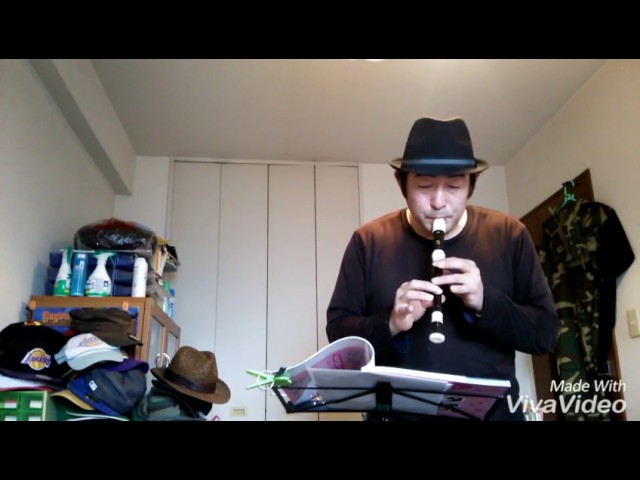
The “Minuet” is often performed not only on the recorder but also on instruments like the piano.
If you play it in F major, it only has one flat and is easy to perform.
The melody climbs smoothly and includes some higher passages, which might be a bit challenging, but it’s a piece that works perfectly well at a slow tempo, so start by taking it slowly.
This piece is known as a work by Bach, but in fact it was originally composed by a composer named Petzold! It’s said that Bach gave the piece to his wife at the time without mentioning the composer, which led to the misunderstanding that it was Bach’s own work.

Jesus, Joy of Man’s Desiring (Lord, the joy of human longing)J.S.Bach

It is known as a masterpiece by Bach, a representative composer of the Baroque era.
Its graceful triple meter feels pleasant and creates a calm, meditative atmosphere.
The music is characterized by a sense of religious depth and peace.
It was revised and premiered in 1723 for a festive visit in Leipzig.
Often favored at weddings and other ceremonies, its solemn, gentle tempo is perfect for welcoming guests.
It’s also recommended for times when you want to settle your mind or feel at ease.