

[For Seniors] Fun 3-Choice Animal Quiz! Introducing Questions Full of Surprises and Discoveries


Why not have fun learning about animals’ surprising behaviors and curious habits? We’ve gathered multiple-choice quizzes you can enjoy discussing with older adults, sharing moments of “Wow!” and “I didn’t know that!” together.
The questions range from easy ones that are simple to answer to a few that make you think a bit.
These quizzes are great for stimulating the brain in an enjoyable way, making them perfect for recreation or everyday conversation.
Whether you love animals or don’t know much about them, you can spend a pleasant time discovering the charm of animals from around the world.
- [For Seniors] Proverb Quiz with Animal Names
- [For Seniors] Multiple-Choice Quiz Collection About Living Creatures
- [For Seniors] Laugh-Out-Loud, Crowd-Pleasing! Fun Quiz
- [For Seniors] Liven Things Up! 3-Choice Ranking Quiz
- [For Seniors] Trivia Multiple-Choice Quiz
- [For Seniors] Fun and Informative! Health Trivia Quiz
- [Brain Training] Lively Word Quiz for Seniors
- [For Seniors] Who Am I? Quiz: A Fun Set of Questions with Exciting Hints
- Let's take on a four-choice quiz that everyone can enjoy together!
- [For Seniors] Boost Your Knowledge! Fun Trivia Quiz
- [For Seniors] Recommended Trivia Quizzes & Fun Facts for November
- [For Seniors] Great for killing time! A fun three-choice trivia quiz
- [For Seniors] Fun and Easy! Dinosaur Multiple-Choice Quiz (3 Options)
[For Seniors] Fun 3-Choice Animal Quiz! Introducing Questions Full of Surprises and Discoveries (1–10)
What color is a panda’s tail?

- black
- white
- brown
See the answer
white
A panda’s tail is actually white. While its body pattern is black and white, the tail is distinctively white and cute. Many Japanese people reportedly believe that a panda’s tail is black. This is because when Kan Kan and Lan Lan arrived at Ueno Zoo from China in 1972, a Japanese toy manufacturer sold stuffed pandas with black tails. The makers hadn’t seen real pandas and designed them from imagination, which led to the idea of a black-tailed panda spreading in Japan.

Why do flamingos stand on one leg?
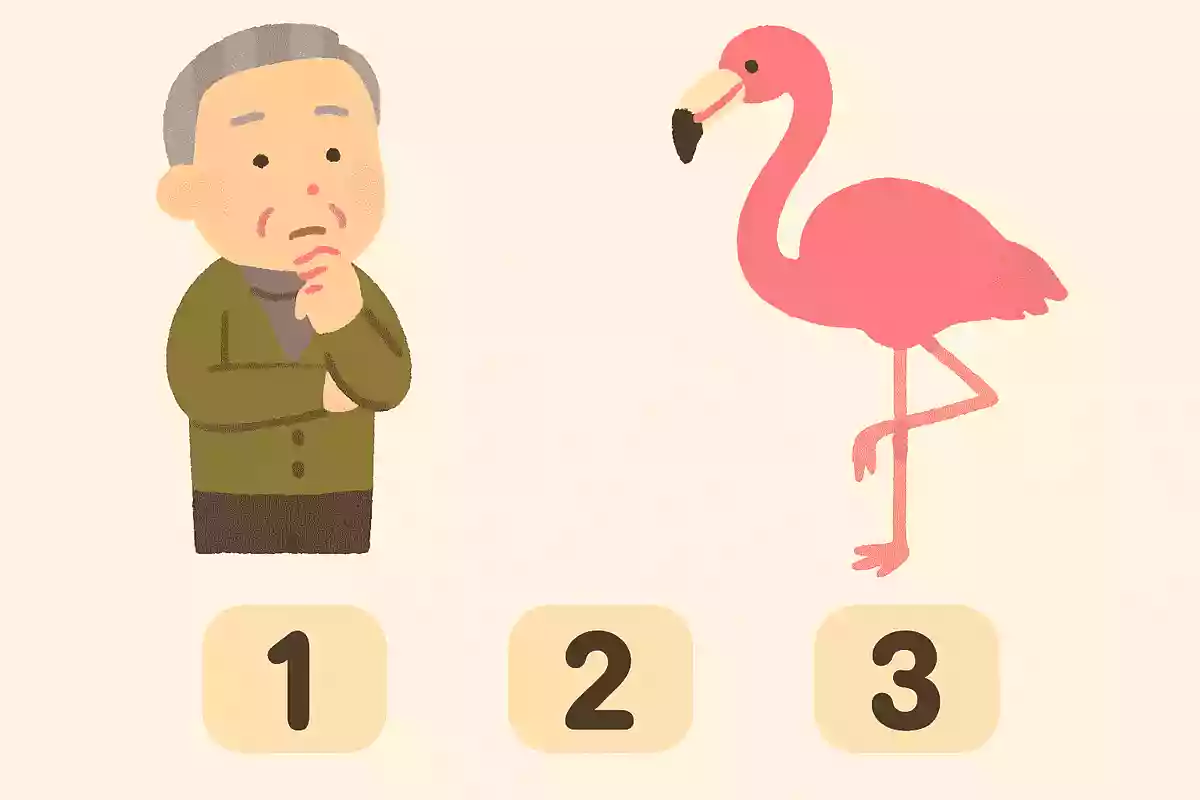
- To improve my sense of balance
- To prevent body heat from escaping
- To make it harder for the enemy to find you
See the answer
To prevent body heat from escaping
Flamingos stand on one leg to prevent their body temperature from dropping even in water. Because birds’ legs generally lack feathers, they cool down easily when exposed to air or water. By tucking one leg up into their bodies, flamingos reduce heat loss.
Which of the following foods should absolutely never be given to dogs?

- chocolate
- carrot
- sweet potato
See the answer
chocolate
Chocolate contains theobromine, which is harmful to dogs, and eating it can cause symptoms such as vomiting, diarrhea, palpitations, and tremors. In the worst case, it can be fatal, so you must never give it to them. In addition to chocolate, it’s best to avoid cocoa and products that contain caffeine.
[For Seniors] Fun 3-Choice Animal Quiz! Introducing Questions Full of Surprises and Discoveries (11–20)
What color is a polar bear’s skin?

- white
- black
- pink
See the answer
black
Polar bears may be covered in fluffy white fur, but their skin is actually black. Because they live in extremely cold regions, they have a thick layer of fat beneath their skin. Their white fur lets sunlight pass through, and the black skin absorbs the sunlight, helping to keep their bodies warm.
What should I do to stop a dog from barking?

- gaze into (someone's) eyes
- walk backwards
- sing a song
See the answer
walk backwards
The answer is to walk backward. It’s said that if you turn your backside to the dog, it won’t bark. There are some dogs that bark loudly and can be scary even during a walk. In such cases, walk backward and quietly move away.

What behavior does a tanuki exhibit when it is surprised?

- to faint
- to bite; to snap at
- dig a hole
See the answer
to faint
Raccoon dogs are quite timid animals. If they get startled, they faint. You don’t see them much in the city these days, but in the countryside you might come across one. If you do, try not to startle it and just watch quietly from a distance.
Why do camels have long eyelashes?

- To protect oneself from natural enemies
- Because (I’m) hairy.
- To protect the eyes from sand
See the answer
To protect the eyes from sand
Since camels live in the desert, it seems their eyelashes have become long to protect their eyes from sand. It’s the same role for humans too—to keep debris from getting into our eyes. Camels have likely grown strong and evolved to thrive in the desert.