

![[Brain Training] Lively Word Quiz for Seniors](https://i.ytimg.com/vi_webp/fzj9Zes4M4M/maxresdefault.webp)
[Brain Training] Lively Word Quiz for Seniors


Word quizzes are a type of recreation that really livens up day services and senior facilities.
Brain training can seem difficult, but these are easy for anyone to enjoy.
In this article, we’ve gathered word-related quiz questions recommended for older adults.
We introduce many ideas, including quizzes you can do while watching videos and ones you can customize, so we hope you find them helpful.
Try adding word quizzes to your daily recreation and give brain training a go!
[Brain Training] Lively Word Quiz for Seniors (1–10)
Old Words Quiz

Even when referring to the same thing, the names we use can differ between the past and the present.
A quiz on old-fashioned words is sure to be a hit as a recreational activity—nostalgic for older adults and fresh for younger generations.
If you go far enough back in time, you’ll even find names you’ve never heard before, so people of all ages can make new discoveries while enjoying the game.
And of course, even quizzes tailored for seniors can serve as brain training by stimulating memory, so everyone, please give it a try.

Wordplay Riddle Quiz

The wordplay quiz where you create new words by adding numbers to given words is a simple yet stimulating recreational activity that can help activate the brain.
For example, by adding “san” (three) to “fuji,” you get “Fujisan” (Mount Fuji).
It’s an easy question anyone can understand, but you still have to think until the answer clicks! Start with the numbers one through ten, and once you get used to it, using numbers like one hundred or one thousand will broaden the range of problems.
It’s a highly satisfying activity when the combined words lead you to the answer, and it’s especially recommended for older adults.
Letter Rearrangement Quiz
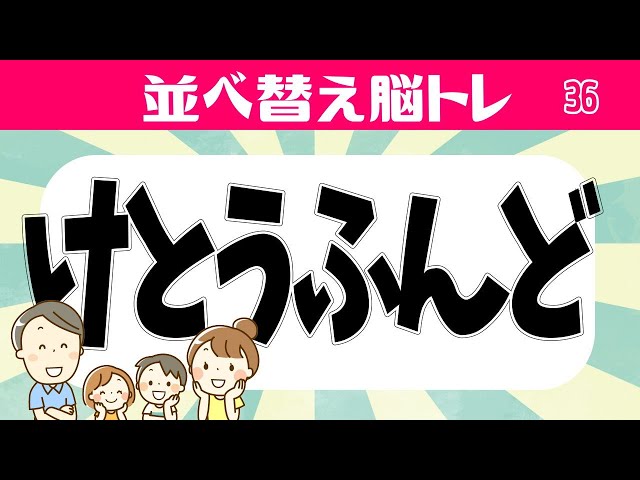
Word-scramble quizzes, where you rearrange scattered letters to find the correct word, can be surprisingly tricky even with a small number of letters—and that makes them exciting.
Start with three-letter words to get the hang of it, then gradually increase the number of letters for a good brain workout.
They help develop both the spark for how to rearrange the letters and the ability to picture what the rearranged word might be, so they’re enjoyable for anyone, not just older adults.
By adjusting the number of letters and the time limit, you can create many variations—it’s a highly recommended recreation activity.
Proverb Quiz

A proverb quiz where part of the saying is hidden and you guess what goes there is a perfect game for seniors.
Even proverbs and idioms we use casually every day suddenly don’t come to mind when they’re turned into fill-in-the-blank questions, which helps stimulate the brain.
If randomly chosen proverbs are too hard to answer, you can adjust the difficulty by, for example, limiting the hidden words to animals.
If you still can’t think of the answer, using the meaning of the proverb as a hint can help train your imagination as well.
Give it a try!
Character Count Brain Training

A brain-training game where you pick one kana from the 50-sound chart and try to find the longest possible word that starts with that character can be expected to stimulate cognitive function.
At first, participants can call out any words they think of, even just two or three characters long, and when no more ideas come up, the person who produced the longest word wins—so everyone will be racking their brains.
By not limiting the categories—welcoming easy ideas like vegetables or fruits, as well as personal names and country names—you might get surprising answers.
It’s a sure-fire, lively recreation activity that we highly recommend for older adults.
palindrome

Do you know what a palindrome is? A palindrome is a sentence that reads the same forwards and backwards.
For example, “たいやきやいた” reads the same even when reversed.
Let’s all try coming up with palindromes like this.
Another approach is to prepare a set of characters in advance and rearrange them.
In that case, it may be easier to reveal the central pivot part and then fit the characters around it accordingly.
There are also YouTube videos that pose such challenges, so feel free to use them as references.

Abbreviation Quiz

Among the words we casually use every day, quite a few turn out to be abbreviations.
Quizzes that ask for the full names of items like ballpoint pens or textbooks can stimulate the brain by making you think.
They’re also recommended because learning the answers can lead to new discoveries.
However, people’s knowledge varies by generation, so you should consider the direction of the questions based on who will answer them.
If the respondent doesn’t know the abbreviated term itself, it won’t work as a quiz, so be mindful when creating the questions.