

![[For Seniors] Fun Riddles That Stimulate the Brain](https://media.ragnet.co.jp/img/1200__png__https://www.ragnet.co.jp/files/2025/04/401161eadb8269482fa1da35d0de265c.webp)
[For Seniors] Fun Riddles That Stimulate the Brain


Riddles have a mysterious charm, don’t they? That exciting feeling that makes you want to keep thinking until you find the answer—why not enjoy it together with older adults? This time, we’ll introduce simple, humorous riddles based on familiar words from everyday life.
Thinking together naturally gets the conversation going and fills the time with smiles.
When you figure out the answer, be sure to share that delightful “I get it!” moment with everyone.
Simple riddle questions (1–10)
What fruit appears when you ring the bell five times?

Here’s a simple riddle about fruit.
What fruit appears when you ring a bell five times? If you think of a common fruit, you might figure it out.
Hint: Try expressing the sound of a bell as onomatopoeia, and you’ll get closer to the answer! The correct answer is “apple.” The key is the bell going “rin-rin” and the number “five” in Japanese.
Apples are familiar to many people—not only can you eat them as they are, but you can also enjoy them as juice, jam, pie, jelly, and more.
Even though you went to the trouble to attach it, what kind of “mochi” can’t be eaten?

The phrase “since you went to the trouble of getting there” is the key to this riddle.
And if you associate “things that stick” (tsuku) and “mochi,” you’ll naturally arrive at “shirimochi” (falling on one’s backside).
By the way, do you know why falling on your butt is called shirimochi in Japanese? Originally, shirimochi referred to a custom where a child under one year old was made to carry mochi on their back and then gently tipped to fall on their bottom.
That’s why even now, falling on your backside is called shirimochi.
Incidentally, it was considered good luck for a baby to fall, so shirimochi was also seen as an auspicious event.

What kind of tree is the tree that exists inside the bodies of humans and animals?

A tree inside the bodies of humans and animals.
Normally, you wouldn’t expect a tree inside a body, but think flexibly.
First, if it’s found in both humans and animals, you might think it’s an organ.
And among organs that are pronounced the same as ‘tree’ (ki) is ichō—meaning the stomach and intestines in Japanese.
If you approach it like a word-association game, this riddle might be easy to solve.
By the way, some might think, “Aren’t there animals without stomachs and intestines?” but most animals do have them.
However, as a rare exception, the platypus lacks a stomach.
There are four rocks swimming in the sea. What on earth could they be?

The key points are “in the sea,” “rock,” “four,” and “swimming,” right? First, since it’s swimming in the sea, we can infer it’s a fish.
Then, combining “rock” (iwa) and “four” (shi), we get “iwashi,” sardine.
By the way, the origin of the word iwashi is said to be “weak” (yowashi), named because they die easily.
There are many riddles that can be solved with similar wordplay, so this seems like a good practice problem.
Definitely try looking for similar ones and give them a shot.
What kind of elephant can you eat, even though it’s an elephant?

It’s a classic type of riddle where you focus on the sound of a word and follow words that contain that sound according to the puzzle’s conditions.
Since the animal “elephant” (zou) isn’t associated with eating, it helps to imagine a food that contains the sound “zou.” The fact that there are only a few foods with that “zou” sound is also a key point, and narrowing down the answer gives your brain a good workout.
It’s a puzzle that brings to mind the simple food name that includes the word “zou,” namely ozōni (New Year’s soup), as the answer.

What fruit is good at judo, kendo, and karate?
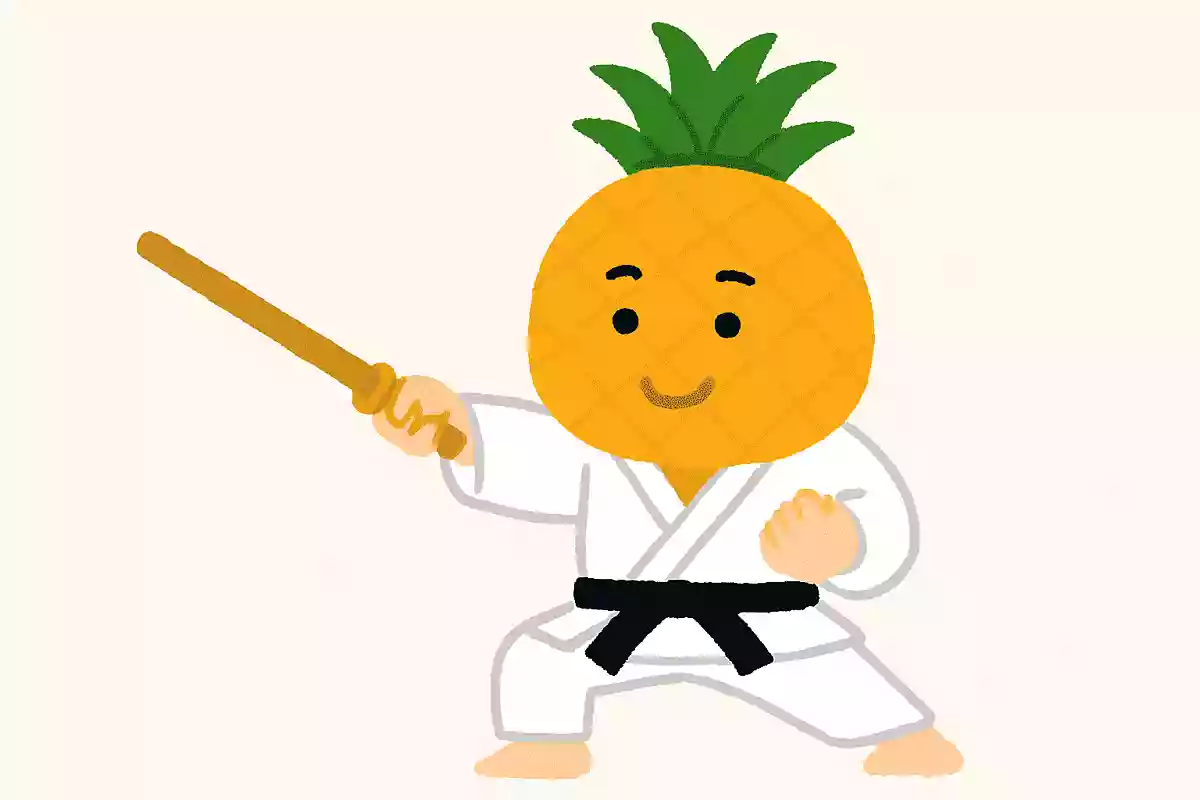
Let’s try a riddle that hinges on words that sound the same but have different meanings.
Which fruit is good at judo, kendo, and karate? If you take the sentence literally, it seems impossible that a fruit would do judo, kendo, or karate.
The hint is to think about what you call judo, kendo, karate, and similar disciplines collectively.
The answer is “grape” (budō).
It sounds the same as the fruit “grape” (budō), but judo, kendo, and karate are collectively referred to as “martial arts” (budō) in Japanese.
It’s a fun riddle that plays on different meanings of the same sound.
Even a barrel is a barrel, but what do you call a barrel that glows?

This is a type of problem where you imagine the given conditions and narrow down the answer from there.
Instead of picturing a barrel, focus on the sound of the word and think about how to arrive at something that fits the conditions.
If you start from the word ‘taru,’ the range is broad, so it may be easier to first imagine something that shines and then gradually narrow it down toward the word ‘taru.’ An item characterized by light that contains the sound ‘taru’—the answer is ‘hotaru’ (firefly).