


Shiritori has long been a beloved game.
It’s also hugely popular as a way for seniors to train their brains and as a venue for communication.
There aren’t any difficult rules—here are some fun variations of shiritori packed with clever twists that make it enjoyable and easy for anyone to start.
There are so many types of shiritori!
Simply connecting words gives your brain a workout and helps you feel refreshed!
Find something that looks interesting in the article and enjoy a wonderful time with your family and friends!
- [For Seniors] Enjoy Brain Training with Fill-in-the-Blank Shiritori!
- [For Seniors] Fun and Engaging Brain-Training Recreation
- [For Older Adults] Games to Enhance Oral Function: Enjoyable and Easy to Do
- [For Seniors] Lively Wordplay Game: Fun Recreation for Elderly Care
- [For Seniors] Extremely Effective Brain Training! A Fun Collection of Hand Games
- [For Seniors] A Brain-Training, Crowd-Pleasing Word Search Game
- [For Seniors] Recommended Easy Strength Training
- [For Seniors] Enjoyable Brain Training! Proverb Quiz Collection
- [For Seniors] Fun Brain Training! Lively Mind Exercises
- Conversations Made Easy! A Collection of Topics That Elderly People Enjoy
- [For Seniors] Fun and Exciting! Difficult Kanji Quiz
- [For Seniors] Fun! Games and Ideas to Boost Memory
- [For seniors] Fun brain training! Let’s get excited with the “Aru-Nashi” quiz
[For Seniors] Fun Shiritori: Enjoyable and Easy (1–10)
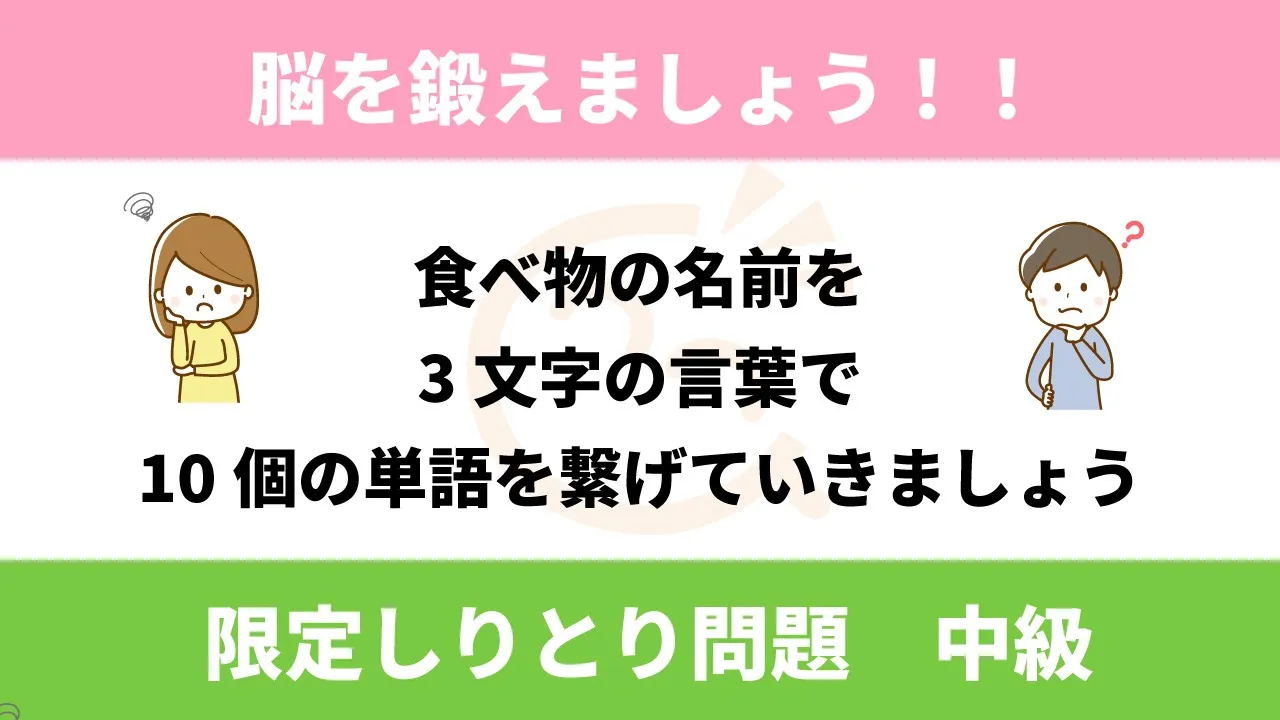
3-letter food shiritori

Even a simple shiritori game where you just connect words can feel challenging with a small rule tweak.
How about adding a rule where players can only use three-letter food names? While it’s limited to foods, there’s still a wide range of words you can use, so keep a steady tempo as you link them.
If you play in time with a rhythm, it adds a bit of pressure and makes the game even more exciting—highly recommended!

Balloon Shiritori Volleyball

Balloon Shiritori Volleyball also helps stimulate the brain.
Have the seniors sit on chairs in a circle and play shiritori.
When it’s their turn and they give a valid answer, they can pass the balloon to the next person.
However, if their word ends in “n” or they get stuck, have them rally the balloon a few times right then.
Once everyone gets used to the game, gradually increase the difficulty.
For example, set a required number of letters for the answers, or measure the rally by seconds instead of the number of hits.

Shiritori using 2 letters

Speaking of shiritori, it’s the classic word game where you take the last character of a word and connect it to a new word.
Let’s make it a bit trickier by using the last two characters to link to the next word.
Even though you’re using more letters, that part isn’t too hard—the real challenge is making sure the second-to-last character isn’t “n,” which would end the chain.
Once you get used to the rules, you can spice it up further—like limiting it to four-letter words—to make it even more exciting.
Shiritori Arrangement

Let’s try playing shiritori by arranging word cards written on paper.
You can make word cards using hiragana, katakana, kanji, or English words.
For example, with kanji cards, from 葉書 (hagaki) to 書道 (shodō), the last kanji of one word becomes the first kanji of the next word.
For English words, do the same by matching the last letter of a word with the first letter of the next word.
There will be multiple cards, and you’ll think through and decide the order of the words from there.
It might be more difficult than regular shiritori.
Please support and engage gently with older adults so everyone can enjoy it together.
Forming teams for a head-to-head match could also make it exciting.
Hole-blank Shiritori

Let’s try leaving blanks in a shiritori chain and think them through together with older adults.
For example, what word could fit between “kujira” (whale) and “burashi” (brush)? There isn’t necessarily only one correct answer, so you might hear a variety of responses from the seniors.
Coming up with words to fill the blanks helps stimulate the brain.
It’s also recommended as a lively, group-friendly version of shiritori.
It can spark conversations with those around, helping seniors engage in communication.
Of course, you can also print the prompts on a whiteboard or paper and enjoy solving them in a smaller, more focused group.
Let’s connect words with shiritori

Let’s play shiritori (word chain) by connecting the arranged characters one by one to reach the goal.
From the many letters, you move vertically and horizontally to continue the word chain.
It could be fun to include some trick paths where, even if you make a valid word, you can’t proceed next.
If you manage the word chain well and reach the goal, older adults are likely to feel a sense of accomplishment.
Searching for words among the letters stimulates the brain, so you can also expect brain-training benefits.
It’s a shiritori game you can enjoy by thinking carefully on your own or lively with a small group.
Shiritori Card Game

Let me introduce a Shiritori game with a card-game twist.
Prepare a deck with one card for each of the 50 Japanese syllables and hand them to older adults.
Give each person five cards to start the game.
Place the remaining deck in the center and flip one card face up to start.
Players take turns playing a card whose syllable continues from the syllable on the current card.
Decide on the turn order, such as clockwise or counterclockwise.
This Shiritori played like a card game may feel fresh and fun for older adults.
Adding rules—like limiting words to three syllables—can make it even more enjoyable.