

![[For Seniors] DIY Hand Rehabilitation Tools to Strengthen Fingertips: A Collection of Handmade Ideas](https://i.ytimg.com/vi_webp/k8jpZUP9bz8/maxresdefault.webp)
[For Seniors] DIY Hand Rehabilitation Tools to Strengthen Fingertips: A Collection of Handmade Ideas


Daily rehabilitation exercises performed by seniors contribute to both mental and physical health.
Finger rehabilitation in particular is recommended, as it provides beneficial stimulation to the brain.
In this article, we introduce handmade items that are great for finger rehabilitation for older adults.
With the goal of improving finger function, we’ve gathered easy-to-incorporate, DIY ideas for everyday life.
You can easily get the materials at 100-yen shops, so why not give them a try? If you’re thinking about making your own rehab items, be sure to use this as a reference.
[For Seniors] Rehabilitation Items to Train Finger Dexterity: Handmade Idea Collection (1–10)
Shoelace tying

Let’s use familiar items to improve the ability to skillfully use your hands and fingertips for precise, detailed tasks.
This time, we’ll use a shoe insole and a lace.
Make holes in the insole similar to those in a shoe so you can thread the lace through.
By lacing it like a shoelace, you can train dexterity—the ability to perform fine motor tasks accurately.
Dexterity is an important physical function directly connected to daily life, such as carrying objects, writing, and opening bottle caps.
With easy shoelace tying, it seems like you could keep up with the training every day.

Button sewing
Let’s try making training tools using scrap materials or items from a 100-yen shop.
Leftover felt pieces and buttons from a craft activity can be transformed into rehabilitation tools.
If you don’t have them, make use of items sold at 100-yen shops.
Cut the felt into squares of about 3 centimeters and make a buttonhole in the center.
Thread the button with string and tie it, then pass it through the felt’s buttonhole.
It may be difficult to pass the button through at first, but with repeated practice you’ll get the hang of it.
Since it’s portable, one of the appealing points is that you can train anytime, anywhere.
Zipper open/close
What kinds of everyday items use zippers? There are pants and jackets, bags, and fabric pencil cases, for example.
Zippers can be difficult to operate if the pull tab is small or your hand movement is limited.
Also, since you open and close zippers by moving your wrist, they’re said to be effective for exercising your fingertips and wrists.
You can use zippers on items you already use in daily life, or on something you make yourself.
Try making a pencil case with a zipper or a small pouch.
It’s also recommended as a craft activity to do with older adults.
Change the zipper’s orientation between horizontal and vertical, and practice.
Imagining real situations where you actually use zippers—like on bags or shoes—while you train is said to be the key.
Chopstick training goods

Chopsticks are perfect for hand and finger rehabilitation because they involve a sequence of actions like grasping and releasing objects.
Prepare a container with dividers, such as an ice cube tray.
You can also make dividers in an empty tissue box using thick paper or cardboard.
Next, get felt balls or small crumpled pieces of paper that fit into each compartment.
That’s all the prep! The person training should use chopsticks to pick up the felt balls or crumpled paper and place them into the container.
By setting a detailed rule—like putting one item in each compartment—you can ensure their hands move thoroughly and effectively.

Triangle Puzzle
Here’s an introduction to a triangle puzzle made with thick paper.
Create triangular puzzle pieces from thick paper, and also prepare several pieces colored red using a red pen.
Using the triangle pieces, you will recreate shapes that match the sample in both form and color.
Pinching and moving the thick paper pieces with your fingertips provides good training.
In addition, making and thinking about shapes that match the sample stimulates the brain and helps activate it.
It can also train spatial awareness and memory, which may help prevent dementia.
Because it’s a rehabilitation tool that can be done seated at a table, many older adults can participate.
rehabilitation chopsticks

Let me introduce rehab chopsticks that are perfect for practicing the act of using chopsticks itself! Prepare one pair of disposable chopsticks, two rubber bands, and a clothespin.
Split the disposable chopsticks and attach the clothespin to the end you hold.
Position the opening side of the clothespin at the end of the chopsticks, clamp it with the chopsticks, and secure each side with a rubber band.
And that’s it—your rehab chopsticks are complete! When you grip the chopsticks with your fingers, the clothespin mechanism moves, making the chopsticks open and close so you can pick up food.
If you find chopsticks hard to use because you can’t move your fingers well, try rehabilitating with these chopsticks!
Möbius tie
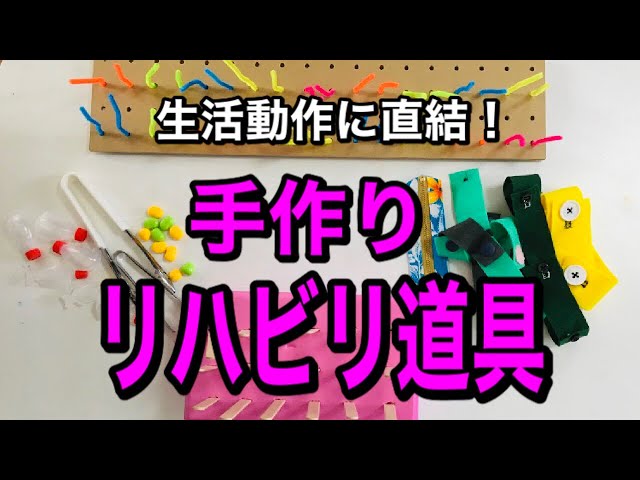
We want seniors to enjoy doing rehabilitation, right? So here’s a fun finger-movement training using chenille stems (pipe cleaners).
Thread the pipe cleaners through a pegboard with evenly spaced holes in advance.
Then have the seniors twist the pipe cleaners using their fingertips.
Twist each pair of pipe cleaners five times.
People tend to feel the effort level when twisting between 5 and 20 pairs.
It’s effective for training finger dexterity and wrist movement.
Pipe cleaners and pegboards are sold at 100-yen shops’ craft sections, so preparation should be easy.
Please use this as a reference and give it a try!