

[For Seniors] DIY Hand Rehabilitation Tools to Strengthen Fingertips: A Collection of Handmade Ideas


Daily rehabilitation exercises performed by seniors contribute to both mental and physical health.
Finger rehabilitation in particular is recommended, as it provides beneficial stimulation to the brain.
In this article, we introduce handmade items that are great for finger rehabilitation for older adults.
With the goal of improving finger function, we’ve gathered easy-to-incorporate, DIY ideas for everyday life.
You can easily get the materials at 100-yen shops, so why not give them a try? If you’re thinking about making your own rehab items, be sure to use this as a reference.
- [For Seniors] DIY Rehabilitation Aids: A Collection of Easy-to-Make Ideas
- [For Seniors] Ideal for Finger Rehabilitation: A Collection of Simple Ideas Made with Yarn
- For seniors: Recommended for day services. Hands-on activities that help prevent dementia.
- [For Seniors] Great for Brain Training! Enjoy Handmade Puzzles
- [For Seniors] Simple Handicrafts Recommended for Finger Exercise
- [For Seniors] Hand and finger play roundup: Finger exercises that lead to brain training
- [For Seniors] Easy and Fun! Tsumami Zaiku Craft Ideas
- [For Seniors] Enjoyable Brain Training! Finger Exercises That Help Prevent Dementia
- [For Seniors] Get Started Easily: Simple Handicraft Kit Ideas
- [For Seniors] Have Fun Making Things Based on Today’s Mood! Today’s Recommended Craft
- [For Seniors] Recommended Muscle Training Gear. Simple and Easy
- [For Seniors] Enjoy Your Alone Time: Perfect Ideas for Passing the Time
- [For Seniors] Small craft ideas: for yourself and as gifts!
[For Seniors] Rehabilitation tools to train fingertips: Handmade idea collection (21–30)
Felt and buttons

It’s a simple activity where you thread a button with a string through a piece of felt that has a slit in the middle.
Because threading a button is a movement used in daily life, it can help improve everyday activities like getting dressed.
Start by threading the button using both hands, and when it feels easy or you’ve gotten used to it, try challenging yourself to do it using only one hand.
Since the movement is simple, it’s important to add fun elements—like choosing felt in colors you love—to keep motivation high.

magnet

This activity focuses on the colors of magnetic chips and arranging them precisely along lines drawn on a whiteboard.
First, draw lines on the whiteboard and gather magnets of various colors into a single mixed set.
At the start signal, participants pick magnets of the same color and line them up straight, competing to see who can finish the arrangement the fastest.
It helps develop color awareness, concentration on accurate placement, and fine motor skills for peeling off and placing the magnets.
The difficulty can be adjusted by changing the number or strength of the magnets, so it’s also recommended to add variations once participants get used to it.
Button fastener training aid
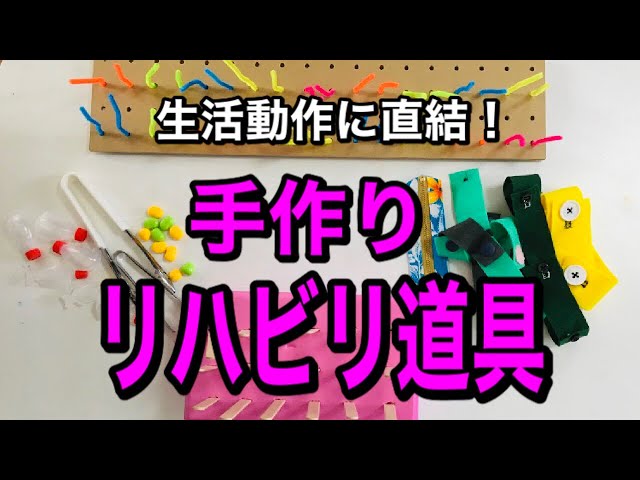
When it becomes difficult to move your fingers, putting on and taking off clothes can be challenging.
One of the hardest tasks is fastening and unfastening buttons.
This item helps you practice exactly that.
Attach a button to one end of a fabric scrap and make a buttonhole on the other end—then you’re ready to go! The person training uses this tool to practice fastening and unfastening the button.
To allow continuous practice, it’s a good idea to prepare several identical pieces.
To keep things interesting and prevent boredom, we also recommend varying the patterns of the fabric scraps and buttons.

A friendship bracelet made of cardboard

Making friendship bracelets with cardboard and yarn is also effective as finger rehabilitation.
Prepare a piece of cardboard and use a compass and ruler to mark your guide points.
Cut slits along the marks.
Once you have your yarn, weave it through the slits as you go.
When it reaches the desired length, remove it from the cardboard, tie it off, and trim any excess yarn to finish.
Because you use cardboard, it avoids excessive strain and lets you exercise your fingertips moderately, making it safe for older adults as well.
It’s also said that the colors of friendship bracelets carry meanings.
Why not make one as a gift for someone special?

Bottle opening and closing training tool
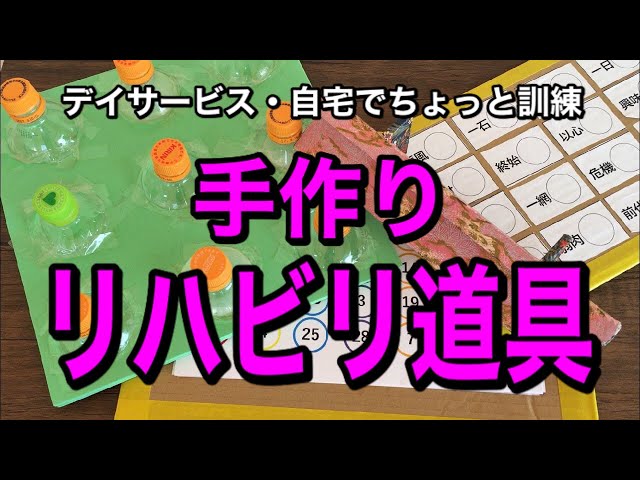
There are times when you can’t get a good grip and it’s hard to open a plastic bottle cap, right? Let’s train with this tool so you can open caps on your own! Prepare several plastic bottles by cutting off the bottom two-thirds and leaving only the area near the mouth.
Firmly attach these to a single sheet of drawing paper or thick cardstock to fix them in place, and you’re done! The person training should practice twisting with the whole hand to open and close the caps, and then increase the difficulty by opening and closing the caps using just the fingertips.
This tool lets you move the hands, fingers, and wrists thoroughly, so definitely give it a try!
Finger and brain training goods
Here is a rehab tool that trains both hand and finger movements and also works as brain training.
First, prepare a sheet of paper with numbers written inside circles placed at random, and plastic bottle caps labeled with the same numbers.
It’s recommended to make the circles about the same size as the bottle caps.
The trainee will pick up a bottle cap with a number on it and place it on the spot with the matching number on the paper.
You can arrange the numbers neatly on the paper, or increase the difficulty by scattering them randomly.
Use this to practice grasping objects with the fingers and to exercise the brain by finding matching numbers!
A device for training fingers by inserting rods
This item can be used to train grasping with the fingertips.
Prepare materials like finely cut pieces of drinking straws or thin, rolled sticks made from origami paper.
Also prepare a container, and make holes in it that are just large enough for the sticks to pass through.
The person training should insert the sticks only through these holes.
It may look simple, but aiming for small holes and inserting the sticks can be quite challenging.
Let’s practice the actions of pinching and releasing with the fingertips until they can be done reliably!