

![[For Seniors] Leg and lower-back training: Fall prevention](https://i.ytimg.com/vi_webp/oDQE6LBCo-A/maxresdefault.webp)

As we age, the muscles in our legs and lower back can weaken, making us more prone to stumbling or falling.
However, by continuing with simple training, you can better support your lower body and aim for a body that’s less likely to fall.
Incorporating easy, low-impact exercises into your daily routine will also help you gain confidence in walking.
This time, we’ll introduce leg and lower-back strengthening exercises that are safe for older adults.
You can start them easily at home, so why not enjoy moving your body while you do them? Keep at it a little each day, and let’s keep walking energetically for years to come!
- [For Seniors] Recreational activities and games that let you have fun while strengthening your legs
- For Seniors: How to Strengthen Your Inner Muscles. Fall Prevention
- For seniors: Leg-strengthening exercises you can do without overexertion.
- [For Seniors] Fun and Easy! Fall-Prevention Exercises for Older Adults
- [For Seniors] Exercises to Walk Again. Fall Prevention
- [For Seniors] Strengthen Your Legs! Recommended Training Items
- [With Video] Lower-limb strength training for seniors that can be done in bed
- [For Seniors] Recommended Easy Strength Training
- [For Seniors] Balance-Training Exercises: Preventing Falls
- Summary of exercises for seniors: introducing preventative care movements by body part.
- [For Seniors] Core Training: Recommended Simple Rehabilitation
- [For Seniors] Easy and Fun Core Training
- [For Seniors] Improve Your Body Concerns! A Summary of Exercises for Urinary Leakage
[For Seniors] Leg and hip training. Fall prevention (1–10)
Exercises to activate the gluteus mediusNEW!

Your walking pattern will change! Activate your gluteus medius to improve posture and enhance walking stability.
In this exercise, start in a kneeling position with your arms raised overhead, then step one foot forward at a time and place the sole on the floor.
Do this 10 times on each side.
To increase effectiveness, raise the arm opposite to the stepping leg.
If your pelvis wobbles when you walk or you find it hard to bring your leg forward, try doing this a little every day.

Gluteus medius training at the wallNEW!

This is a training exercise aimed at strengthening the gluteus medius by placing your hands on a wall while in a squat and opening and closing your legs.
Keeping the unstable squatting posture while moving your legs effectively stimulates the glute muscles.
The deeper you squat, the more the gluteus medius engages, but if you’re concerned about bending your knees, it’s recommended to start with a shallow squat.
By paying attention to the angle at which you use the wall for support, you may find a more efficient movement that suits you.

Gluteus medius training using a wall and a ballNEW!

This is a training exercise that strengthens the gluteus medius in particular by placing a large ball between the wall and your body, using the ball’s rebound to help you move.
Take a posture where you lean lightly against the ball, then lift one leg while keeping your balance in mind.
While maintaining the lifted-leg position, move your hips; as you work to hold the posture, your muscles will activate.
By maintaining an awareness of balance throughout the exercise to avoid tipping over, it also seems likely to improve your everyday posture.
Single-Leg Balance Stability UP: Gluteus Medius TrainingNEW!

Standing on one leg was easy when we were kids, but as we get older, many of us find our bodies wobbling and can’t balance well.
One possible reason is weakening of the gluteus medius.
The gluteus medius is an important muscle for stabilizing the pelvis, so take this opportunity to train it well.
This training introduces two movements to build strength, plus a stretch.
The strength exercises are simple: open and close your legs while bent, and move your leg diagonally backward while extended.
Do the stretch in a seated position.
Three standing exercises to train the gluteus mediusNEW!

This is a training routine that works the gluteus medius by moving your legs while standing, helping to prevent hip and knee pain.
Try patterns like standing with your back to a wall, lightly supporting yourself with your hands while moving your leg out to the side, or holding onto a chair and moving your leg forward and backward.
Move your legs through various angles to stimulate the muscles.
It’s important not to grip the support too tightly; by also focusing on maintaining good posture, you’ll effectively engage the muscles.
Be mindful to apply a load that doesn’t cause pain, while moving thoroughly and with control.
Side leg raise in a standing positionNEW!
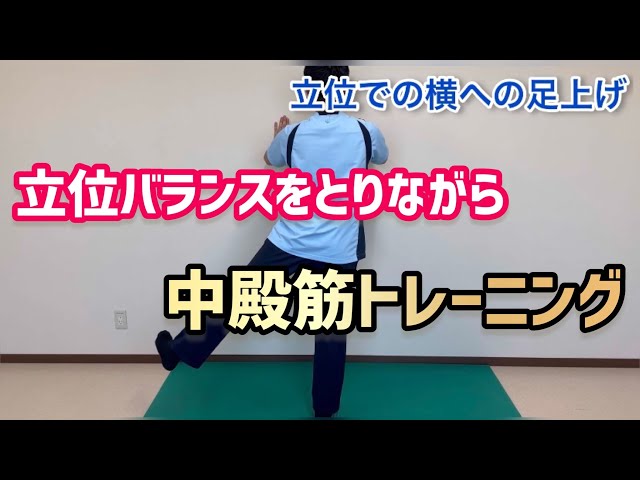
Stand with both hands on the wall and open one leg to the side at a time.
Be careful not to let your toes point outward when you open your leg, and avoid leaning your body to the opposite side.
Aim for 3 sets of 10 reps, but start within a comfortable range until you get used to it.
Because falling can be dangerous, be sure to do this where you have something to hold onto.
By practicing a little every day, you can strengthen the gluteus medius.
The gluteus medius is important for stable walking, so take this opportunity to give it a try.
5-minute iliopsoas stretchNEW!

A psoas stretch you can do while sitting, lying down, or even watching TV, letting you relax for five minutes.
When you splay your legs, take your time and keep them parallel to the floor.
Keep your gaze facing forward or look down at the floor—whichever helps you feel the muscle stretch—and focus on moving carefully.
Steady your breathing, slowly inhaling and exhaling.
You may find it even more effective if you do it after getting out of the bath.
