

[For Older Adults] Games to Enhance Oral Function: Enjoyable and Easy to Do

Oral functions play an important role in daily life, such as eating and speaking.
We all want to keep enjoying meals and conversations as we get older.
In this article, we’ll introduce fun and easy activities that help improve oral function.
For example, are you familiar with vowel articulation practice like “a-i-u-e-o”?
It’s a simple and enjoyable articulation exercise, and in fact, it not only enhances oral function but also helps strengthen your abdominal muscles.
We also introduce exercises that are essential for health management, so please try to find some that you feel you can do!
- [For Seniors] Spice Up Your Usual Oral Exercises! Patakara Exercises and Tongue Twisters
- [For Seniors] Boost Oral Function with Tongue Twisters! Recommended Picks to Try
- For seniors: Fun shiritori—enjoyable and easy to play
- [For Seniors] Stay Healthy Through Your Mouth with the A-I-U-BE Exercises!
- [For Seniors] Recommended Easy Strength Training
- [For Seniors] Oral Exercises to Keep Eating Deliciously and Enjoyably
- [For Seniors] Lively Wordplay Game: Fun Recreation for Elderly Care
- [For Seniors] Hand and finger play roundup: Finger exercises that lead to brain training
- [For Seniors] Core Training: Recommended Simple Rehabilitation
- For Seniors: Effective Recreation for Preventing Care Needs—Have Fun While Staying Healthy
- [For Seniors] Fun! Games and Ideas to Boost Memory
- [For Seniors] Extremely Effective Brain Training! A Fun Collection of Hand Games
- [Recommended for Seniors] Simple and Fun Gesture Game Prompts
[For Older Adults] Games to Improve Oral Function: Enjoyable Activities (41–50)
Ultimate luxury aircraft at a deserted Kyushu airport
The tongue twister “kuukyo na Kyushu kuukou no kyuukyoku koukyuu koukuuki” (empty Kyushu airport’s ultimate luxury aircraft) feels difficult just by looking at it written down.
The sentence is also on the longer side for a tongue twister, and it’s characterized by a mix of hard k sounds and kya-kyu-kyo clusters.
Because of that, it’s said to be hard to say without tripping up.
To be able to say tongue twisters, the key is to be conscious of each word and pronounce every one clearly and distinctly.
By the way, there is no actual airport called “Kyushu Airport.” If you were to use a real airport in a tongue twister, it would be one of the airports in the Kyushu region, such as Kitakyushu Airport.

red paper roll, blue paper roll, yellow paper roll
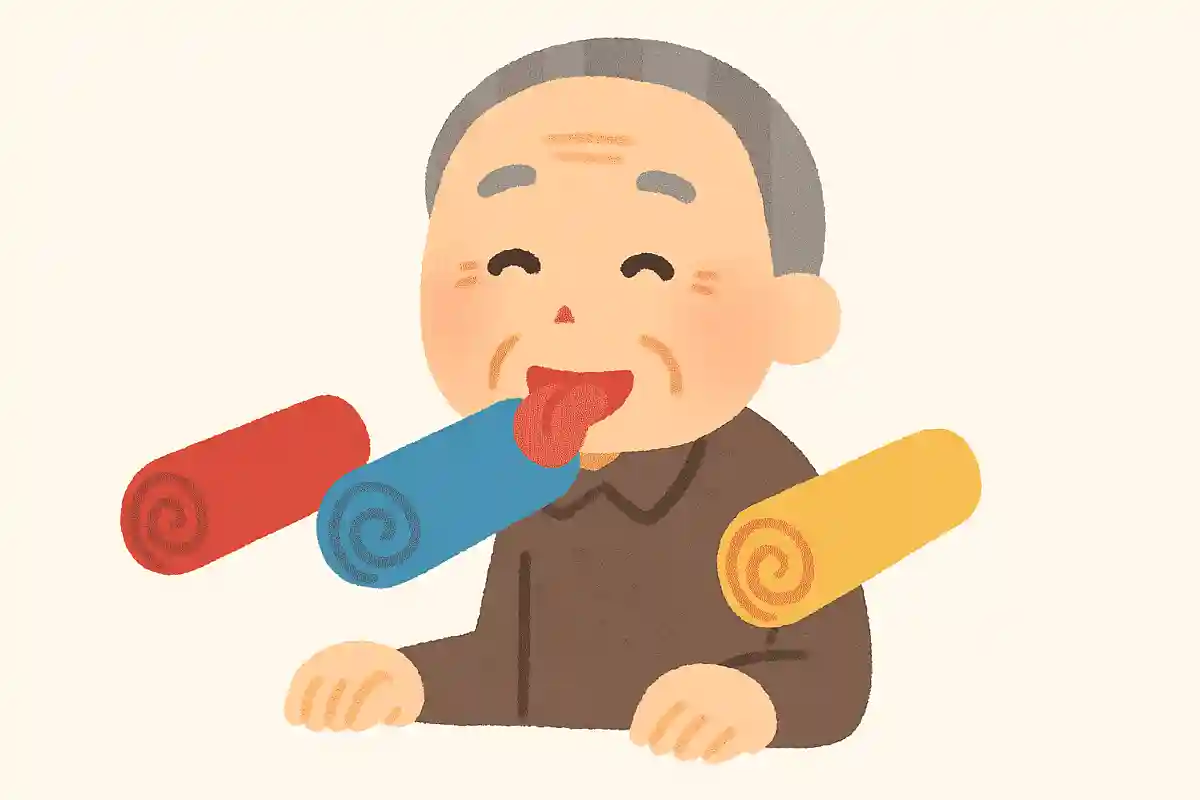
Tongue twisters often consist of strings of hard-to-pronounce words.
“Aka-makigami ao-makigami ki-makigami” (red scroll paper, blue scroll paper, yellow scroll paper) is also a sequence of tricky words.
By the way, makigami refers to paper made by joining together sheets of hansetsu paper (a tall, narrow paper) side by side to make a long roll.
It’s sold in scroll form.
This tongue twister lines up red, blue, and yellow scroll paper.
It looks easy at first glance, but when you try to say it repeatedly, it becomes hard to pronounce.
As a tip, if you pause slightly between the color names—like red or blue—and the word “makigami,” it should be a bit easier to say.
Try it together with older adults.
Swallowing exercises you can do in 3 minutes

Aspiration is when food accidentally enters the lungs instead of the stomach.
Aspiration pneumonia caused by this can have a major impact on older adults’ health.
To enjoy meals and live healthily, how about trying these swallowing exercises? First, take a deep breath in over 3 seconds, then slowly exhale over 5 seconds to engage the lungs and trachea.
Gently stretch your neck and shoulders within a comfortable range to loosen the muscles around the neck.
Focusing on your breathing while doing this helps stimulate the lungs.
Finally, practice moving your tongue in and out and touching the corners of your lips to the left and right to strengthen the ability to move food toward the throat.
Doing these exercises before meals is especially effective, so we highly recommend them.
Please give them a try.

Pronunciation practice with the vowels a-i-u-e-o

The most popular hiragana vowels: a, i, u, e, o.
This time, we’ll introduce an oral-motor exercise you can do using only these sounds.
It’s simple: just say “a i u e o.” But it’s not just saying them.
Say them while opening your mouth as wide as possible, say them in a low pitch, then in a high pitch, say them as slowly as you can, then quickly—the variations are plentiful.
Once you get used to it, you can mix up the order, like “i e a o u,” to keep it feeling fresh.
Anyone can do it, regardless of age or gender, so enjoy it while helping maintain your oral health!
Click-Clack Brain Training Exercises

To stay healthy, you need adequate nutrition, and the ability to eat—especially chewing power—is essential.
With the “Kachi-Kachi Brain-Training Exercise,” you can strengthen your chewing while also stimulating your brain and enjoying the process.
It’s simple: open your mouth wide and close it, biting so your teeth make a clicking sound.
Bite 15 times while silently counting 1, 2, 3 in your head, and clap on every multiple of 3.
Just this alone helps maintain overall oral and dental health and stimulates the brain.
It’s recommended because you can do it anytime, anywhere, regardless of the number of people.
Throat training with a rubber ball and a plastic bottle

Aspiration pneumonia, which is common among older adults.
Aspiration pneumonia is an inflammation that occurs when saliva or food accidentally enters the windpipe, allowing bacteria to invade the lungs.
The movement of the Adam’s apple, which is important for preventing aspiration, is said to decline from the 60s to 70s.
Here, we introduce training exercises that are expected to help prevent aspiration.
For example, you can hold a rubber ball under your chin or grip the mouth of an empty plastic bottle (with the cap removed).
It’s great that you can train using familiar items without any special equipment.
Let’s work on daily exercises to help prevent aspiration.
Patakara Card Game

The Patakara exercise is one of the training methods used to prevent aspiration.
By pronouncing “pa-ta-ka-ra,” it strengthens the mouth and tongue with the goal of maintaining and improving eating and swallowing functions.
This time, we’d like to introduce a card game that makes the Patakara exercise more fun.
Create cards with letters/words using “pa-ta-ka-ra” as the keyword and place them on a table.
Flip over the top card and read the letters on it as quickly as you can.
Once you’ve read it, pass the turn to the next person.
When the next person draws a card, they read both the previous card and the new card quickly in sequence.
The third person, fourth person, and so on will have more and more cards to read.
The more players there are, the higher the difficulty—but the more exciting it gets.
Use this to help maintain your oral health!