

![[For Seniors] Spice Up Your Usual Oral Exercises! Patakara Exercises and Tongue Twisters](https://i.ytimg.com/vi_webp/ULRX8cmgIzM/maxresdefault.webp)
[For Seniors] Spice Up Your Usual Oral Exercises! Patakara Exercises and Tongue Twisters


In facilities where older adults live, many residents look forward to mealtimes.
This time, we’re introducing oral exercises that can strengthen chewing and swallowing abilities to help you enjoy meals more.
If your facility already uses such exercises, adding some variations to your usual routine can make it more fun to continue.
If you haven’t started yet, why not try beginning with slower-paced exercises?
By increasing saliva production, you can help prevent aspiration, improve digestive function, and potentially boost appetite!
[For Older Adults] Put a twist on your usual oral exercises! The Pa-Ta-Ka-Ra exercise and tongue twisters (1–10)
Gymnastics with various animals

Many senior care facilities incorporate the Pa-Ta-Ka-Ra mouth exercises before meals and at other times.
If you’re thinking, “I want to add some variation instead of doing the same routine,” or you’re running out of ideas, here’s a recommended Pa-Ta-Ka-Ra exercise.
Ask the seniors to name animals that start with Pa, Ta, Ka, and Ra.
For example, for “Pa” they might say “panda,” and for “Ta,” “tanuki” (raccoon dog).
After they come up with words, have them repeat each word several times.
The words don’t have to be animals—they can be familiar everyday items as well.
It can be fun to think up ideas for oral exercises together with the seniors, and having them come up with words also serves as brain training.

Patakara exercise: Theme from Shoten

For older generations, the TV show “Shōten” is a familiar favorite.
Here’s an idea for enjoying Patakara exercises using the Shōten theme song.
It’s very simple! Just make the four sounds “pa,” “ta,” “ka,” and “ra” in time with the music.
That’s all it takes, yet it can help maintain and improve your ability to eat and swallow, and the act of inhaling and exhaling can also benefit the respiratory system.
If you can, try opening and closing your hands repeatedly at the same time.
Doing multiple activities simultaneously creates a “dual-task,” which may help prevent cognitive decline.
It’s fun, easy to do, and highly recommended.

Pata-Kara exercises: tongue twisters

Here’s a method that adds the sounds “pa-ta-ka-ra” to tongue twisters so you can practice while having fun.
Start slowly, and as you get used to it, speed up—this way, people of various abilities can enjoy participating.
This exercise can help with digestion of food, prevent aspiration pneumonia, promote sterilization and disinfection through saliva secretion, and help prevent infections.
In addition, since a decline in oral function is said to increase the risk of developing dementia, it is also effective for dementia prevention.
In settings such as senior care facilities, explaining these benefits before the exercise can encourage more motivated participation.
Gymnastics with a quiz

Here’s an introduction to an oral exercise that incorporates exciting quiz elements.
The facilitator gives older adults a “target phrase” that they want them to say—no matter what the facilitator says—and they go back and forth with words.
Partway through, the facilitator deliberately says a phrase similar to the older adults’ “target,” creating a trick to trip them up.
It’s a mouth exercise that gets lively when people get caught, but that’s not all.
Realizing they were influenced by the facilitator’s words and then rebuilding the intended phrase also serves as brain training.
It’s a fun way to combine oral exercises with cognitive training, so please give it a try.
Hand and mouth Pa-Ta-Ka-Ra exercises

We would like to introduce ideas for the Patakara exercises, which allow you to care for your mouth and get some exercise while seated in a chair.
By pronouncing “pa,” “ta,” “ka,” and “ra” while performing full-body movements, these exercises are highly efficient, benefiting not only your physical function but also helping to maintain and improve oral function.
In addition, because you perform two actions simultaneously—movement and pronunciation—the increased positive stimulation to the brain is expected to help prevent cognitive decline.
It may feel complicated at first, but please try it slowly at your own pace.
Pa-Ta-Ka-Ra finger exercises

Many care facilities incorporate the “Pa-Ta-Ka-Ra” oral exercises.
However, some older adults may get bored if it’s the same routine every time.
So let’s add finger movements to the usual Pa-Ta-Ka-Ra exercises.
While saying pa-ta-ka-ra out loud, clap your hands or make a “fox” hand pose and move your hands.
The key is to enjoy it.
You’ll be using both your mouth and your hands, which can be tricky at first if you’re not used to it.
But it’s fine to make mistakes.
We use both our mouths and hands when eating, right? Using your fingertips during the exercises also helps train the movements needed for meals.
Try doing Pa-Ta-Ka-Ra with added finger movements at the pace that suits the older adults.
Exercise to the Mito Komon song
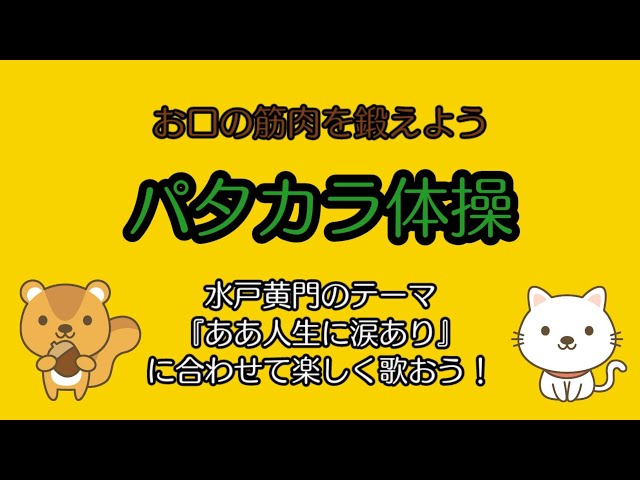
It seems that many older adults watch television.
Some of them probably look forward to dramas, don’t they? Period dramas are especially popular, and among them, “Mito Kōmon” is well-known.
It became a series and ran for 42 years, and its theme song is as famous as the show itself.
Let’s try incorporating the “Mito Kōmon” theme song—familiar to many seniors—into the Patakara mouth exercises! If the oral exercises use a song they know, older adults are likely to find it easier and more enjoyable to give them a try.
It can also help promote communication, such as by sparking lively conversations about the show.