

[For Seniors] Spice Up Your Usual Oral Exercises! Patakara Exercises and Tongue Twisters

In facilities where older adults live, many residents look forward to mealtimes.
This time, we’re introducing oral exercises that can strengthen chewing and swallowing abilities to help you enjoy meals more.
If your facility already uses such exercises, adding some variations to your usual routine can make it more fun to continue.
If you haven’t started yet, why not try beginning with slower-paced exercises?
By increasing saliva production, you can help prevent aspiration, improve digestive function, and potentially boost appetite!
- [For Seniors] Let's try customizing the usual Pa-Ta-Ka-Ra exercises!
- [For Seniors] Boost Oral Function with Tongue Twisters! Recommended Picks to Try
- [For Seniors] Stay Healthy Through Your Mouth with the A-I-U-BE Exercises!
- [For Seniors] Oral Exercises to Keep Eating Deliciously and Enjoyably
- [For Older Adults] Games to Enhance Oral Function: Enjoyable and Easy to Do
- [Recommended for seniors] Rejuvenating Rock-Paper-Scissors Exercise
- Tongue twisters that will make you laugh out loud! Super funny
- [For Seniors] Guaranteed to Liven Things Up! A Collection of Brain Training Activities That Will Spark Laughter
- Energetic and Lively! Sing-and-Exercise Program for Seniors
- With upbeat rhythm routines! Music therapy for seniors
- Hand games that liven things up for seniors—also great brain training
- A Food Quiz for Seniors to Make Eating More Enjoyable
- For Seniors: Fun and Lively Exercise Recreation
[For Seniors] Spice Up Your Usual Oral Exercises! Pa-Ta-Ka-Ra Drills and Tongue Twisters (41–50)
Tadpoles are frog children doing gymnastics.

Why not try adapting the Pa-Ta-Ka-Ra mouth exercises to the children’s song “Tadpoles Are Baby Frogs”? Change the lyrics to include words related to plants or animals that begin with “pa,” “ta,” “ka,” and “ra.” You could even make it a quiz and ask the older adults to suggest words that start with each sound.
Then fit sentences using those words into the song and sing together.
Many older adults have sung “Tadpoles Are Baby Frogs” at least once, so it should feel approachable.
By singing and having fun, you can strengthen the muscles of the mouth, tongue, and face.
Give it a try to help reduce food spillage during meals and prevent aspiration.

Gymnastics to the tune of the tulip song

Let’s do oral care with the “Pa-Ta-Ka-Ra exercises,” which are actively practiced at day services and nursing facilities.
By moving the mouth while pronouncing “pa,” “ta,” “ka,” and “ra,” you train the movements of the mouth and tongue, aiming to improve the functions of eating and swallowing and to prevent aspiration.
This time, we changed the lyrics of the well-known children’s song “Tulip” to “pa, ta, ka, ra” and tried singing it.
Children’s songs have easy melodies and rhythms, so even older adults can get started right away.
Gymnastics with face rock-paper-scissors

We’d like to introduce “face rock-paper-scissors,” which also helps train facial muscles and stimulates the brain.
Decide facial expressions that match the shapes of rock, scissors, and paper.
For example, for rock, you can close your eyes, purse your lips, and puff out your cheeks to form the shape with your face.
It’s fun to think up “rock, scissors, paper” together with older adults.
It could become an original, personalized version of face rock-paper-scissors.
Playing it normally will likely be lively, but we also recommend the “after-the-fact” version.
First, a staff member makes one of rock, scissors, or paper with their face, and then the older adults respond with a facial expression that “wins” or “loses” accordingly.
Thinking about which face to make helps activate the brain.
New Singer New Year Chanson Show
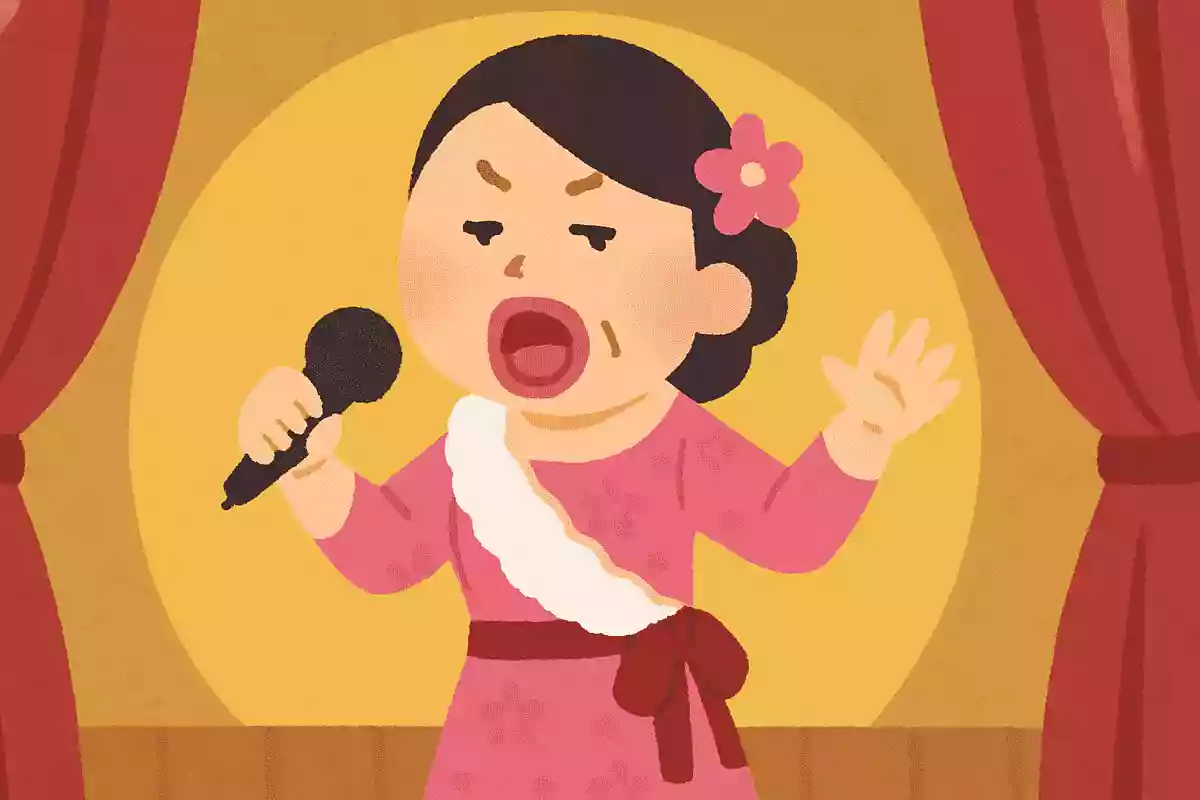
Chanson, which means “song” in French.
In Japan, the chanson “Meke Meke,” covered and sung in Japanese by Akihiro Miwa, is also well-known.
Older people may have heard it at least once.
The tongue twister “Shinjin Kashu Shinshun Chanson Show” can be understood to mean a New Year’s chanson show performed by new singers.
The tongue twister evokes an image of listening to a beautiful singing voice in a refreshing atmosphere.
But when you try the tongue twister, it’s hard to say.
In particular, the ‘so’ in chanson tends to turn into ‘sho.’
Patakara exercises in a spring brook

We’d like to introduce the Patakara exercise that you do while singing.
By pronouncing “pa,” “ta,” “ka,” and “ra,” the Patakara exercise helps train the muscles around the mouth and the tongue.
Some facilities have already incorporated it into their daily exercise routines.
Using a familiar song for older adults, such as “Spring Brook,” makes it easier for them to engage in the exercise.
“Spring Brook” has a gentle melody, making it especially suitable.
Choosing songs that reflect the season can also help older adults feel the change of seasons.
Why not try adding it to your usual exercise routine?
Exercises in time with the song ‘Frog Chorus’

Many senior care facilities have residents do oral exercises before meals, don’t they? When we eat, we use not only the mouth but also the muscles of the neck and shoulders.
With this oral exercise routine, you can move everything in time with the children’s song “The Frog Chorus” and train comprehensively.
Within a single song, you can incorporate plenty of exercises—such as moving the body and changing the lyrics to the syllables pa-ta-ka-ra while singing.
Thanks to the humorous, lighthearted feel of “The Frog Chorus,” older adults may find it easier to participate in the exercises with a relaxed, pleasant mood.
Try adding this “Frog Chorus” routine—an inventive twist on your usual oral exercises—and give it a go.
Gymnastics with Pa-Pi-Pu-Pe-Po

Here’s an introduction to an oral-motor exercise that changes the lyrics of “Hato Poppo” to only use the sounds pa, pi, pu, pe, and po.
At first, write the lyrics on paper or a whiteboard and have participants sing along.
Once they get used to it, hide the lyrics—having them think while singing often leads to laughter.
Recalling the lyrics can also stimulate the brain and may help prevent cognitive decline.
It’s also recommended to add variations, such as raising the arms or marching in place while singing.
Of course, seniors should only do what they comfortably can.
This oral exercise is likely to be a hit when done with a small group of older adults.