

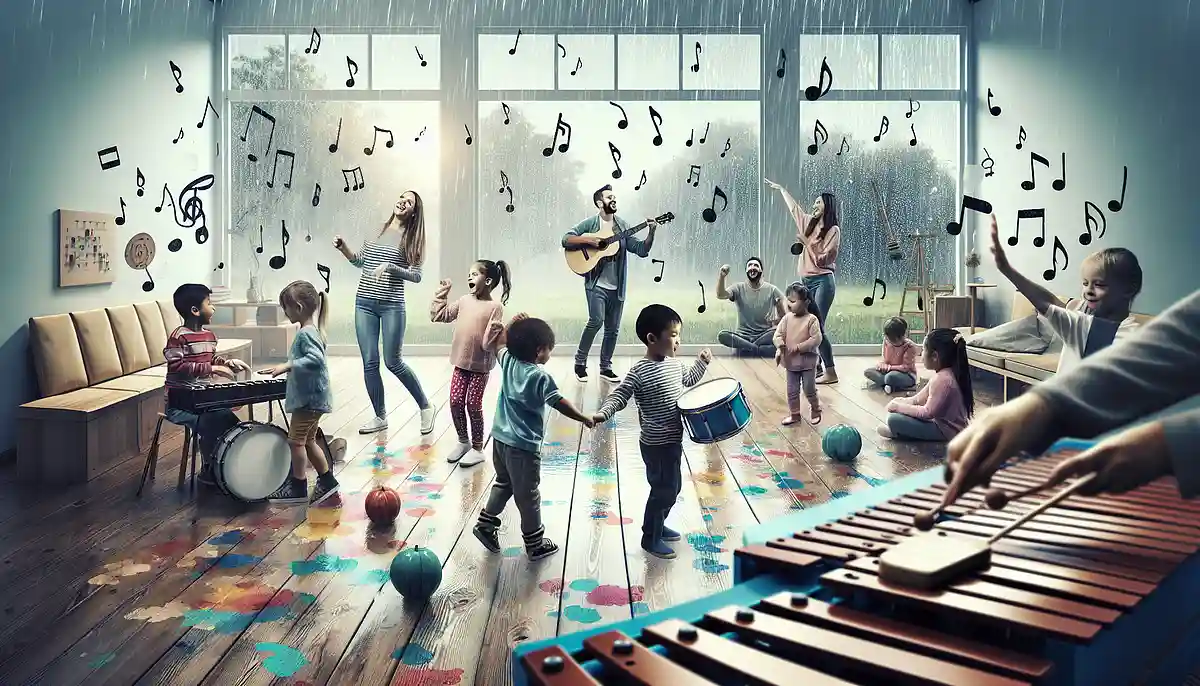

During the rainy season and the cold winter months, many mothers may wonder, “How can I help my child burn off their boundless energy with indoor play?” That’s why I’d like to introduce fun at-home music-based rhythmic activities (Eurhythmics) you can enjoy together!
- Recommended songs for eurhythmics. Let's enjoy music using our bodies!
- [Childcare] Fun Rhythm Play! Recommended Games and Hand-Clapping/Hand-Play for Kids
- Eurhythmics to help you internalize musical notes. Let’s play with chestnuts and fallen leaves!
- Let’s pretend to be sea creatures with Eurhythmics! Fun music education for children
- A big hit with kids! A collection of songs that gets everyone pumped for childcare and recreation
- Actually, it’s packed with the basics of playing instruments. Let’s play with educational castanets!
- Rhythmic bean-throwing for Setsubun: fun music education for children
- Five important ways to share the joy of music with children
- Kids will love it! A collection of dance song ideas with easy-to-follow rhythms
- [Make Music Education More Fun] The Appeal of Eurhythmics, Where You Can See Children’s Growth
- Pretend play in Eurhythmics! Fun music education for children
- Recommended musical instruments for children's lessons
- This is how everyone came to love music: the charm of Ponkikki
What is Eurhythmics?
EurhythmicsIt is a form of early childhood education that aims to enhance children’s sensibility, intelligence, and motor skills through a variety of musical activities, helping support their healthy growth while they play and have fun.
Writing it as “early childhood education” makes it sound kind of difficult, but basically it’s just musical play with a few simple twists.
It’s perfect for rainy-day indoor play because as long as you have music and a playful spirit, you can do it easily anywhere!
This time, I’ll introduce a simplified version of some lessons we do in my classroom so you can easily try them at home. On the next rainy day, be sure to enjoy some Eurhythmics with your child!
Let's try playing in the ocean at home!
Big waves, small waves
The vast, expansive ocean that children love.
Let's use things you have at home and try playing in the ocean!
First, prepare a large piece of cloth. A blanket, bath towel, or even a large trash bag will also work!
Alright then, have your child and the mother hold the two ends of the “sea” (a cloth or a trash bag) and sway it gently like waves to the music.
Any music with an ocean-like feel will work, but if you only have one track, the way you wave the cloth can become monotonous. The key, if possible, is to prepare two tracks with different tempos.
In my class, we do eurhythmics with live piano accompaniment, and, as in the video below, I alternate between two types of music.
If you’d like, please feel free to use it and have fun.
A melody where the notes move slowly gives the image of “big waves,” while a melody where the notes move quickly gives the image of “small waves.”
Alright, let's grab the cloth and sway it to the music!
- Big wave → Imagine waves that recede and return with a “zaboon, zaboon...” sound—large and leisurely.
- Small waves → Imagine the wind gently stroking the water’s surface, creating waves that go ‘sara-sara-sara…’—small and fine.
This game requires the ability to distinguish differences in tempo and to adjust the speed of your arm movements accordingly.
In other words, the better and more enjoyably your child can play, the higher their ability to distinguish sounds with focus and judgment, and the better their physical ability to control arm movements.
Fishy swims smoothly and hops around!
Next, we’ll play by placing lots of little fish on the ocean (a large piece of cloth)!
Like this↓
You can either draw pictures on construction paper for the fish, or make them out of origami!
Making things is great fine-motor practice, so I often incorporate it into lessons in my classroom.
By the way, the following site shows an easy and clear way to fold an origami fish, so I recommend it:
Reference:Let’s easily fold a fish with origami! Finished in just 100 seconds! | Origami Kingdom

Alright, if the sea and the little fish are ready, let’s start playing along with the music!
I’ve also prepared a reference video for the music. Feel free to check it out below:
The key to this music activity is to hold both ends of the cloth with the little fish on it...
- Suisui~♪ → With the image of a fish swimming comfortably in the sea, gently sway the cloth left and right in a relaxed manner.
- Boing boing! → Picture lively fish hopping over the sea; shake the cloth up and down while jumping.
One point
If you place instruments like bells on it beforehand, the sound will ring in sync with the fabric’s movement and make it even more fun!
This is a practice for distinguishing music that has a side-to-side sway or an up-and-down bounce, and for feeling it with your body.
By the way, to put it a bit technically, the side-to-side swaying music is set in 6/8 time, while the up-and-down swaying music is set in 4/4 time.
These two time signatures are commonly used in music, and if your child takes up any instrument in the future, they will definitely encounter them.
So if you get used to feeling the difference between these two meters in your body from a young age, it’ll be really handy when it counts!
Even without thinking about it, your body responds smoothly.
Once you get the hang of it, it becomes more and more fun!
The two music activities I introduced this time are also part of the main program in my class this month, and to be honest, they’re a huge hit!
It seems what they like is vigorously flapping a big piece of cloth and that constant tension of having to keep listening so you don’t “miss the wave!” (lol).
At first, I don't even notice when the music changes and keep doing the same moves, or even if I do notice, my body's reaction is slow. But after doing it many times, my ears, my mind, and my body's responses all get better and better.
That way, they seem to enjoy Eurhythmics even more, and they actively engage with other programs, which in turn further strengthens their concentration and responsiveness, and they also develop a good ear and sense of rhythm—creating a positive cycle.
So, it’s just a bit of musical fun—yet it’s also serious musical fun!
If you’ve got nothing to do on a rainy day and are just idly bored, try some easy rhythmic activities (Eurhythmics) at home!
It's so fun that time flies by in no time!