

Nostalgic yet fresh!? Classic masterpieces of Japanese rock from the 1970s and 1980s


I think it’s fair to say that up through the 1980s, Japan’s rock scene was, in a sense, the golden age of Japanese rock.
From the 1990s onward—after the Heisei-era “Ika-ten” band boom—rock became, for better or worse, a polished “product.” In contrast, up until the ’80s, it was truly an age of fierce rivalry, with uniquely individual rock bands and rock singers flourishing.
Here, I’ll introduce some “classic rock masterpieces” from the era before Japanese rock came to be labeled J-ROCK or J-POP.
For those who experienced that time in real time, I hope this brings back fond memories; for younger listeners who didn’t live through Showa in real time, I think you’ll find it fresh and exciting.
Please surrender yourself to the sounds of Japan’s good old rock and enjoy.
- A special feature on classic and hit songs by bands that were active in the 1980s
- [1970s] Classic and hit songs of Japanese rock that blazed through the dawn era
- Cool songs from the Showa era. Masterpieces from Showa that shine with sensuality, passion, and rugged charm.
- [1970s] Collection of Japanese hit songs. Nostalgic masterpieces of Japan
- Classic and hit Japanese pop songs from the nostalgic 80s
- [J-Rock] Timeless masterpieces that colored the 1990s. Nostalgic hit songs.
- Thrilling to Cool Showa-Era Tunes! Classic Songs from Female Singers and Artists of the Showa Period
- Legendary Japanese rock masterpieces and hit songs of the 1960s
- Popular Showa-era pop. Timeless hit songs.
- 1980s: Legendary Western Rock Bands’ Classic and Hit Songs
- [Revisited] A roundup of popular and classic Showa-era songs that are trending now [2026]
- Now’s the time to listen! Uplifting Showa-era songs that brightened Japan
- Revival hits driven by social media! Classic Showa-era songs popular with Gen Z
Nostalgic yet fresh!? Classic Japanese rock hits from the 1970s and 80s (41–50)
AngelinaSano Motoharu

This song, the debut single by Motoharu Sano released in 1980, stunned first-time listeners with its sophisticated melody and innovative Japanese lyrics set to a then-new kind of beat.
The technique of rhythmically fitting two or more syllables of lyrics into a single note likely had a strong influence on subsequent Japanese music.

ZOOECHOES

Centered around Jinsei Tsuji—who continues to thrive in various fields, including as a writer—the four-piece rock band ECHOES.
Their 6th single, “ZOO,” a self-cover of a song they originally provided to Kaori Kawamura, also drew attention when Miho Kanno covered it in 2000 under her character’s name in the TV drama “Ai wo Kudasai.” The lyrics, which liken oneself and society to a zoo, likely resonated with many listeners.
It’s an emotional number marked by a timeless message and a catchy melody.

IllusionNOVELA

NOVELA is a rock band known as a key player in the Japanese progressive scene.
They gained popularity with their unique metal sound that makes full use of lush synthesizer tones.
“Illusion,” included on their 1980 album The Beautiful Illusion Theater (Miwakugeki), is a beautiful yet fleeting number brimming with a symphonic atmosphere.
Each member’s technical performance brings out the essence of prog.
Be sure to pay attention to Terutsugu Hirayama’s melancholic yet powerful vocals.
Why not give this Showa-era classic a listen—you’ll discover something new every time you hear it.

CRAZY DOCTORLOUDNESS

Formed in 1981 mainly by former members of LAZY and continuing to operate through multiple lineup changes, LOUDNESS is an indispensable presence among rock bands of the 1980s.
Even now, as a Japanese heavy metal band, they rank among the world’s leading metal acts.
Their appeal lies in their heavy sound and technical performances, which greatly influenced not only listeners of the time but also musicians who went on to shape Japan’s music scene.

Star Love LetterTHE BOOM

Debuting in the 1980s, THE BOOM is a rock band from Yamanashi Prefecture that broke through with hits like “Shima Uta” and “Kaze ni Naritai.” This is one of their signature rock numbers from the ’80s, featuring Kazufumi Miyazawa’s indescribably clear, captivating vocals.
Roppongi HeartbreakAn Ruisu

Although she debuted as an idol singer, Anne Lewis later became a leading figure in kayō-rock, making full use of her powerful vocals.
This is her 23rd single.
It caught fire mainly through cable radio and became a long-running hit, now widely recognized as one of Anne Lewis’s signature songs.
It’s also long been a karaoke standard, so even younger listeners who don’t know the original have likely heard it.
With an intro that layers a classical-sounding synth phrase over a guitar riff, and vocals and melodies tinged with melancholy, this track perfectly embodies the best of both rock and kayōkyoku—an emblematic number of the 1980s music scene.
B BLUEBOØWY
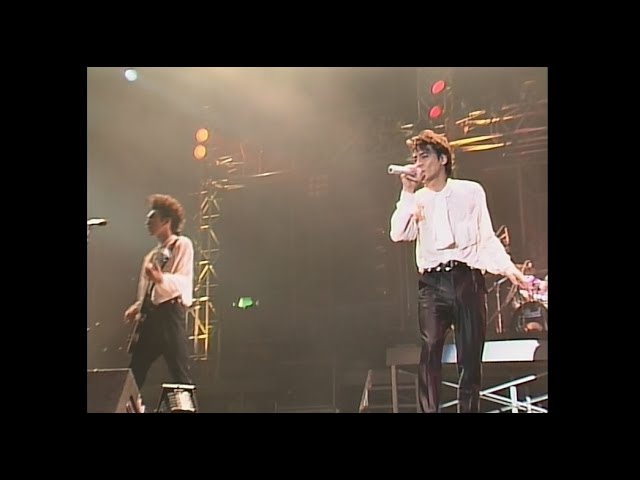
This song is BOØWY’s fourth single.
BOØWY has many songs that most people have heard at least once, but in fact they only released eight singles.
B•BLUE is a song that’s always performed live, and it opened the set at their LAST GIG.