

[Middle School Students] Easy One-Day Science Projects and Crafts Ideas


Have you already decided on your summer vacation independent research project? It’s easy to panic when you feel you have to do it but don’t have much time.
For junior high school students like that, here are some simple research and craft ideas you can complete in a day.
Once you gather the necessary materials, you can start right away! For example, there are experiments using everyday items and fun crafts you can make.
If you enjoy it, you’ll finish in no time.
After the experiment, write up your summary and reflections in a report.
That’s the most important part of the project.
Start thinking about it early so you can enjoy your summer vacation!
- Recommended for high school students! A collection of easy one-day science project ideas
- Stand out with your junior high school independent research! A collection of fun experiment and craft ideas
- DIY science projects that elementary school boys will love: ideas you can make with everyday materials
- [For Adults] Simple yet Impressive Crafts: A Stylish, Eye-Catching Collection
- Recommended for middle school students! A collection of quick science project ideas you can do in a short time.
- For upper-grade boys! Simple yet awesome craft project [Don’t call it lazy]
- Simple and cute summer project crafts! A collection of ideas for girls that will make you want to create
- Simple but awesome! Craft ideas for upper-grade girls
- Plastic bottles transformed! A collection of simple yet amazing craft ideas
- Adults will be hooked! A collection of craft ideas using toilet paper rolls
- [I don't want to be like everyone else!] Recommended independent research topics for high school students
- Simple yet amazing crafts: craft ideas that elementary school students will want to make
- Elementary School Students: Simple One-Day Science Project and Craft Ideas
[Middle School] Easy One-Day Independent Research & Craft Ideas (61–70)
Make a cloud in a plastic bottle

Let’s try an experiment to create a cloud inside a plastic bottle.
Prepare a carbonated beverage plastic bottle, some water, and a carbonation-removal pump cap sold at hardware stores.
Put a little water into the bottle, close it with the pump cap, and press the pump about 30 times.
While warming the bottle with both hands, mix the water and the pumped-in air to make a high-temperature saturated state.
Then open the cap: the rapid change in air pressure will cause a cloud to form inside the bottle.
It’s a simple experiment, so feel free to give it a try.

Japanese tea

When time is limited, it’s hard to prepare anything unusual, isn’t it? So here’s something to try: a study of Japanese tea.
You should be able to find tea leaves at nearby stores like supermarkets or shopping malls.
Once you get some, explore how the flavor changes with water temperature and steeping time, and figure out the best way to brew it for the most delicious taste.
Since you’ll probably be brewing a lot of tea, having paper cups on hand will be convenient! You could also look for traditional Japanese sweets that pair well with tea.

Newton’s cradle

Have you ever heard of Newton’s cradle? It’s a device where about five small steel balls are suspended on strings in a row.
When you lift and release one ball at the end, only the ball on the opposite end is knocked outward.
This is related to the conservation of momentum and the conservation of mechanical energy.
Let’s write a report summarizing the results of changing conditions—for example, what happens if you lift and release two balls instead of one, or what happens if you change the size of the balls.
Another nice point is that after the experiments, the Newton’s cradle you made can be displayed as interior decor.

Friction experiment using a hovercraft

Let’s build a hovercraft using a balloon and a film canister, and explore the concept of friction! If you don’t have a film canister, there’s also a way to make one using a plastic bottle, so try to be creative.
Hovercrafts are actually used to transport people, and this experiment investigates how they work! See for yourself what kind of motion occurs when there is no friction.
Investigating regional characteristics through “yuru-chara” (local mascots)

Let’s learn about the unique features of each region in Japan through their beloved local yuru-chara mascots.
For example, Shiga Prefecture’s hugely popular Hikonyan incorporates elements of Ii Naotaka, the second lord of the Hikone Domain; Nagano’s Arukuma combines a bear and apples; Kumamoto’s Korokun is linked to Kii Castle; and Osaka’s Takinomichi Yuzuru features yuzu and maple leaves.
These mascots reflect local history, famous figures, and specialty products.
Enjoy studying the history and specialties from all over Japan through these fun, pop-style characters.
Experiment to make clear ice
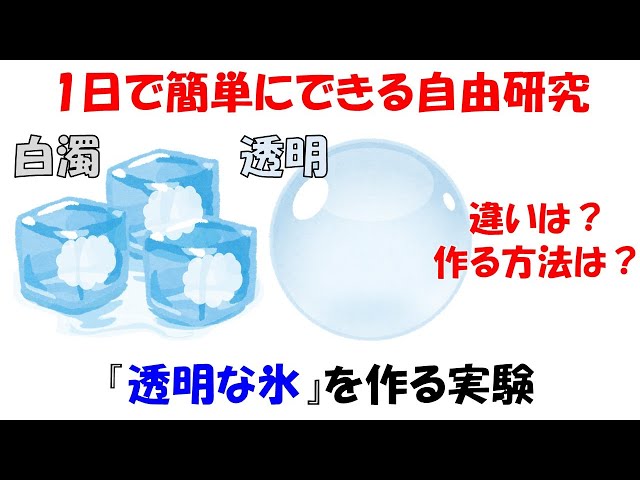
If you take a close look at the ice in drinks served at shops or the ice cubes sold in stores, they’re beautifully clear.
Meanwhile, the ice you make at home often looks cloudy, doesn’t it? That’s because clear ice contains fewer impurities and is frozen slowly over time.
Once you know the trick, it’s nothing special—but turning this mystery into a science project could be fun.
People often say you can make clear ice by wrapping water in bubble wrap (the cushioning material) and chilling it, but it would be great to run comparative experiments on those conditions.
Ultra-clear ice really draws attention!
Cook home-style dishes from countries around the world

How about a tasty independent research project? In this project, you’ll explore home-cooked dishes from countries around the world.
Of course you’ll look into how they’re made and the ingredients, but it’s also important to think about what the dishes reveal about each country’s climate and culture.
Home cooking is extremely helpful for understanding a country’s people and their daily lives.
Someday, when you travel, the knowledge from your project will help bring you closer to that country.