

[Middle School Students] Easy One-Day Science Projects and Crafts Ideas


Have you already decided on your summer vacation independent research project? It’s easy to panic when you feel you have to do it but don’t have much time.
For junior high school students like that, here are some simple research and craft ideas you can complete in a day.
Once you gather the necessary materials, you can start right away! For example, there are experiments using everyday items and fun crafts you can make.
If you enjoy it, you’ll finish in no time.
After the experiment, write up your summary and reflections in a report.
That’s the most important part of the project.
Start thinking about it early so you can enjoy your summer vacation!
- Recommended for high school students! A collection of easy one-day science project ideas
- Stand out with your junior high school independent research! A collection of fun experiment and craft ideas
- DIY science projects that elementary school boys will love: ideas you can make with everyday materials
- [For Adults] Simple yet Impressive Crafts: A Stylish, Eye-Catching Collection
- Recommended for middle school students! A collection of quick science project ideas you can do in a short time.
- For upper-grade boys! Simple yet awesome craft project [Don’t call it lazy]
- Simple and cute summer project crafts! A collection of ideas for girls that will make you want to create
- Simple but awesome! Craft ideas for upper-grade girls
- Plastic bottles transformed! A collection of simple yet amazing craft ideas
- Adults will be hooked! A collection of craft ideas using toilet paper rolls
- [I don't want to be like everyone else!] Recommended independent research topics for high school students
- Simple yet amazing crafts: craft ideas that elementary school students will want to make
- Elementary School Students: Simple One-Day Science Project and Craft Ideas
[Middle School] Simple One-Day Independent Research and Craft Ideas (51–60)
reverse-yolk egg

When you think of eggs, the yolk is normally surrounded by the white, right? This is a hard-boiled egg with a curious look where the positions of the yolk and the white are reversed.
The key is to spin the egg thoroughly; by keeping it rotating while boiling, you spread the yolk to the outside and trap the white in the center.
First, put the egg in a stocking, hold both ends, and spin it vigorously.
Keep spinning firmly until you hear a sloshing sound, then take it out and start boiling.
After boiling, chill it in ice water, peel the shell, and it’s done.
Even at this stage, be mindful to keep it rotating throughout.

Observe the shape of sound

We hear voices and sounds every day as if it’s the most natural thing—but did you know they have shapes? Sound is transmitted through vibrations, and the shape of those vibrations changes depending on factors like volume and pitch.
Amazingly, you can observe these differences quite easily! You only need simple materials: a bowl, a black plastic bag, vinyl tape, and some salt.
Different sounds produce different patterns, so try making various sounds and see what shapes appear.
Electric string telephone production

String telephones are a classic kids’ craft, but they’re a bit too simple for middle schoolers, aren’t they? So this time, I’d like to introduce the idea of an electric string telephone.
It looks just like a regular string telephone, but by using components built into a personal safety alarm, we’ll make a string telephone that carries your voice as an electrical signal.
It’s a simple yet authentic project that uses tools and a soldering iron, so middle school students should have fun building it.
Once the string telephone is complete, please also put together a summary of the steps and an explanation of how the voice transmission works.

A science project you can just leave alone
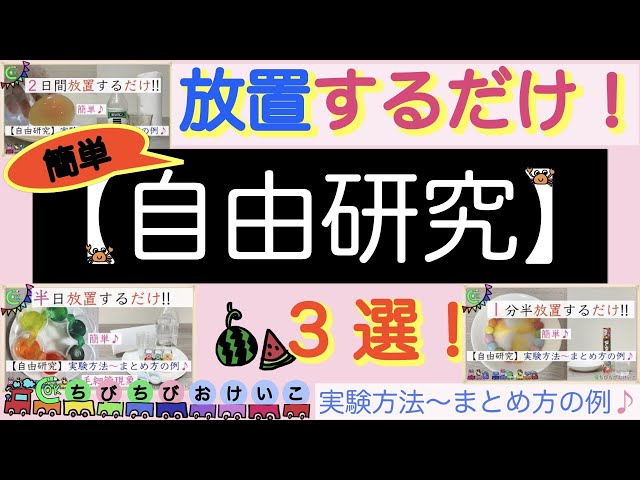
It’s hard to decide what to do for an independent research project, and you don’t want to spend too much time on it, right? So why not try some ideas that you can basically just set and forget? Here are three simple projects.
The first is to line colorful candy-coated chocolates around the rim of a plate, pour in water, and observe what happens.
The second is to soak an egg in vinegar to make a “skeleton egg.” The third is to dip kitchen paper into colored water and observe how it absorbs and changes color.
All of them are very easy, so give them a try!
[Middle School] Easy One-Day Independent Research & Craft Ideas (61–70)
solar water heater

An experiment to see whether you can make hot water using sunlight—the simplicity of doing it with just a plastic bottle and paint is also a key point.
The procedure is simply to paint the plastic bottle with paint, fill it with water, and then monitor how the temperature changes under sunlight.
It’s important to thoroughly coat it with opaque paint, as if wrapping the transparent plastic bottle.
If you prepare various colors, you can observe temperature differences by color and find out which colors absorb more sunlight.
Diatomaceous earth coaster

When you leave a glass filled with a cold drink on the table, condensation forms and makes the surface wet.
Let’s try making your own diatomaceous earth coasters that absorb those droplets.
Because it’s closely related to staying hydrated, it’s also perfect as a summer science project.
The steps are simple: put water in a paper cup, add diatomaceous earth powder and stir, pour it into a mold, and let it dry—that’s it.
The key is to mix so there’s no unevenness and to remove air bubbles thoroughly; keep this in mind to make a sturdy coaster that won’t crack.
If you use waterproof paint at the water-mixing stage, you can color the entire piece as well.
Research how to make a paper airplane fly farther

Summer vacation is fun, but the thing that always trips us up is the independent research project or craft assignment, right? We also have to do our other homework, and we’ve got to go out and play! So here’s a project you can finish in one day.
This is a paper airplane everyone knows well… but it’s one that flies straight and far.
By getting creative with how you fold it and how you throw it, you can make a paper airplane that’s a little different.
How about explaining, with diagrams and text, how you came up with your ideas?