

Fun facts quiz about Kiyomizu-dera: a three-choice quiz to learn its history and appeal

Kiyomizu-dera is one of the World Heritage Sites and is popular not only with Japanese visitors but also with tourists from overseas.
Spots like Kiyomizu-zaka and Sannen-zaka let you feel the history along the pilgrimage route.
In this article, we’ve gathered quizzes that will deepen your knowledge about Kiyomizu-dera.
We’ll present fun questions to help you learn about the temple grounds, which offer breathtaking scenery.
You can also check out explanations covering everything from the Main Hall and the entrance gates to episodes related to the principal image of worship.
Give these quizzes a try and experience the traditional culture and history embodied by Kiyomizu-dera.
Kiyomizu-dera Trivia Quiz: 10 multiple-choice questions (1–10) to learn its history and charm
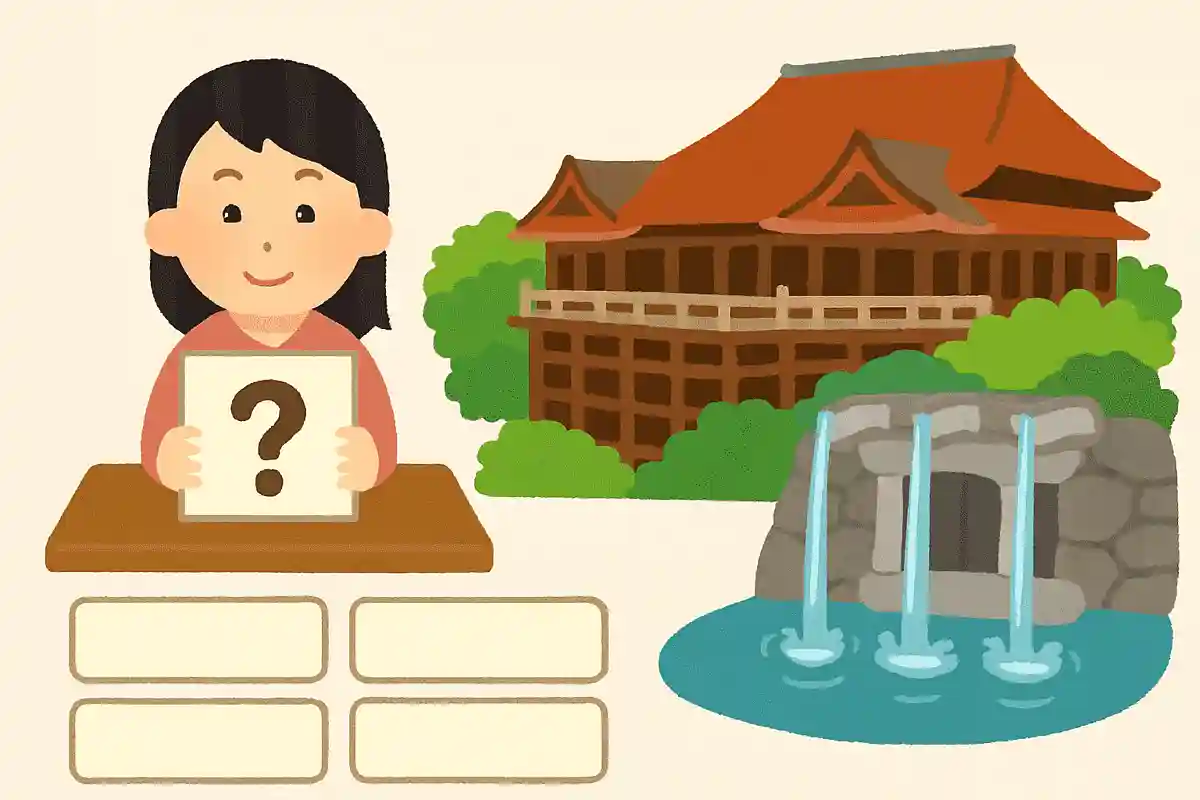
What is the name of the waterfall with three streams at Kiyomizu-dera?

- Tenryu Waterfall
- Otowa Waterfall
- Shenlong Falls
See the answer
Otowa Waterfall
The three waterfalls at Kiyomizu-dera are collectively called Otowa no Taki. Each stream is associated with a different wish—academics, longevity, and love—and visitors drink from the one that corresponds to their desire. With a long history and widespread popularity, this waterfall is considered one of Japan’s most famous power spots.

Who built Kiyomizu-dera?

- Kūkai
- Saichō
- Sakanoue no Tamuramaro
See the answer
Sakanoue no Tamuramaro
Kiyomizu-dera is said to have been founded by Sakanoue no Tamuramaro. On the site of Kiyomizu-dera, the origins lie in Kenshin first building a hall and enshrining a Buddhist statue. It is also said that when Sakanoue no Tamuramaro later visited the area, he received a divine revelation and resolved to construct a larger temple. The result became the predecessor of today’s Kiyomizu-dera.
When was jumping off the Kiyomizu-dera stage prohibited?

- Year 1821
- the year 1872
- the year 1912
See the answer
the year 1872
The answer is 1872. Before then, some people even jumped from the Kiyomizu stage, inspired by a legend that their wishes would be granted. In the Meiji era, as legal systems were developed for a modern nation-state, such life-threatening acts came to be prohibited.
When did the last major fire at Kiyomizu-dera occur?
- the year 1600
- the year 1629
- 1750
See the answer
the year 1629
The last major fire at Kiyomizu-dera occurred in 1629. This blaze is remembered as one of the most significant incidents in the temple’s history and resulted in the destruction of many of its buildings. The subsequent reconstruction is known to have required considerable effort and time, but it is through this event that the Kiyomizu-dera we know today came to exist.
In what year was Kiyomizu-dera built?

- Year 688
- the year 778
- the year 858
See the answer
the year 778
Kiyomizu-dera was founded in 778, in the early Heian period. It has undergone numerous restorations since then to reach its present form. Especially famous is the large wooden balcony known as the Stage, from which the view is celebrated as spectacular. With its long history, the temple is an extremely valuable asset as a Japanese cultural property.
What is the official name of Kiyomizu-dera?

- Ankō-in
- Tofuku-ji Temple
- Otowa Mountain Kiyomizu-dera (Kiyomizu-dera on Mount Otowa)
See the answer
Otowa Mountain Kiyomizu-dera (Kiyomizu-dera on Mount Otowa)
The formal name of Kiyomizu-dera is Otowa-san Kiyomizu-dera. This name comes from the Otowa Waterfall located there, which is also the origin of the temple’s name.
What is the reason Kiyomizu-dera does not use nails?

- to strengthen the bond between pieces of wood
- To pursue structural beauty
- Because the nail and the wood have different coefficients of thermal expansion
See the answer
Because the nail and the wood have different coefficients of thermal expansion
Because nails and wood have different coefficients of expansion, Kiyomizu-dera was constructed without using nails. It employs unique joinery techniques that flexibly accommodate the expansion and contraction of the wood. This wisdom has preserved the building’s durability over many years and can be seen as the culmination of traditional Japanese architectural technology.