

[For Seniors] Crafts to Make in March! Recommended Project Ideas


March is full of delightful motifs like peach and cherry blossoms, as well as fun events such as Hinamatsuri (Girls’ Day).
In this article, we’ll introduce craft ideas recommended for seniors to enjoy in March! By mainly using soft colors like pink, white, and pale green for origami and construction paper, you can create bright, cheerful pieces—making both the crafting process and the finished display exciting.
When making origami crafts, adding patterned paper can change the atmosphere and give your work a unique touch! Feel free to use these ideas as references in care facilities such as day service centers.
- For Seniors: Come, Spring! Recommended March Craft Ideas for Daycare Services
- For Seniors: Recommended Wall Decoration Ideas for March
- For seniors: Heartwarming and cozy. Recommended handmade Hina dolls
- [Day Service] Spring Take-Home Crafts: Ideas to Warmly Brighten Your Room
- [For Seniors] Spring Wall Decorations: A Collection of Ideas to Brighten Up Your Room
- [For seniors] Enjoy spring: April craft ideas
- For Seniors: Simple and Lovely Crafts – A Collection of Take-Home Project Ideas for Day Service
- [For Seniors] Color Your Care Facility’s Spring: Wall Decoration Ideas
- [For seniors] A handmade calendar you’ll want to make in February
- [For Seniors] Have Fun Making Things Based on Today’s Mood! Today’s Recommended Craft
- For Seniors: Feel the Arrival of Warm Spring. Cherry Blossom Wall Decoration Ideas
- [For Seniors] Introducing Fun Crafts Made with Plastic Bottle Caps
- [For Seniors] Making a March Calendar: Introducing Spring-Themed Motifs and Arrangements
[For Seniors] Crafts You’ll Want to Make in March! Recommended Project Ideas (11–20)
No-sew felt hanging decoration

The no-sew felt hanging ornaments are lovely pieces that give a warm, cozy feel.
Use 5.5 cm × 4 cm felt and chirimen fabric scraps to make small birds.
Adding metallic yarn creates a neat accent and makes them look festive.
For the eyes, simply paint rhinestones black for an easy solution.
Use small pieces of pink, white, and green felt to make hishi-mochi, and use small oval felt pieces and chirimen scraps to make zori sandals.
After crafting three-dimensional cherry blossoms, use a bamboo skewer and embroidery thread to assemble them into hanging ornaments.
Soft-colored felt and chirimen fabrics blend well with interior decor, so they’re recommended.
Give it a try!

Hanging Hina (traditional hanging Hina doll decorations)

Speaking of big events in March, it has to be the Peach Festival (Hinamatsuri)! How about a calendar design that captures the season, featuring adorable hanging hina ornaments? Choose your favorite color of construction paper for the backing, then attach this year’s March calendar to it.
Fix a piece of cardboard to the top of the backing, punch four holes, and tie on some yarn.
Create motifs like the Empress and Emperor dolls and cranes using felt or origami, and hang them from the yarn.
It makes a lovely calendar that gently sways.
Watercolor Dandelion

When you hear “watercolor,” you might picture something difficult or a lot of preparation.
But using watercolor brush pens makes it easy to give it a try.
Here, we’ll show you a simple way to paint a dandelion, so even if you’re not confident in drawing, you can enjoy it.
With a yellow brush pen, draw several short lines.
Switch to green, then under the yellow lines, draw an oval and a stem to suggest a plump calyx.
Sketch in some rough veins, then add the leaves.
It helps to imagine arrowheads or hearts for the leaf tips.
Even small mistakes can give your illustration character.
Use a lovely watercolor to brighten up your March calendar!
Cherry blossoms in watercolor

Cherry blossoms, an essential part of spring in Japan, are a perfect motif for a March calendar.
Here we introduce an easy way to paint cherry blossoms that even beginners can handle.
Start by adding five small pink dots in the center of the flower.
Then, using a brush dipped only in water, spread each dot outward into the shape of petals.
The key is to make the center darker.
Add branches and new buds, and draw lines and pollen on the petals for detail.
It’s amazing how a little extra effort can produce such realistic cherry blossoms.
Why not brighten your March calendar with watercolor cherry blossoms that will warm your heart every time you see them?
Hinamatsuri Flower Ball

A flower ball you can hang from the ceiling or simply place on a table as a decoration.
Even with items from the 100-yen shop, you can make something lovely and cute that’s perfect for Hinamatsuri.
Use a glue gun to attach artificial flowers to a craft foam sphere.
Try using artificial peach blossoms, cherry blossoms, or other pink flowers.
Add a ribbon, and it’s done.
Since it’s made from lightweight materials, it might be easy for seniors to handle and create as well.
You can get everything you need at the 100-yen shop, so give it a try.

Marguerite Wreath

Margaret’s wreath is an origami piece whose charm lies in how freely you can arrange it.
By changing the flower colors within a single wreath and varying their sizes for emphasis, you create a look that avoids being overly uniform.
Placing the leaves so they extend outward adds movement to the ring shape and gives a light, airy impression.
The key is to adjust the placement while watching the overall balance rather than aiming for strict symmetry.
The finished mood changes depending on the combinations you choose, making it easy to style the wreath to suit where it will be displayed.
Do try making one and enjoy the feeling of spring.

[For Seniors] Crafts You’ll Want to Make in March! Recommended Project Ideas (21–30)
Tulip wreath
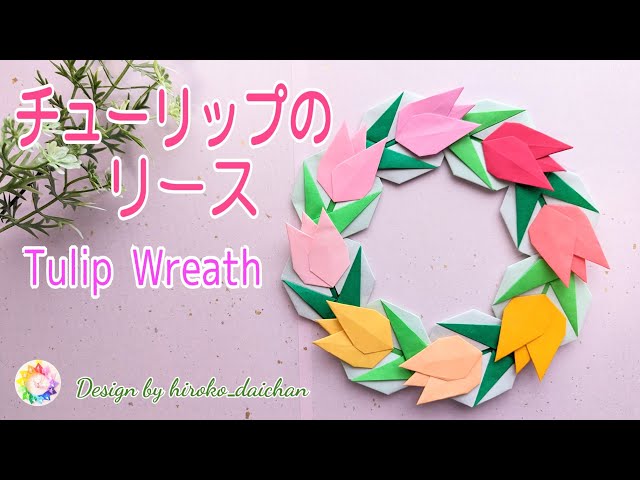
This wreath, which arranges tulips into a circle while highlighting their shape, is an origami piece whose impression changes depending on how the flowers are placed.
Whether you align the direction of the flowers and stems or vary their angles slightly will affect how cohesive the design feels.
By considering color combinations, you can tighten the overall look or steer it toward a softer mood.
Introducing variations in the flowers’ heights helps prevent a flat appearance.
Finally, surveying the whole and adjusting the placement stabilizes the shape and improves how it looks when displayed.
The bright colors of the finished wreath gently stand out in a space and evoke the arrival of spring.