

![[For Seniors] Introducing May-themed Origami!](https://i.ytimg.com/vi/a6fU7t8_YCE/sddefault.jpg)

Origami is a popular recreational activity in senior care facilities.
Finger exercises are effective for stimulating the brain, and displaying completed pieces or feeling a sense of accomplishment adds to the enjoyment.
May is a month filled with events, such as Children’s Day and Mother’s Day.
So this time, we’ll introduce origami with a May theme.
Origami that activates both the fingers and the brain while feeling the season—and offers a sense of achievement—can be considered an ideal recreation for older adults.
By all means, try making May-themed origami together with the older adults around you.
- [For Seniors] Enjoy May: A Collection of Seasonal Craft and Wall Decoration Ideas
- [For Seniors] Recommended Events for May: A Roundup of Ideas That Get Everyone Engaged
- [For Seniors] May Calendar Craft: Motifs that color May, such as Children's Day (Tango no Sekku), Mother's Day, and seasonal flowers
- [For Seniors] May-Themed Wall Decoration Ideas Full of Seasonal Flair
- [For Seniors] Easy Koinobori Crafting: A Collection of Fun Ideas Using Various Materials
- [Recreation] Summary of Recommended Origami Ideas for Seniors
- [For Seniors] Fun Origami That Also Works as Rehabilitation
- [For Seniors] Enjoy Something New Every Day! Today’s Origami
- [Easy!] Flower paper-cut art you can make using just scissors
- [For Seniors] Enjoy at Day Service: A Roundup of May Craft Ideas
- [For Seniors] Perfect for June: Introducing simple origami projects
- [For Seniors] Make an April Calendar: Fun Ideas to Brighten Your Mood
- Simple origami that can be folded from a single sheet
[For Seniors] Introducing May-themed Origami! (1–10)
butterfly
In May, when warm days continue, you’ll often see new buds opening and flowers blooming.
You may also spot butterflies flitting around flower beds in fields and parks.
Let’s make spring-heralding butterflies with origami.
We’ll create a butterfly by combining two sheets folded in an accordion (fan) style.
By adjusting the folding method, you can make the reverse side look like a pattern on the butterfly.
The steps are simple, so many older adults should find it approachable.
And as they work, they can also enjoy the feeling of spring.
Once finished, try hanging them up or decorating a wall with them.

Carnation message cardNEW!

When giving carnations for Mother’s Day, a message card is a must.
This set you can gift together starts by preparing regular origami paper cut down to 1/16 size, then making small carnation petals.
Bundle three of these together, add leaves, and finish one carnation.
Prepare about five sets like this.
Next, make a bouquet wrapper from another sheet of origami, arrange the carnations inside, and add a ribbon made from a different origami sheet.
Finally, attach a message card in the center, and you’re done! You can also hang it on the wall, so be sure to give it a try.

kashiwa mochi (oak leaf-wrapped rice cake)

Let me introduce how to make kashiwa-mochi with origami.
All you need is white and green origami paper, so prep is super easy.
First, crumple up the green paper into a ball and open it.
Apply glue and fold it in half.
Cut it into the shape of an oak leaf, then fold diagonally to create the veins.
Next, crumple the white paper.
Shape it so it’s a size that can be wrapped by the oak leaf.
Once the size and position are set, put double-sided tape on the oak leaf and attach it.
In no time, your kashiwa-mochi is done.
It’s cute as is, but making a tray with double-sided origami paper will make it look even nicer.
Give it a try!

Easy Origami Koinobori (Carp Streamer)

Just layer and glue origami paper—so simple, yet the brilliance will catch your eye! This carp streamer craft is made using eight 7.5 cm origami sheets and googly-eye stickers.
First, carefully pick eight sheets of your favorite origami paper and fold each one into a triangle twice.
Pair the triangular pieces in twos, then insert and overlap the corners where two layers meet.
Next, take the four completed parts and, in order, insert and stack them in the same direction to form the shape of a carp streamer.
Add the eye sticker and you’re done! The colors and patterns you choose will bring out your individuality, so make it uniquely yours.

Cute koi-shaped streamers with traditional Japanese patterns

You can find many kinds of origami paper at 100-yen shops and variety stores.
Let’s try folding a carp streamer (koinobori), which you can also use for a May calendar, using Japanese-patterned origami paper.
Some steps are a bit intricate, so please make it together with support from those around you.
If you’re good at origami, you’ll find this project fun.
Origami involves lots of finger movement, which helps stimulate the brain.
It can be done while seated, so many older adults are likely to enjoy making it.
You can create a calendar decorated with lovely origami koinobori.
Kintaro

On Children’s Day in May, many households display Kintaro dolls.
They are put up with the wish that children will grow up kind and lively like Kintaro.
So for a May origami craft, let’s try folding Kintaro.
If you fold the face, hair, and body with separate sheets of origami paper, you can create a piece that looks just like the real Kintaro.
The folds aren’t very complicated and are simple enough that older adults may also find this project easy to do.
Adding an origami carp streamer to the finished piece or mounting it on a backing board for display will make it look wonderful.
Papercut CarnationNEW!
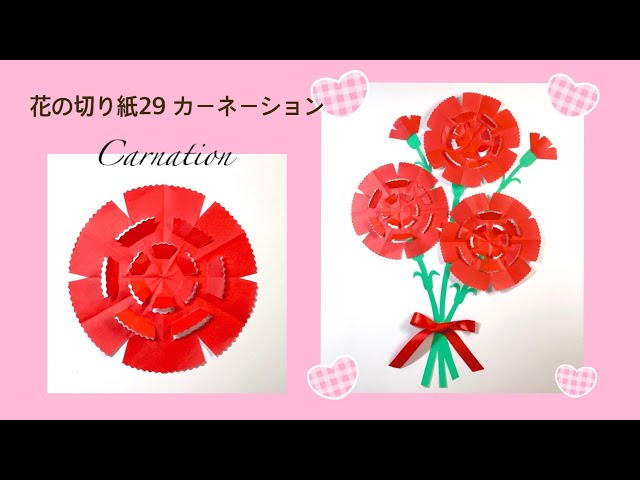
This is a papercutting craft to make a carnation.
First, place the origami paper face down with a corner toward you, and fold it into a triangle twice.
Open it once, then fold both sides upward at an angle using the center as the axis, and fold it in half again, aligning the center carefully.
Draw a papercutting pattern on the origami, and carefully cut it out with pinking shears or similar scissors.
Adding slits and patterns will give the petals a three-dimensional look and movement.
When you finally unfold it, it will take on a fluffy carnation shape, which you can display as is or enjoy by attaching it to a card.
