

[Japanese Military Songs and Marches] A collection of famous Japanese pieces deeply etched in the hearts of the Showa and wartime generations

The rousing “Warship March” by Fujiyoshi Setoguchi, Koji Tsuruta’s “Sakura of the Same Class” echoing in the spring as cherry blossoms fall, and Aya Shimazu’s “Comrade” that pierces the heart with thoughts of fallen friends.
In Japan’s military songs and marches reside pride in the homeland, the resolve of soldiers heading to the front, and deep prayers in remembrance of comrades who never returned.
These melodies, at times powerful and at times sorrowful, pass down the memory of war and ask us to reflect on the preciousness of peace.
Here, we introduce gem-like masterpieces that remain etched in many hearts even today, alongside Japan’s history.
- [March] Carefully selected popular songs recommended for entrance and exit at sports days and athletic festivals!
- “Song of War”: A classic that sings of the tragedy and folly of war
- Anti-war songs that pierce the heart: Japan’s masterpieces conveying prayers for peace
- [March] A curated selection of classic marches and dazzling crowd-pleasers for concerts!
- Old songs from the Showa to Heisei eras: a collection of timeless classics loved across generations
- [Hometown Songs] A curated selection of popular Japanese tracks that fill your heart with nostalgia
- A roundup of classic Showa-era kayō songs: a comprehensive introduction to timeless tracks loved across generations.
- Fight songs from the good old days! Showa-era classics you should listen to when starting school
- Showa-era masterpieces roundup: A must-listen collection of nostalgic oldies and hit songs
- The Spirit of Japan: A Collection of Famous and Popular Shamisen Pieces
- [Showa-Era Classics] A carefully selected collection of uplifting anthems that empower people across generations
- Famous songs celebrating heroes. Recommended popular tracks.
- Introducing famous songs about Shizuoka: Local anthems and popular tracks [2026]
[Japanese Military Songs and Marches] A collection of renowned Japanese pieces deeply etched in the hearts of the Showa and wartime generations (21–30)
Until the day of victoryŌmi Toshiro and others

With lyrics by Hachiro Sato and music by Masao Koga, this work was created by a star-studded team who remained active until the not-so-distant postwar era.
It’s a song encouraging everyone to devote themselves to their daily work, join forces for the sake of the nation, and persevere until the day of victory.
I believe it is a piece addressed to those protecting the home front, expressing gratitude toward those on the battlefield.
comrade-in-armsShimazu Aya

Even though Aya is young, she masterfully performs this weighty song.
It isn’t a number for show; she sings with a soul-stirring depth, as if embodying the sorrow of watching comrades survive and pass away, and it moved me as though I could see the scene before my eyes.
I felt it was one expression of the sadness of war.
Camping SongMisora Hibari

The Rising Sun flag, the advance, the victory…
Even if it was an era dyed in a single color, being encouraged in a dream to die and come home is such a sorrowful song.
The young men in the song would still be high school students today.
Though it is a time of peace, they were slack—completely the opposite of now.
I sense the sad courage of those days, when one had to accept this as right.
Song of the Showa Restoration (Song of Young Japan)Roiyaru Naitsu
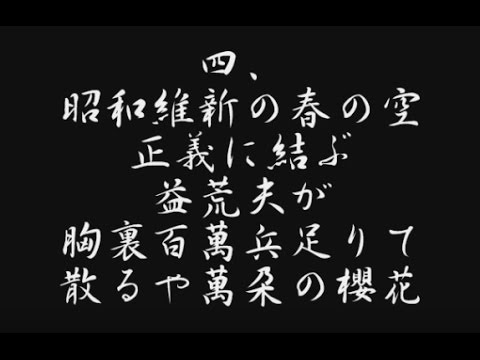
It was released in the early Showa era and is said to have been passed down in song among the young officers involved in the May 15 Incident and the February 26 Incident.
The lyrics are quite difficult, so I don’t really understand them.
Is it saying that Japanese youth should be like this? I feel it’s a song with real backbone.
Women’s War Service SongPegī Hayama

This is a song by a Japanese Red Cross military nurse.
Sung from the perspective of a nurse, its concrete lyrics make the wounded soldiers feel all the more pitiful.
Peggy’s calm singing seems to soothe the wounded, and it carries a quietly enveloping, heartfelt persuasiveness.
Kato Hayabusa Fighter SquadronHaida Katsuhiko

It is said to be the air squadron led by Lieutenant Colonel Kato of the Army.
They fought bravely and performed admirably until the very end.
Since an individual’s name has been remembered and even a song was made, we can imagine that their exploits were that remarkable—and perhaps that he had a charismatic presence as well.
Warriors of the SeaMichi Yatsu・Shōji Tarō

It feels like steadily pressing forward across the sea.
I think the lyrics are filled with feelings for the brave heroes.
Even so, perhaps it was the times, but the songs from that era never complain in their lyrics.
With a song like this—so upbeat at times—you could almost forget it’s a military song that accepts the possibility of death.